
Enter your mortgage balance, rate, years left, extra principal, and any penalty to estimate your real interest savings.
Advanced options
Extra payment timing
Statement and fee check
Table of contents
How to use our Mortgage Interest Savings Calculator
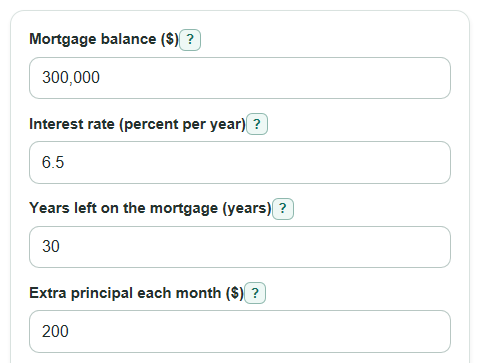
- Enter Mortgage balance ($) as your current unpaid loan balance, not the original home price.
- Enter Interest rate (percent per year), Years left on the mortgage (years), and Extra principal each month ($).
- Open Advanced options if you need to add a One-time extra principal payment ($), delay the extra payment, enter your statement payment, or include a Prepayment penalty or fee ($).
- Click Calculate and read Net interest saved after any penalty first, then check Time cut off the mortgage and Payoff time with extra principal.
- Sanity-check the result by making sure Regular principal and interest payment used is close to your mortgage statement, excluding taxes, insurance, HOA dues, and escrow.
Definitions
Mortgage balance ($): The unpaid principal on the loan. Principal means the loan balance you still owe.
Interest rate (percent per year): The yearly rate used to calculate the lender's interest charge on the balance.
Extra principal each month ($): Money paid on top of the regular principal and interest payment to lower the loan balance faster.
Prepayment penalty or fee ($): A fee some loans charge if you pay early or make certain extra payments.
Regular principal and interest payment used: The monthly loan payment used in the math. It does not include taxes, insurance, HOA dues, or escrow.
Net interest saved after any penalty: Interest saved before any penalty minus the penalty or fee you entered. A negative value means the fee is larger than the interest savings.
Common mistakes and quick fixes
Mistake: Entering the home purchase price in Mortgage balance ($).
Fix: Use the current unpaid principal balance shown on your mortgage statement.
Mistake: Entering APR fees or points in Interest rate (percent per year).
Fix: Enter the loan's yearly interest rate only.
Mistake: Putting taxes, insurance, or escrow into Use my regular principal and interest payment ($).
Fix: Enter only the principal and interest part of the payment, or leave it blank.
Mistake: Treating Interest saved before any penalty as the final benefit when a fee applies.
Fix: Enter Prepayment penalty or fee ($) and use Net interest saved after any penalty as the main answer.
Mistake: Setting Start extra monthly payment after this many months to 0.
Fix: Use 1 if the extra payment starts with the next mortgage payment.
Mistake: Reading Payoff time with extra principal as a calendar date.
Fix: Treat it as the number of monthly payments counted from the next payment month.
Limitations & Key Assumptions / Boundary Conditions
- The calculator assumes a fixed interest rate and monthly interest calculation for the rest of the loan.
- It compares principal and interest only. It does not include taxes, insurance, PMI, HOA dues, escrow changes, refinancing costs, or investment returns on the extra cash.
- The regular payment override must be high enough to reduce the balance. If it is too low, the calculator shows an error instead of projecting a growing loan.
- The final payment may be smaller than the normal payment because the loan only needs enough money to bring the balance to zero.
- If a one-time extra payment is scheduled after the loan is already paid off, the calculator ignores that payment and notes that it was not needed before payoff.
- Results can differ from a lender payoff quote because lenders may use daily interest, payment posting rules, rounding rules, fees, or escrow adjustments.
- The payoff loop is limited to 1200 months as a safety boundary.
Methodology
Calculation steps
The calculator first turns the yearly interest rate into a monthly rate.
monthly_rate = annual_rate_percent / 100 / 12
If no payment override is entered, it calculates the regular fixed principal and interest payment from the balance, monthly rate, and months left.
if monthly_rate = 0: regular_payment = loan_balance / (years_left * 12)
else: regular_payment = loan_balance * monthly_rate / (1 - (1 + monthly_rate)^(-years_left * 12))
For each month, interest is added to the starting balance. Then the regular payment, active monthly extra payment, and active one-time extra payment are applied. The final payment is capped so it does not pay more than the remaining balance plus that month's interest.
interest_for_month = balance_start * monthly_rate
payment_available = regular_payment + active_monthly_extra + active_one_time_extra
actual_payment = min(balance_start + interest_for_month, payment_available)
balance_end = balance_start + interest_for_month - actual_payment
The calculator runs this payoff loop twice: once with the regular payment only, and once with the extra-principal plan. It totals the interest charged in each path.
total_interest_saved_before_penalty = total_interest_without_extra - total_interest_with_extra
net_interest_saved_after_penalty = total_interest_saved_before_penalty - prepayment_penalty
months_cut_off = baseline_payoff_months - payoff_months_with_extra
Mini-example
Suppose the mortgage balance is $1,200, the interest rate is 12% per year, the time left is 1 year, and the extra principal is $100 per month starting with the next payment. The calculated regular principal and interest payment is about $106.62. Without extra principal, payoff takes 12 months and interest is about $79.42. With the extra $100 per month, payoff takes 6 months and interest is about $42.42. Interest saved before any penalty is about $37.01. If the prepayment penalty is $0, net interest saved after any penalty is also about $37.01.