
Enter your balance, rate, payment, and extra principal to compare faster payoff with an estimated recast payment.
Advanced options
Yearly extra payment
Table of contents
How to use our Mortgage Principal Reduction Calculator
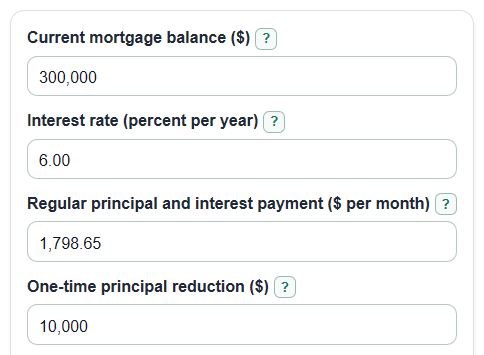
- Enter the Current mortgage balance ($), which is the unpaid principal balance, not the home value.
- Enter the Interest rate (percent per year) and your Regular principal and interest payment ($ per month), leaving out taxes, insurance, HOA dues, and escrow.
- Enter any One-time principal reduction ($) and Extra principal each month ($). If you also make a yearly extra payment, open Advanced options and enter Extra principal once a year ($) plus the Month for yearly extra payment.
- Select Calculate, then compare Payoff time with extra principal, Total interest saved, and Estimated payment after a recast.
- Sanity-check the results: a larger early principal payment should usually lower Remaining interest with extra principal, and the recast estimate should only change when the one-time principal reduction changes.
Definitions
Principal: The part of the mortgage balance you still owe, before interest for future months is added.
Principal reduction: Extra money applied to the loan balance instead of interest, taxes, insurance, or fees.
Regular principal and interest payment: The scheduled monthly mortgage payment for loan principal and interest only.
Extra principal: Money paid above the regular principal-and-interest payment to reduce the balance faster.
Payoff time with extra principal: The number of monthly payment cycles needed to reach a zero balance after the planned extra principal payments.
Recast: A lender-approved recalculation of the principal-and-interest payment after a lump-sum principal reduction, usually keeping about the same remaining payoff schedule.
Remaining interest: The estimated interest paid from now until the loan is paid off under a specific payment plan.
Months cut from current schedule: The scheduled payoff months without extra principal minus the payoff months with your planned extra principal.
Common mistakes and quick fixes
Mistake: Using the home's market value for Current mortgage balance ($) .
Fix: Enter the unpaid principal balance from your mortgage statement.
Mistake: Putting the full escrowed payment into Regular principal and interest payment ($ per month) .
Fix: Enter only the principal-and-interest part, not taxes, insurance, HOA dues, or escrow.
Mistake: Entering APR in Interest rate (percent per year) when the calculator needs the mortgage note rate.
Fix: Use the interest rate listed on the loan note or mortgage statement.
Mistake: Treating One-time principal reduction ($) as if it automatically lowers the required payment.
Fix: Use Estimated payment after a recast only as a planning estimate, because the lender must approve and quote a recast.
Mistake: Counting the same money in both One-time principal reduction ($) and Extra principal each month ($) .
Fix: Put a lump sum in the one-time field and only recurring monthly extra money in the monthly field.
Mistake: Leaving invalid text in Extra principal once a year ($) or choosing the wrong Month for yearly extra payment .
Fix: Use 0 or a single dollar amount, then choose the month when that yearly extra principal is actually paid.
Limitations & Key Assumptions / Boundary Conditions
- The calculator assumes a fixed interest rate and monthly interest accrual.
- It models principal and interest only. Taxes, homeowners insurance, mortgage insurance, HOA dues, escrow changes, late fees, and servicing fees are not included.
- The estimated recast payment is not a lender quote. A lender can require a minimum lump sum, charge a fee, deny a recast, or use its own timing rules.
- The recast estimate uses the one-time principal reduction and the scheduled payoff length from the current payment. It does not include monthly or yearly extra principal in the recast payment estimate.
- Yearly extra principal is applied in the selected calendar month after that month's interest is calculated.
- If the regular payment is too low to cover interest and pay down the balance, the calculator blocks the result instead of showing a payoff that cannot happen.
- The final modeled payment can be smaller than the regular payment so the loan balance does not go below zero.
Methodology
Monthly rate
The yearly mortgage rate is converted to a monthly rate because the payoff loops use one monthly payment cycle at a time.
monthly_rate = annual_rate_percent / 100 / 12
Scheduled payoff without extra principal
The baseline path starts with the current mortgage balance and applies only the regular principal-and-interest payment each month. Interest is added first. Then the payment is applied. The final payment is capped so the balance does not become negative.
interest_due = balance * monthly_rate
payment_this_month = min(regular_pi_payment, balance + interest_due)
new_balance = balance + interest_due - payment_this_month
Payoff with extra principal
The extra-principal path first applies the one-time principal reduction, capped at the current balance. Then each month adds the regular payment, the monthly extra principal, and the yearly extra principal only when the selected month is due.
start_balance = max(current_balance - one_time_principal_applied, 0)
planned_payment = regular_pi_payment + extra_principal_monthly + yearly_extra_if_due
payment_this_month = min(planned_payment, balance + interest_due)
Interest and time saved
Total interest is computed from the cash paid into each payoff path compared with the starting balance. The saved interest is not forced to zero, so an unusual plan can show a negative savings amount if it costs more.
total_interest = total_payments_made + one_time_principal_applied - current_balance
months_cut_from_schedule = scheduled_payoff_months - payoff_months_with_extra
total_interest_saved = scheduled_interest_without_extra - total_interest_with_extra
Estimated recast payment
The recast estimate uses the balance after the one-time principal reduction and spreads that balance over the scheduled payoff length. This matches the planning idea of lowering the required payment instead of keeping the same payment to finish sooner. Mortgage lenders use principal, interest rate, and loan length when calculating principal-and-interest payments [1].
recast_balance = max(current_balance - one_time_principal, 0)
if monthly_rate = 0: recast_payment = recast_balance / scheduled_payoff_months
otherwise: recast_payment = recast_balance * monthly_rate / (1 - (1 + monthly_rate)^(-scheduled_payoff_months))
estimated_monthly_payment_drop = regular_pi_payment - estimated_recast_pi_payment
Mini example
For a $300,000 balance, 6.00% interest rate, $1,798.65 regular principal-and-interest payment, $10,000 one-time principal reduction, and $200 extra principal each month, the scheduled baseline takes about 361 months and has about $347,515.59 of remaining interest. With the extra principal plan, the payoff time is 260 months, which cuts 101 months and saves about $119,466.42 of interest. The estimated recast payment from the $10,000 lump-sum reduction is about $1,736.98 per month, for an estimated monthly payment drop of about $61.67.