
Estimate how extra principal payments can shorten your mortgage and reduce total interest, or find the monthly extra needed for a payoff goal.
Advanced options
Table of contents
How to use our Extra Mortgage Payment Calculator
- Choose What do you want to find?: use See savings from an extra monthly payment if you know the extra amount, or Find extra monthly payment for a payoff goal if you know your target payoff time.
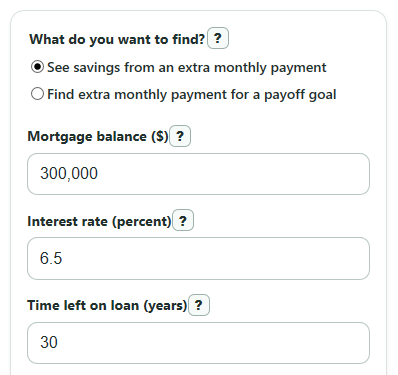
- Enter Mortgage balance, Interest rate, and Time left on loan using your current loan details, not the original purchase price or original loan term.
- Enter Extra monthly principal in savings mode, or Pay off within in target mode. Open Advanced options only if you need a Regular principal and interest payment override, a One-time extra principal payment, or Extra principal each year.
- Select Calculate, then read Main answer first. Interest saved and Time saved show how the plan compares with making only the regular principal and interest payment.
- Sanity-check the output: Regular principal and interest payment should look close to your mortgage statement before escrow, and Payoff time with this plan should be shorter when extra principal is positive.
Definitions
Principal: The money still owed on the mortgage, before interest is added for the next payment.
Mortgage balance: The current unpaid principal on the loan, not the home value and not the original loan amount.
Interest rate: The yearly rate charged on the remaining balance, entered as a percent.
Regular principal and interest payment: The required monthly loan payment used before any extra principal is added. It excludes taxes, insurance, HOA dues, PMI, and escrow.
Extra monthly principal: Extra money paid on top of the regular payment to reduce the balance faster.
Interest saved: The estimated interest avoided compared with making no extra principal payments.
Time saved: The number of months earlier the loan is paid off compared with the no-extra baseline.
Final payment: The last payment needed to finish the loan. It can be smaller than the regular monthly payment plus extra principal.
Common mistakes and quick fixes
Mistake: Using the original loan amount for Mortgage balance.
Fix: Enter the current Mortgage balance, which is the principal you still owe.
Mistake: Putting taxes, insurance, PMI, or escrow into Regular principal and interest payment.
Fix: Use only the principal and interest part of the payment, or leave Regular principal and interest payment blank.
Mistake: Entering an Interest rate as 0.065 instead of 6.5.
Fix: Type the Interest rate as a percent, such as 6.5 for 6.5 percent.
Mistake: Choosing a Pay off within value that is the same as or longer than Time left on loan.
Fix: In target mode, make Pay off within shorter than Time left on loan.
Mistake: Sending Extra monthly principal without telling the servicer it is principal-only.
Fix: Follow the Principal-only reminder and confirm that extra money reduces principal instead of being held for a future payment.
Mistake: Setting Apply one-time extra after payment number or First yearly extra after payment number outside the loan schedule.
Fix: Use a payment number that falls within the remaining loan months.
Limitations & Key Assumptions / Boundary Conditions
- The calculator is for fixed-rate mortgages with monthly payments. It does not model adjustable rates, interest-only periods, balloon payments, or changing loan terms.
- Results use the current Mortgage balance and Time left on loan. If your statement has fees, late charges, escrow shortages, or a different payoff quote, your servicer's number can differ.
- Extra payments are treated as principal-only. If your servicer applies extra money to future payments instead, the savings may not happen as shown.
- The Regular principal and interest payment excludes taxes, insurance, HOA dues, PMI, and other escrow items.
- One-time and yearly extra payments are applied by payment number, not by calendar date.
- Refinancing, recasting, skipped payments, prepayment rules, and servicer rounding are not included.
Methodology
Payment used
The calculator first finds the regular monthly principal and interest payment from the balance, yearly interest rate, and remaining months. A typical fixed-rate mortgage keeps the combined principal and interest payment level, while the split between principal and interest changes over time [3]. If you enter Regular principal and interest payment, the calculator uses that amount after checking that it is large enough to reduce the balance.
monthly_rate = Interest rate / 100 / 12
total_months = Time left on loan * 12
if monthly_rate = 0, regular_payment = Mortgage balance / total_months
otherwise, regular_payment = balance * monthly_rate * (1 + monthly_rate)^total_months / ((1 + monthly_rate)^total_months - 1)
Month-by-month payoff
The calculator runs a monthly payoff loop. Each month, interest is added first. Then the regular payment and any active extra principal are applied. Extra principal can include Extra monthly principal, One-time extra principal, and Extra principal each year. The required payment is not lowered after extra principal is paid.
interest = balance * monthly_rate
extra_principal = monthly extra + active one-time extra + active yearly extra
payment_this_month = min(regular_payment + extra_principal, balance + interest)
balance = balance + interest - payment_this_month
The loop stops when the balance is paid off. The final payment is the smaller amount actually needed to cover the remaining balance plus that month's interest.
Comparison results
The calculator also runs a no-extra baseline. Interest saved and Time saved compare the extra-payment plan with that baseline.
Interest saved = Interest with no extra payments - Interest with this plan
Time saved = baseline payoff months - payoff months with this plan
Payoff goal mode
For Find extra monthly payment for a payoff goal, the calculator finds the extra monthly principal needed to pay off within the target number of years. If there are no optional extra payments, it uses the standard payment formula for the target months and subtracts the regular payment. If One-time extra principal or Extra principal each year is entered, it uses a binary search with the same monthly payoff loop. A negative answer is shown as 0 because no extra monthly payment is needed.
target_months = Pay off within * 12
Extra monthly payment needed = max(0, target payment for target_months - regular_payment)
Mini-example
For a $300,000 balance at 6.5 percent with 30 years left, the formula gives a regular principal and interest payment of about $1,896.20. Adding $200 of Extra monthly principal pays the loan off in about 277 months instead of 360 months. That saves about 83 months and about $103,449 of interest in this model.
Principal-only handling
The calculator assumes extra money is applied as additional principal, not held as a future scheduled payment. Mortgage servicing guidance treats identified additional principal payments as principal reductions, so the Principal-only reminder is included with every result [2].