
Compare mini-split and central air costs using the same home size, ductwork, electricity price, efficiency, and time period.
Advanced options
| Cost | Mini-split | Central air |
|---|---|---|
| Installed cost | ||
| Cooling bill per year | ||
| Total over selected years |
Table of contents
How to use our Mini Split vs Central Air Cost Calculator
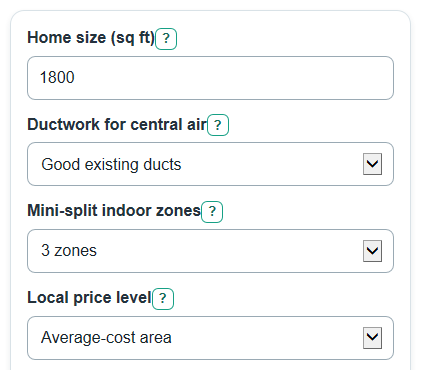
- Enter Home size as the cooled floor area, then choose Ductwork for central air, Mini-split indoor zones, and Local price level.
- Enter Electricity price from your power bill if you have it, or keep the default for a quick planning estimate.
- Open Advanced options if you want to change Central air efficiency, Mini-split efficiency, Full-power cooling hours per year, Years to compare, sizing, or cost assumptions.
- Select Calculate and read the gap outputs first: a positive gap means central air costs more, and a negative gap means mini-split costs more.
- Sanity-check the Estimated cooling size used and the installed costs against any contractor quotes you have before using the result for a budget decision.
Definitions
Mini-split indoor zone: One indoor head or separately controlled area served by a ductless mini-split system.
Ductwork for central air: The condition of the air ducts central air would use. The selected duct cost is added only to the central air estimate.
SEER2: A cooling efficiency rating. In this calculator, a higher SEER2 lowers estimated electricity use for the same cooling load.
Full-power cooling hours per year: The yearly hours used to turn system size into estimated cooling energy. It is a full-power equivalent, not every hour the system fan runs.
Sizing shortcut: The number of sq ft assigned to one ton of cooling for a rough planning size.
Ton: A cooling capacity unit. This calculator uses 12,000 Btu per hour per ton.
kWh: Kilowatt-hour, the unit most electric bills use for electricity use.
Cost gap: Central air cost minus mini-split cost. Positive means central air costs more. Negative means mini-split costs more.
Common mistakes and quick fixes
Mistake: Entering lot size or unfinished space in Home size.
Fix: Use only the cooled sq ft for Home size.
Mistake: Picking Good existing ducts for Ductwork for central air when ducts need sealing, repair, replacement, or do not exist.
Fix: Choose the Ductwork for central air option that matches the work central air would need.
Mistake: Leaving Electricity price at the default when your utility rate is much higher or lower.
Fix: Enter the $ per kWh from your electric bill in Electricity price.
Mistake: Treating Mini-split indoor zones as outdoor units.
Fix: Count indoor areas or heads for Mini-split indoor zones, such as living room plus bedrooms.
Mistake: Comparing a quote with a different Central air efficiency or Mini-split efficiency than the calculator uses.
Fix: Enter the SEER2 ratings from the quotes in Central air efficiency and Mini-split efficiency.
Mistake: Reading Installed cost gap as the full long-term answer.
Fix: Also check Total cost gap over selected years because lower upfront cost can be partly offset by Yearly cooling bill gap.
Limitations & Key Assumptions / Boundary Conditions
- This is a planning estimate, not a contractor quote. Real bids can change because of equipment brand, line-set length, electrical work, permits, access, ceiling height, insulation, and local labor.
- The Estimated cooling size used comes from Home size divided by Sizing shortcut. A real system size should come from a load calculation for the home.
- Cooling energy is simplified with SEER2, full-power cooling hours, and Electricity price. It does not model part-load behavior, thermostat settings, humidity control, shade, or duct leakage.
- Energy costs include cooling electricity only. Heating, maintenance, filters, repairs, financing, rebates, tax credits, and equipment lifespan are not included.
- Ductwork costs apply only to Central air estimated installed cost. Mini-split estimates do not include ductwork, but they may need other work not listed here.
- Local price level uses fixed planning multipliers. It cannot know your exact market, contractor workload, or material pricing.
- Mini-split indoor zones are limited to the choices in the calculator. Homes with more zones may need a custom estimate.
Methodology
How the comparison is calculated
The calculator estimates both systems from the same Home size, Local price level, Electricity price, and comparison period. It then subtracts the mini-split result from the central air result for each gap.
estimated_tons = home_sqft / sqft_per_ton
duct_add = 0 if Ductwork for central air is good existing ducts; duct_repair_cost if repair; duct_replace_cost if replace; duct_new_cost if no ducts now
market_multiplier = 0.90 for lower-cost area; 1.00 for average-cost area; 1.15 for high-cost area; 1.30 for very high-cost area
central_installed_cost = (central_base_cost + estimated_tons * central_cost_per_ton + duct_add) * market_multiplier
mini_installed_cost = (mini_base_cost + estimated_tons * mini_cost_per_ton + mini_split_zones * mini_cost_per_zone) * market_multiplier
Cooling energy uses the estimated cooling size, 12,000 Btu per hour per ton, the entered full-power cooling hours, and the entered SEER2.
annual_kwh = estimated_tons * 12000 * cooling_hours_per_year / (seer2 * 1000)
annual_energy_cost = annual_kwh * electric_rate
total_cost_selected_years = installed_cost + annual_energy_cost * compare_years
upfront_cost_gap = central_installed_cost - mini_installed_cost
annual_energy_cost_gap = central_annual_energy_cost - mini_annual_energy_cost
total_cost_gap_over_selected_years = central_total_cost_selected_years - mini_total_cost_selected_years
How to read the signs
Each gap is central air minus mini-split. A positive gap means central air costs more for that line. A negative gap means the mini-split side costs more for that line.
Mini-example
Using 1,800 sq ft, 600 sq ft per ton, good existing ducts, 3 mini-split zones, average local prices, $0.16 per kWh, 900 full-power cooling hours, 15.2 SEER2 for central air, 20 SEER2 for the mini-split, and 10 years gives an estimated size of 3 tons.
central_installed_cost = (3500 + 3 * 1700 + 0) * 1.00 = 8600
mini_installed_cost = (1500 + 3 * 1800 + 3 * 1200) * 1.00 = 10500
central_annual_energy_cost = 3 * 12000 * 900 / (15.2 * 1000) * 0.16 = 341.05
mini_annual_energy_cost = 3 * 12000 * 900 / (20 * 1000) * 0.16 = 259.20
total_cost_gap_over_selected_years = (8600 + 341.05 * 10) - (10500 + 259.20 * 10) = -1081.47
In that example, central air is $1,900 cheaper upfront, but costs about $81.85 more per year for cooling. Over 10 years, the mini-split side is still about $1,081.47 higher because its higher installed cost is not fully offset by the cooling bill difference.