
Compare tank and tankless water heater costs using your installed prices, energy use, local rate, and ownership period.
Advanced options
Table of contents
How to use our Tank vs Tankless Water Heater Cost Calculator
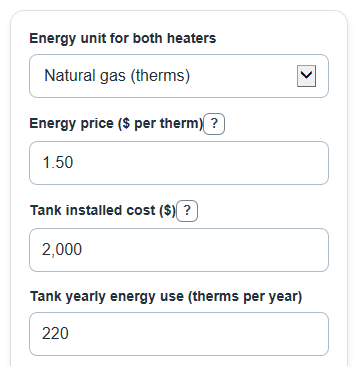
- Choose Energy unit for both heaters, then enter Energy price in the matching unit from your utility bill or estimate.
- Enter Tank installed cost, Tank yearly energy use, Tankless installed cost, and Tankless yearly energy use from bids, labels, or estimates.
- Set Years to compare, and add Tank yearly service cost or Tankless yearly service cost if you want maintenance included.
- Click Calculate to see Tankless cost advantage over the chosen years, payback time, yearly savings, and both total costs.
- Sanity-check the results: if Yearly cost saved with tankless looks too high or too low, recheck that Energy unit for both heaters and Energy price match.
Definitions
Energy unit for both heaters: The unit used for both yearly energy use entries, either therms for natural gas or kWh for electricity.
Energy price: Your cost for one chosen unit, such as $ per therm or $ per kWh.
Installed cost: The full starting cost to buy and install the heater, including labor and required basic parts when you know them.
Yearly energy use: The amount of gas or electricity one heater is expected to use in one year.
Yearly running cost: Energy cost plus any yearly service cost for one heater.
Tankless cost advantage over the chosen years: Tank total cost minus tankless total cost. A positive number means tankless costs less.
Payback time for tankless extra upfront cost: The years of tankless yearly savings needed to cover its higher installed cost.
Common mistakes and quick fixes
Mistake: Choosing Natural gas for Energy unit for both heaters but entering an electric Energy price.
Fix: Use $ per therm for gas or $ per kWh for electricity, and make both yearly energy use entries match that unit.
Mistake: Entering only the equipment price for Tank installed cost or Tankless installed cost.
Fix: Use the full installed price when you have it, including labor, basic parts, permits, and required upgrades.
Mistake: Mixing Tank yearly energy use in therms with Tankless yearly energy use in kWh.
Fix: Enter both yearly energy use numbers in the unit selected under Energy unit for both heaters.
Mistake: Setting Years to compare to 0 or using a time period that is too short for your decision.
Fix: Enter a number greater than 0, such as the years you expect to keep the home or heater.
Mistake: Entering a monthly amount in Tank yearly service cost or Tankless yearly service cost.
Fix: Enter the full yearly service cost, or enter 0 if you do not want service included.
Mistake: Reading a negative Tankless cost advantage over the chosen years as savings.
Fix: A positive value means tankless costs less; a negative value means tankless costs more over the chosen years.
Limitations & Key Assumptions / Boundary Conditions
- The calculator uses the Energy price you enter as a flat rate. Tiered rates, fixed monthly fees, taxes, and seasonal gas prices can change real bills.
- It does not estimate the installed costs for you. Enter complete bids for Tank installed cost and Tankless installed cost if you want a bid-level comparison.
- It treats Yearly energy use as a steady yearly average. Household size, water temperature, climate, and heater settings can change actual use.
- It does not include inflation, discount rates, financing, rebates, tax credits, major repairs, replacement during the period, or resale value.
- Both heaters must use the same Energy unit for both heaters. The calculator does not convert gas therms to electric kWh.
Methodology
How the costs are calculated
The calculator first turns each heater's entered energy use into a yearly running cost. Optional yearly service cost is added after energy cost.
yearly_running_cost = yearly_energy_use * energy_price + annual_service_cost
Then it adds installed cost to the running cost over the comparison period.
total_cost = installed_cost + years_to_compare * yearly_running_cost
The main comparison is tank total cost minus tankless total cost.
tankless_cost_advantage = tank_total_cost - tankless_total_cost
A positive tankless cost advantage means tankless costs less over the chosen years. A negative value means the tank option costs less.
tankless_yearly_cost_savings = tank_yearly_running_cost - tankless_yearly_running_cost
tankless_upfront_extra_cost = tankless_installed_cost - tank_installed_cost
Payback is calculated only when tankless costs more upfront and also saves money each year.
payback_years = tankless_upfront_extra_cost / tankless_yearly_cost_savings
If Tankless extra installed cost is 0 or below, no extra upfront cost needs payback. If Yearly cost saved with tankless is 0 or negative, the calculator shows no payback under the entered numbers.
Worked example
Suppose gas costs $1.50 per therm, the tank heater costs $2,000 to install and uses 220 therms per year, and the tankless heater costs $4,200 to install and uses 150 therms per year. With 15 years and no yearly service cost, the tank yearly running cost is $330 and the tankless yearly running cost is $225.
The 15-year tank total is $6,950. The 15-year tankless total is $7,575. Tankless cost advantage is -$625, so the tankless option costs $625 more over 15 years in this example. Its extra installed cost is $2,200, and its yearly savings are $105, so payback is about 20.95 years.
Input handling
Money and energy fields may include commas or spaces, which are removed before calculation. Required cost, energy, price, and year entries must be valid finite numbers. Installed costs and energy use cannot be negative, and Years to compare must be greater than 0. Optional yearly service cost can be blank, and blank is treated as $0.