
Estimate your water heater running cost from daily hot water use, temperature settings, heater type, and local energy prices.
Advanced options
Table of contents
How to use our Water Heater Running Cost Calculator
- Choose the closest Water heater type, such as electric tank, heat pump, natural gas, or propane.
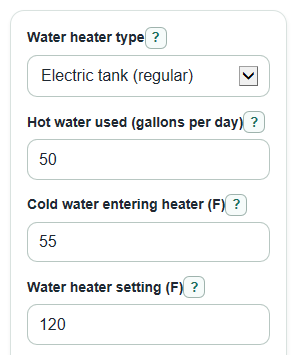
- Enter Hot water used, Cold water entering heater, and Water heater setting using gallons per day and F.
- Enter the energy price that matches the selected heater: Electricity price, Natural gas price, or Propane price.
- Open Advanced options only if you know Your efficiency factor, want to match Days in billing month, or have an Extra idle cost.
- Check whether Estimated monthly running cost and Monthly change compared with 120 F make sense; a very high cost often means the gallons, temperature rise, price unit, or efficiency factor was entered wrong.
Definitions
Hot water used: The gallons of heated water used each day, not total cold plus hot water.
Cold water entering heater: The temperature of water before the heater warms it.
Water heater setting: The target hot water temperature used for the cost estimate.
Temperature rise: The Water heater setting minus Cold water entering heater. A bigger rise means more energy is needed.
Btu: British thermal unit, a small unit of heat energy often used to compare fuels [2].
Therm: A natural gas billing unit equal to 100,000 Btu.
Efficiency factor: The useful heat delivered to the water compared with the energy the heater uses. Higher means less fuel for the same hot water.
UEF: Uniform Energy Factor, a water heater efficiency rating. The exact UEF from the yellow EnergyGuide label is usually better than a preset estimate.
Extra idle cost: A fixed monthly dollar amount you add for known standby or idle losses that are not entered as fuel units.
Common mistakes and quick fixes
Mistake: Entering total household water in Hot water used instead of hot water only.
Fix: Use an estimate for showers, baths, dishwashing, laundry, and other hot water use only.
Mistake: Setting Cold water entering heater equal to or higher than Water heater setting.
Fix: Enter a Cold water entering heater value below the Water heater setting, because the heater must raise the water temperature.
Mistake: Leaving Electricity price in the form after choosing Natural gas price or Propane price.
Fix: Match the visible price field to Water heater type; hidden price fields are ignored.
Mistake: Turning on Use my own efficiency factor but entering a percent in Your efficiency factor, such as 95 instead of 0.95.
Fix: Enter the factor as a plain number, such as 0.95 for a regular heater or 3.4 for some heat pump water heaters.
Mistake: Comparing Estimated monthly running cost to a bill with a different Days in billing month.
Fix: Change Days in billing month to the number of days on the bill before comparing.
Mistake: Treating Monthly change compared with 120 F as a safety recommendation.
Fix: Use it as a cost comparison only, and follow your appliance, health, and local guidance for Water heater setting.
Limitations & Key Assumptions / Boundary Conditions
- The estimate is for running cost only. It does not include water cost, sewer cost, repairs, purchase price, venting, or installation.
- Preset efficiency factors are rough starting points. Use Your efficiency factor if you know the model UEF or a better measured factor.
- The calculator assumes the entered Hot water used is the same every day in the billing period.
- The calculation treats Cold water entering heater as constant, but incoming water can change by season and location.
- Extra idle cost is added as dollars, so it changes cost outputs but not Energy used per month.
- The 120 F comparison is only a what-if cost check. It is not a rule for every home, appliance, or health situation.
- If Cold water entering heater is 120 F or higher, the 120 F comparison is not useful because there is no positive temperature rise to 120 F.
Methodology
How the estimate is calculated
The calculator first finds the temperature rise, which is the amount the heater must warm the water.
delta_temp_f = hot_water_temp_f - cold_water_temp_f
It then estimates the useful heat added to the water. The shortcut uses 8.34 lb per gallon for water and 1 Btu to raise 1 lb of water by 1 F [2][3].
useful_btu_per_day = daily_hot_water_gal * 8.34 * delta_temp_f
The heater input energy is higher when the efficiency factor is below 1 and lower for heat pump factors above 1.
input_btu_per_day = useful_btu_per_day / efficiency_factor
The calculator converts input Btu to the fuel unit used by the selected Water heater type.
electric_kwh_per_day = input_btu_per_day / 3412
gas_therms_per_day = input_btu_per_day / 100000
propane_gallons_per_day = input_btu_per_day / 91452
Monthly energy is the daily fuel amount multiplied by Days in billing month. Monthly cost uses the matching energy price and then adds Extra idle cost.
monthly_energy = selected_fuel_units_per_day * days_per_month
monthly_cost = monthly_energy * selected_energy_price + extra_idle_cost_month
annual_cost = monthly_cost * 12
daily_cost = monthly_cost / days_per_month
120 F comparison
The comparison reruns the same calculation at 120 F when Cold water entering heater is below 120 F. Lowering water heating temperature can reduce energy use, and 120 F is a common comparison point from energy-saving guidance [1].
cost_at_120 = (((daily_hot_water_gal * 8.34 * (120 - cold_water_temp_f)) / efficiency_factor) / fuel_btu_per_unit) * days_per_month * selected_energy_price + extra_idle_cost_month
monthly_change_vs_120 = monthly_cost - cost_at_120
A positive Monthly change compared with 120 F means the selected Water heater setting costs more than 120 F. A negative value means it costs less.
Cost per gallon
Cost for each gallon of hot water divides the monthly cost by the gallons used in that billing month.
cost_per_gallon = monthly_cost / (daily_hot_water_gal * days_per_month)
Mini-example
For an electric tank using 50 gallons per day, 55 F incoming water, a 120 F setting, $0.16 per kWh, 30.4375 days, and a 0.95 efficiency factor, the temperature rise is 65 F. The useful heat is 27,105 Btu per day. After the efficiency factor and kWh conversion, monthly energy is about 254.52 kWh. The estimated monthly running cost is about $40.72, yearly cost is about $488.68, and the monthly change compared with 120 F is $0.00 because the selected setting is already 120 F.