
Enter the VA rating and power factor to calculate real power in watts, with an optional check against a UPS watt limit.
Required apparent power = watts / power factor. This conversion is not a UPS recommendation; allow for manufacturer watt limits, startup loads and other installation requirements separately.
Table of contents
How to use our VA to Watts Calculator
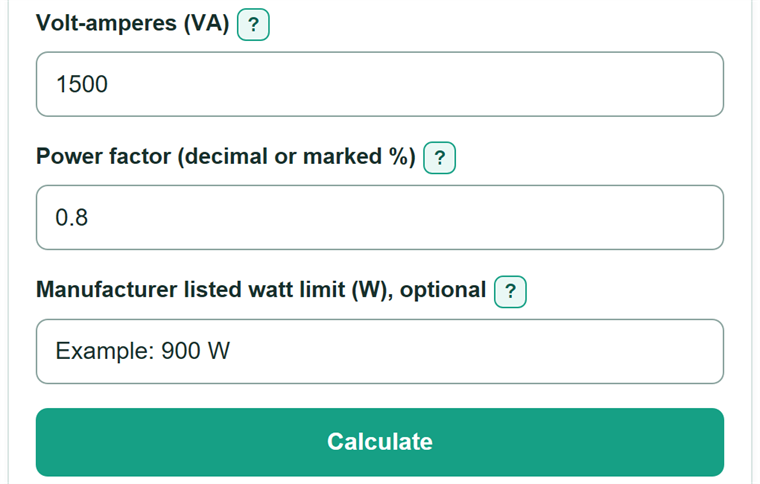
- Enter the volt-amperes (VA) rating shown on the equipment label, UPS label, or product specification.
- Enter the power factor from the same equipment information or a power meter: use a decimal such as 0.90, or a percent with the percent sign, such as 90%.
- If you are checking a UPS, enter its manufacturer listed watt limit; otherwise, leave that field blank.
- Click Calculate to see real power in watts first, followed by the same power in kilowatts.
- Sanity-check the result: watts equal VA only at a power factor of 1, and a lower listed UPS watt limit becomes the applicable capacity.
Definitions
Volt-amperes (VA): Apparent power, found from voltage and current before power factor is applied.
Real power (watts or W): Power available to do work after power factor is considered. Real power and apparent power are not always the same. [2]
Power factor: The share of apparent power that becomes real power. It runs from 0 to 1, so 0.90 is the same as 90%.
Kilowatt (kW): A power unit equal to 1,000 watts.
Manufacturer listed watt limit: A UPS watt rating stated on its label or specification. It may be lower than the watts calculated from VA and power factor.
Common mistakes and quick fixes
Mistake: Entering 90 as a power factor.
Fix: Enter 0.90, or enter 90% with the percent sign. A bare power factor must be from 0 to 1.
Mistake: Assuming 1,500 VA always equals 1,500 W.
Fix: Multiply VA by the actual power factor. At a power factor of 0.80, 1,500 VA equals 1,200 W.
Mistake: Guessing the power factor when the device label or datasheet gives one.
Fix: Use the stated power factor for that equipment and operating condition, or use a suitable power-meter reading.
Mistake: Ignoring a UPS watt rating because the VA rating is higher.
Fix: Enter the manufacturer listed watt limit. The lower of calculated watts and the listed limit is the applicable capacity.
Mistake: Treating watts as battery runtime or electricity use.
Fix: Watts measure power at one moment. Runtime needs battery energy and load details; electricity use also needs time and is measured in kilowatt-hours.
Mistake: Using a comma as a decimal mark, such as 1,50 VA.
Fix: Use a decimal point for decimals, such as 1.50 VA. Use commas only for thousands, such as 1,500 VA.
Limitations & Key Assumptions / Boundary Conditions
- The calculation is only as accurate as the VA rating and power factor entered. It cannot determine a missing or changing power factor.
- The VA rating and power factor should describe the same equipment and operating condition; a label value may not match every load level.
- The optional UPS check compares only calculated watts with the listed watt limit. It does not check startup demand, outlet limits, waveform needs, or manufacturer requirements.
- This calculator reports power, not battery runtime, battery energy, electricity use, or electricity cost.
- Zero VA or zero power factor produces zero watts. Negative VA, negative power factor, and power factor above 1 are outside this conversion's valid range.
Methodology
Calculation
A marked percent power factor is changed to a decimal before multiplication. For example, 90% becomes 0.90. A power factor entered without a percent sign must already be a decimal from 0 to 1.
power factor as a decimal = entered percent / 100
real power (W) = apparent power (VA) × power factor
real power (kW) = real power (W) / 1,000
UPS watt-limit check
When a manufacturer listed watt limit is entered, the calculator reports the lower of that rating and the calculated watts as the applicable UPS watt capacity. This check compares two capacity ratings only.
applicable UPS watt capacity = lower of calculated watts and listed watt limit
Worked example
A 1,500 VA UPS with a power factor of 0.80 calculates to 1,200 W because 1,500 × 0.80 = 1,200. Dividing by 1,000 gives 1.2 kW. If its label also lists 900 W, the applicable capacity is 900 W because that is the lower rating.