
Use this converter to turn RMS voltage, RMS current, or sine-wave peak values into watts for a load.
Advanced options
Table of contents
How to use our RMS to Watts Converter
- Pick a choice in What do you want to convert? based on the values you already know.
- Enter the visible required fields, such as RMS voltage (V), RMS current (A), Load resistance (ohms), or a peak-voltage field.
- Open Advanced options if you want to change Decimal places, turn on Show extra details, or enter Power factor for a real AC load.
- Click Calculate, then read Power (W) first and use Formula used, Converted RMS voltage, or Apparent power to see how the answer was built.
- Sanity-check the result: if you used Peak voltage (V) or Peak-to-peak voltage (V), make sure the waveform is close to a sine wave, and if you used speaker Load resistance (ohms), treat the watts value as an estimate.
Definitions
RMS voltage: The effective AC voltage that would produce the same heating in a resistor as an equal DC voltage.
RMS current: The effective AC current that matches the heating effect of DC in a resistor.
Load resistance: The resistance value used in the watt calculation, measured in ohms.
Peak voltage: The highest voltage reached by a waveform above zero.
Peak-to-peak voltage: The full voltage swing from the most negative point to the most positive point.
Power factor: A number from 0 to 1 that tells how much of AC voltage times AC current becomes real power.
Apparent power: RMS voltage times RMS current, measured in volt-amperes (VA), before power factor is applied.
Real power: The part of power that actually turns into heat or useful work, measured here as Power (W).
Common mistakes and quick fixes
Mistake: Entering a peak value into RMS voltage (V) .
Fix: Put sine-wave peaks in Peak voltage (V) or Peak-to-peak voltage (V) , or convert to RMS first.
Mistake: Using 0 or a negative number for Load resistance (ohms) .
Fix: Enter a positive resistance value greater than 0 before calculating Power (W) .
Mistake: Leaving Power factor blank in the AC mode.
Fix: In the power-factor path, enter a value from 0 to 1 so the calculator can find real Power (W) .
Mistake: Using RMS voltage (V) and RMS current (A) without thinking about phase shift.
Fix: If the load is not purely resistive, use the mode with Power factor so the watts answer is not overstated.
Mistake: Treating a speaker's rated impedance as an exact Load resistance (ohms) value at all frequencies.
Fix: Read the Note and treat the result as an estimate because speaker impedance changes with frequency.
Mistake: Thinking Converted RMS voltage is the final answer.
Fix: Use Converted RMS voltage as a check step, then read Power (W) as the main result.
Limitations & Key Assumptions / Boundary Conditions
- The resistance-based formulas assume the load is purely resistive. Real AC loads with phase shift need power factor for accurate watts.
- The Peak voltage (V) and Peak-to-peak voltage (V) paths assume a sine wave. They are not reliable for square, triangle, clipped, or music program waveforms.
- Using RMS voltage (V) and RMS current (A) without Power factor assumes voltage and current are in phase.
- If you enter a speaker's nominal impedance as Load resistance (ohms), the result is only an estimate because speaker impedance changes with frequency.
- The calculator shows steady-state power from the chosen formulas. It does not model frequency response, distortion, crest factor, temperature effects, or time-varying loads.
- Results are rounded only for display based on Decimal places. Internal math uses fuller precision before rounding the shown answer.
Methodology
How the calculator finds watts
The calculator chooses one formula based on What do you want to convert?. For resistive loads, RMS values can be used directly to find real power [2].
P = Vrms^2 / R
P = Irms^2 * R
P = Vrms * Irms
P = Vrms * Irms * pf
Peak and peak-to-peak conversion
If you start with Peak voltage (V) or Peak-to-peak voltage (V), the calculator first converts that value to RMS voltage. The square-root-of-2 relationship is valid for sine waves [2].
Vrms = Vpeak / sqrt(2)
Vrms = Vpp / (2 * sqrt(2))
After that, it uses the resistance formula to get watts.
Worked mini-example
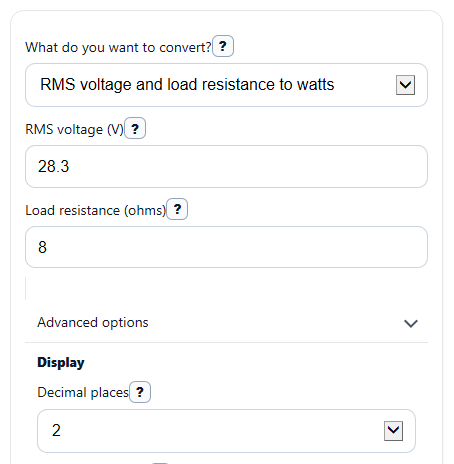
Suppose you choose RMS voltage and resistance, enter 28.3 V for RMS voltage (V), and 8 ohms for Load resistance (ohms).
P = 28.3^2 / 8
P = 800.89 / 8
P = 100.11125 W
With 2 decimal places, the displayed Power (W) is 100.11 W.
How support outputs are shown
Converted RMS voltage appears when you start from peak or peak-to-peak voltage. Apparent power appears in the power-factor mode and is found from RMS voltage times RMS current before power factor is applied. Formula used echoes the equation that matched your input path.
Assumptions used here
This tool treats resistance-based modes as resistive-load problems. In the AC power-factor mode, it uses real power equals RMS voltage times RMS current times power factor, which matches standard AC power treatment [1]. If your waveform is not sine-shaped or your load changes with frequency, a real measurement may differ.
Sources
- ADALM1000 SMU Training Topic 9: Power and Power Factor in AC Circuits | Analog Devices - Analog
- RMS Voltage (Root Mean Square) of an Alternating Waveform - Electronics-tutorials
- Lecture 1: Introduction and Lumped Abstraction | Circuits and Electronics | Electrical Engineering and Computer Science | MIT OpenCourseWare - MIT