
Convert radiation units correctly by choosing the measurement type first, so you only compare units that actually belong together.
Advanced options
Table of contents
How to use our Radiation Converter
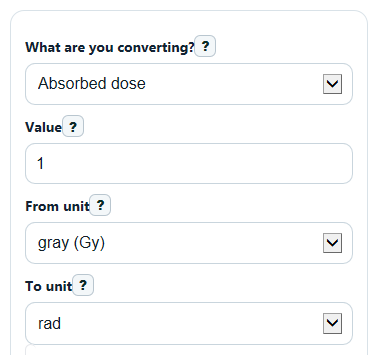
- Pick What are you converting? first, such as Absorbed dose, Exposure in air, Radioactivity, or Dose rate.
- Enter the Value, then choose the From unit and To unit from the same measurement family.
- If you want easier-to-read results, open Advanced options and set Answer digits or turn Auto-pick a smaller or larger unit on.
- Use Photon X-ray or gamma approximation helper only when you need an approximate bridge between exposure and dose for photons, then read Approximation note carefully.
- Check Measurement type and Warning before using the answer; if they do not match what you meant to convert, change the family or turn the helper off.
Definitions
Absorbed dose: Energy deposited in matter by radiation. Common units here are gray (Gy), rad, milligray (mGy), and microgray (uGy).
Equivalent or effective dose: A dose measure used to describe biological effect. Common units here are sievert (Sv), rem, millisievert (mSv), microsievert (uSv), and millirem (mrem).
Exposure in air: A measurement for ionization in air, not the same thing as tissue dose. Common units here are roentgen (R) and coulomb per kilogram (C/kg).
Radioactivity: How many nuclear decays happen in a source over time. Common units here are becquerel (Bq) and curie (Ci).
Dose rate: Dose received per unit of time, such as uSv/h or mrem/h.
Auto-pick a smaller or larger unit: A display option that may switch the answer to a nearby same-family SI unit so the number is easier to read.
Photon approximation: A helper that gives an approximate bridge between exposure and dose for X-rays or gamma rays only, instead of a strict exact conversion.
Common mistakes and quick fixes
Mistake: Picking Exposure in air in What are you converting? and expecting a direct tissue dose answer from To unit.
Fix: Keep From unit and To unit in the same family, or turn on Photon X-ray or gamma approximation helper only for the supported photon approximation.
Mistake: Entering a blank or non-numeric Value.
Fix: Type a real number in Value, such as 1, 0.5, or 100, then calculate again.
Mistake: Using From unit and To unit from different families, such as becquerel and sievert.
Fix: Match both unit menus to the family chosen in What are you converting?, because Radioactivity does not directly convert to dose.
Mistake: Treating Dose rate like total dose, such as reading uSv/h as if it were uSv.
Fix: Keep Dose rate conversions inside dose-rate units and remember that Converted value is a rate per time, not a total amount.
Mistake: Leaving Auto-pick a smaller or larger unit on and then wondering why Converted value is not shown in the exact To unit you picked.
Fix: Turn Auto-pick a smaller or larger unit off if you want Converted value displayed in the exact To unit.
Mistake: Turning on Photon X-ray or gamma approximation helper for alpha, beta, neutron, or mixed radiation cases.
Fix: Turn Photon X-ray or gamma approximation helper off unless you are using a photon approximation, and read Approximation note for the assumptions.
Limitations & Key Assumptions / Boundary Conditions
- This converter does exact unit scaling only within the same measurement family unless the photon helper is turned on for a supported exposure-to-dose bridge.
- Exposure in air, absorbed dose, equivalent dose, and activity are different physical quantities. A value in one family does not usually determine a value in another by unit conversion alone.
- The photon helper is approximate, not exact. It is intended for X-ray or gamma situations only and depends on assumptions about medium and radiation weighting factor.
- Dose rate results stay as rates. This page does not turn a rate into total dose because that would also need exposure time.
- Physical radiation quantities are normally non-negative, so negative inputs may be mathematically convertible but are usually not meaningful in real use.
- Auto-pick a smaller or larger unit changes only the displayed same-family unit. It does not change the physical quantity being converted.
Methodology
How the converter works
The calculator first uses What are you converting? to choose one measurement family. Then it converts the entered Value into a base unit for that family and converts again into the target unit. This prevents mixing unlike quantities such as activity and dose.
Core conversion rules
Absorbed dose: 1 Gy = 100 rad; 1 mGy = 1e-3 Gy; 1 uGy = 1e-6 Gy
Equivalent dose: 1 Sv = 100 rem; 1 mSv = 1e-3 Sv; 1 uSv = 1e-6 Sv; 1 mrem = 1e-3 rem
Exposure: 1 R = 2.58e-4 C/kg; 1 mR = 1e-3 R; 1 uR = 1e-6 R
Activity: 1 Ci = 3.7e10 Bq; 1 mCi = 1e-3 Ci; 1 uCi = 1e-6 Ci
Dose rate: convert the dose unit prefix and the time unit separately
Dose-rate idea
If a rate unit changes from per hour to per minute, the time part changes too. For example, one hour equals 60 minutes, so a per-hour value and a per-minute value are not the same size number unless that time conversion is included.
Photon helper
When Photon X-ray or gamma approximation helper is on, the calculator allows a limited bridge between exposure and dose families for photons only.
For photons: 1 R approx 0.00877 Gy in air
For photons with radiation weighting factor 1: 1 R approx 0.01 Sv
If the helper is used, the page shows Approximation note and Warning so the result is not mistaken for a universal exact identity. This is useful when someone has exposure units such as roentgen but needs an approximate photon dose estimate.
Mini example
Suppose Value = 2, From unit = Gy, and To unit = rad in the Absorbed dose family. First keep 2 Gy as the base value. Then use 1 Gy = 100 rad. So 2 Gy = 200 rad, which becomes the Converted value.
For a photon helper example, if Value = 100 and the conversion is from R to Gy with the helper on, use 1 R approx 0.00877 Gy. Then 100 R approx 0.877 Gy.
Formatting rules
Answer digits controls rounding of the displayed result. Scientific notation shows the same answer in power-of-ten form, which helps when the number is very large or very small. If Auto-pick a smaller or larger unit is on, the displayed unit may switch to a nearby same-family SI prefix such as mSv or uSv for readability.
Assumptions used
This page assumes direct unit conversion only within a chosen family unless the photon helper is explicitly used. It does not estimate shielding, source distance, exposure duration, biological details beyond the stated photon approximation, or source-specific dose from activity alone. Real measurements can differ from these simplified conversions because radiation type, geometry, medium, and time matter [1][3].