
Estimate an uncalibrated radiocarbon age from carbon-14 left, percent modern carbon, or activity ratio, then view it in years BP and a simple year-from-1950 format.
How to use our Radiocarbon Dating Calculator
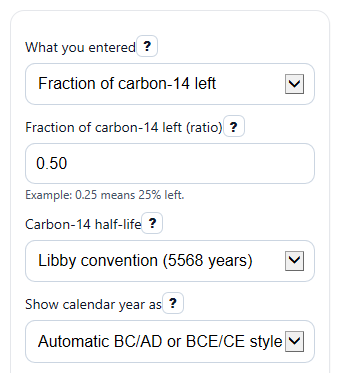
- Choose What you entered, then fill in the matching value: Fraction of carbon-14 left, Percent modern carbon (%), or Activity ratio (sample/modern).
- Pick Carbon-14 half-life. Use Libby 5568 years for standard radiocarbon reporting, physical 5730 years for the modern physical value, or enter Custom half-life (years) if your class or lab gives one.
- Choose Show calendar year as if you want the simple 1950-based year display written as BCE/CE, BC/AD, or automatic style.
- Click Calculate, then read Uncalibrated radiocarbon age (years BP) first. Use Approximate year from 1950 reference only as a quick orientation, not as a calibrated calendar date.
- Sanity-check the result: if Carbon-14 left is 0.50, the age should be about one half-life; if it is 0.25, the age should be about two half-lives.
Definitions
Years BP: Radiocarbon age in years before 1950. In this field, "present" is defined as 1950 [1].
Uncalibrated radiocarbon age: The raw age from the decay formula, before any calendar calibration.
Fraction of carbon-14 left: The share of carbon-14 still remaining compared with the modern reference level. A value of 0.50 means half is left.
Percent modern carbon (%): The same remaining amount on a 0 to 100 scale. A value of 50 means the sample has half the modern reference level.
Activity ratio (sample/modern): Sample carbon-14 activity divided by the modern reference activity. In the simple model here, it works the same way as the remaining fraction.
Half-life: The time needed for half of the carbon-14 to decay. One half-life left means 50% remains; two half-lives left means 25% remains.
Decay constant: A per-year number used in the exponential decay formula. It equals ln(2) divided by the selected half-life.
Calibration curve: A data-based curve used to convert a raw radiocarbon age into calendar age, because that conversion is not done by one simple formula [2].
Common mistakes and quick fixes
Mistake: Entering 50 in Fraction of carbon-14 left when you mean 50%.
Fix: Use 0.50 for Fraction of carbon-14 left , or switch What you entered to Percent modern carbon (%) and enter 50.
Mistake: Typing 0.5 into Percent modern carbon (%) when you mean half the modern level.
Fix: Enter 50 in Percent modern carbon (%) , or use 0.50 in Fraction of carbon-14 left .
Mistake: Using a value above 1 in Activity ratio (sample/modern) or above 100 in Percent modern carbon (%) for this basic model.
Fix: Keep Activity ratio (sample/modern) in the range 0 to 1 and Percent modern carbon (%) in the range 0 to 100. Values above that can happen in post-1950 bomb-carbon cases, which this calculator does not model.
Mistake: Forgetting that Carbon-14 half-life changes the age slightly.
Fix: Check whether your assignment or lab expects Libby 5568 years or the physical 5730 years before trusting Uncalibrated radiocarbon age (years BP) .
Mistake: Reading Approximate year from 1950 reference as an exact calendar date.
Fix: Treat Approximate year from 1950 reference as a simple 1950 minus age display only. For real calendar dating, use a calibration curve; this tool keeps the result uncalibrated.
Mistake: Leaving Custom half-life (years) blank after choosing a custom setting in Carbon-14 half-life .
Fix: Enter a positive number in Custom half-life (years) before you calculate.
Limitations & Key Assumptions / Boundary Conditions
- This calculator gives an uncalibrated radiocarbon age only. It does not perform calendar calibration.
- The displayed calendar year is just 1950 minus the radiocarbon age, so it is a reference-year conversion, not a true calendar date.
- The basic model assumes the entered Fraction of carbon-14 left, Percent modern carbon (%), or Activity ratio (sample/modern) is in the simple pre-bomb range above 0 and at or below 1, or 100% for percent input.
- Values above 1 or above 100% are blocked here because post-1950 bomb-carbon situations need a different interpretation.
- Changing Carbon-14 half-life changes the result slightly. Use the convention your class, lab, or problem statement expects.
- Very tiny remaining fractions can produce extremely large ages, but real-world radiocarbon dating becomes much more uncertain for very old samples.
- This tool does not model contamination, measurement uncertainty, reservoir effects, isotopic fractionation corrections, or lab-specific reporting methods.
Methodology
Core method
This calculator first turns your input into a remaining fraction of carbon-14, then uses exponential decay to estimate an uncalibrated radiocarbon age.
N(t) = N0 * e^(-λ * t)
t = -ln(f) / λ
λ = ln(2) / t_half
Here, f is the fraction remaining, t is age in years, and t_half is the selected carbon-14 half-life.
Input conversions
If you enter Percent modern carbon (%), the calculator converts it to a fraction first.
f = pmc / 100
If you enter Activity ratio (sample/modern), the calculator uses that ratio directly as f in this simple model.
Year display
The calculator also shows a simple year-from-1950 display because radiocarbon ages are reported in years BP, where BP means before 1950 [1].
reference_year = 1950 - age_bp
That year display is only for orientation. A real calendar-age conversion needs a calibration curve rather than this single subtraction step [2].
Mini example
Suppose Fraction of carbon-14 left is 0.50 and the selected half-life is Libby 5568 years. Then λ = ln(2) / 5568, and the age becomes one half-life, or about 5568 years BP. The simple year-from-1950 display is 1950 - 5568 = -3618, which is shown as 3619 BC or 3619 BCE depending on the label style.
Assumptions behind the math
This page uses the standard simple decay model and blocks values above the modern reference range so beginners do not accidentally mix pre-bomb dating with post-1950 bomb-carbon cases. It also does not adjust for contamination, measurement uncertainty, or calibration datasets, so real lab results can differ from this estimate.