
Use this mole calculator to convert between grams, moles, particles, gas volume at STP, and solution volume from molarity.
Advanced options
Formula helper
Answer formatting
Gas at STP
How to use our Mole Calculator
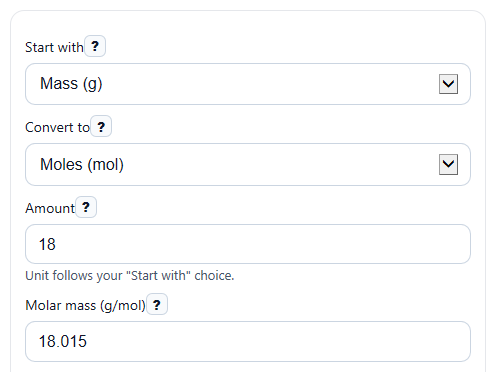
- Choose Start with and Convert to, then enter the Amount using the unit that matches your starting choice.
- Fill in Molar mass (g/mol) if mass is part of the conversion, and fill in Molarity (mol/L) if solution volume is part of the conversion.
- Pick the right Particle label so the wording matches your substance, and use Chemical formula in Advanced options if you want help checking molar mass.
- Click Calculate, then check that Moles used in the middle makes sense for your homework steps and that the final unit matches Convert to.
Definitions
Mole (mol): A counting unit in chemistry, like a very large dozen. It links mass, particles, gas volume, and solution amount.
Molar mass (g/mol): The mass of 1 mole of a substance in grams. You use it to convert between grams and moles.
Particle label: The word used for the counted pieces of a substance, such as atoms, molecules, ions, or formula units.
Formula unit: The simplest whole-number ratio of ions in an ionic compound, such as NaCl, so this label is better than molecules for many ionic substances [4].
Avogadro constant: 6.02214076 x 10^23 particles per mole. It converts between particles and moles [1].
STP: Standard temperature and pressure. In this calculator, gas volume at STP uses the selected molar volume value.
Molarity (mol/L): Moles of solute per liter of solution. You use it to connect moles and solution volume.
Common mistakes and quick fixes
Mistake: Entering grams in Amount when Start with is set to Moles (mol).
Fix: Make sure the number in Amount uses the unit named in Start with , or change Start with to Mass (g).
Mistake: Leaving Molar mass (g/mol) blank during a mass conversion.
Fix: Enter a positive value in Molar mass (g/mol) any time mass is the start or the result.
Mistake: Using Particle label = Molecules for an ionic compound such as NaCl.
Fix: Change Particle label to Formula units so the wording matches ionic compounds.
Mistake: Using Solution volume from molarity (L) without entering Molarity (mol/L) .
Fix: Enter a positive Molarity (mol/L) before calculating any path that starts with or converts to solution volume.
Mistake: Treating any gas volume like STP volume.
Fix: Only use Gas volume at STP (L) when the gas is at the chosen STP standard , and read the Assumption note after calculating.
Mistake: Copying only the final answer and skipping the middle step.
Fix: Check Moles used in the middle to make sure your unit-canceling path matches your class method.
Limitations & Key Assumptions / Boundary Conditions
- This calculator uses moles as the bridge, so results are only as good as the values you enter for Molar mass (g/mol), Molarity (mol/L), and STP standard.
- Gas volume conversions apply only to gases at the selected STP condition. If the gas is not at STP, the gas-volume result will not match real conditions.
- Solution volume conversions assume the solution concentration is correctly described by one constant molarity.
- The Chemical formula helper is optional and may not parse every formula style, especially unusual notation, hydrates with special formatting, or formulas with charges written in uncommon ways.
- Particle label changes the wording of results, not the math, so you still need to choose the scientifically correct label for your substance.
- Negative amounts, zero or negative molar mass for mass paths, and zero or negative molarity for solution paths are blocked because they do not fit this beginner conversion tool.
- Rounding can make a displayed answer look slightly different from a textbook answer if your class uses a different significant-figure rule.
Methodology
Core idea
This calculator converts everything through moles when needed. That means it first turns your starting amount into moles, then turns moles into the unit you want.
Formulas used
n = m / M
m = n x M
n = N / N_A
N = n x N_A
n = V / V_m
V = n x V_m
n = C x V
V = n / C
Here, n is moles, m is mass in grams, M is molar mass in g/mol, N is particle count, N_A is Avogadro constant, V is volume in liters, V_m is molar volume at STP, and C is molarity in mol/L.
Constants used
N_A = 6.02214076 x 10^23 particles/mol
V_m = 22.414 L/mol or 22.4 L/mol
Avogadro's constant is used for particle conversions [1]. The STP molar volume choice is shown to make the gas assumption visible [2].
Worked mini-example
Suppose you start with 18.015 g of water and want moles, using a molar mass of 18.015 g/mol.
n = m / M = 18.015 / 18.015 = 1.000 mol
So the Converted amount is 1 mol, and Moles used in the middle is also 1 mol.
If you then wanted particles and your Particle label was Molecules, the next step would be:
N = n x N_A = 1.000 x 6.02214076 x 10^23
N = 6.02214076 x 10^23 molecules
How the path is chosen
If mass is the start or result, the calculator uses molar mass. If particles are the start or result, it uses Avogadro's constant. If gas volume at STP is the start or result, it uses the selected STP molar volume. If solution volume is the start or result, it uses molarity.
Formula helper
The optional Chemical formula helper estimates molar mass by adding atomic masses from the typed formula. If the formula cannot be read clearly, the calculator does not guess and instead relies on the manual Molar mass (g/mol) entry.
Assumptions and limits
This tool is for standard intro chemistry conversions. Real gas conditions away from STP, incorrect molarity values, or an incorrect particle label can make a result scientifically misleading even when the arithmetic is correct. Ionic compounds are often better described with formula units rather than molecules [4].