
Enter pH to find hydrogen ion concentration, or enter a hydrogen ion concentration in mol/L, mM, uM, nM, or pM to find pH.
Table of contents
How to use our Hydrogen Ion Concentration Calculator
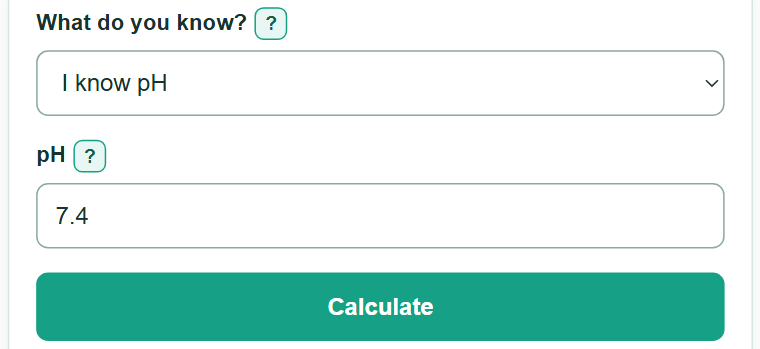
- Choose "I know pH" if you have a pH reading, or choose "I know [H+]" if you have a hydrogen ion concentration.
- Enter the active value. For concentration, choose the unit shown with your value, such as M, mM, or uM.
- Click "Calculate" to see hydrogen ion concentration first when you enter pH, or calculated pH first when you enter concentration.
- Sanity-check the answer: lowering pH by 1 should make hydrogen ion concentration 10 times larger.
- Use pOH, hydroxide ion concentration, and the acidic, neutral, or basic label only for the stated 25 C aqueous condition.
Definitions
pH: A logarithmic measure related to hydrogen ions. In this calculator's concentration-based model, a pH decrease of 1 means a 10-fold increase in hydrogen ion concentration.
Hydrogen ion concentration [H+]: The amount of hydrogen ions per liter of solution. This calculator reports the normalized value in mol/L.
M (molar): Mol per liter. One mM equals 0.001 M, and one uM equals 0.000001 M.
Scientific notation: A compact way to write very small or large numbers. For example, 1e-7 means 1 x 10⁻⁷.
pOH: A logarithmic measure related to hydroxide ion concentration [OH-]. In the 25 C aqueous model, pH plus pOH equals 14.
Common mistakes and quick fixes
Mistake: Entering 1 mM while the selected unit is M.
Fix: Select mM, or enter the equivalent value, 0.001 M.
Mistake: Reading 1e-7 as negative 7.
Fix: Read 1e-7 as 1 times 10 to the negative 7th power, or 0.0000001.
Mistake: Entering zero or a negative hydrogen ion concentration.
Fix: Enter a positive value greater than 0. A logarithm of zero or a negative number is undefined.
Mistake: Typing a unit suffix that disagrees with the selected unit.
Fix: Make them match, such as "250 uM" with uM selected.
Mistake: Treating pH 7, pOH 7, and pH plus pOH equals 14 as temperature-independent.
Fix: Use those secondary results only for the calculator's 25 C aqueous model.
Limitations & Key Assumptions / Boundary Conditions
- The calculator uses hydrogen ion concentration as a classroom-style approximation for pH. Formal pH is based on hydrogen ion activity, which can differ in concentrated or nonideal solutions.
- The acidic, neutral, or basic label, pOH, and hydroxide ion concentration use water relationships at 25 C. Temperature changes the water ion product and the neutral pH point.
- pH values outside 0 through 14 can be mathematically valid or occur in concentrated systems. A calculated value does not prove that a real sample behaves ideally.
- Hydrogen ion concentration must be positive and finite. Zero and negative concentrations cannot be converted to pH.
- Results do not replace a calibrated pH meter, laboratory procedure, or activity-based chemical equilibrium calculation.
Methodology
Calculation method
For a known pH, the calculator finds hydrogen ion concentration in mol/L. For a known concentration, it first converts the selected unit to mol/L, then calculates pH.
[H+] = 10-pH
pH = -log10([H+])
Unit conversions use metric prefixes: 1 mM = 10-3 M, 1 uM = 10-6 M, 1 nM = 10-9 M, and 1 pM = 10-12 M.
25 C secondary calculations
For an aqueous solution at 25 C, the calculator finds pOH and hydroxide ion concentration from the water ion product. These secondary calculations use pH + pOH = 14 and Kw = 1 x 10-14. [1]
pOH = 14 - pH
[OH-] = 1 x 10-14 / [H+]
Worked example
If pH is 7.4, [H+] is 10-7.4 = 3.9810717 x 10⁻⁸ mol/L. The 25 C calculations give pOH 6.6 and [OH-] about 2.5118864 x 10⁻⁷ mol/L.