
Enter your solute amount and solvent mass to calculate molality in moles per kilogram of solvent.
Table of contents
How to use our Molality Calculator
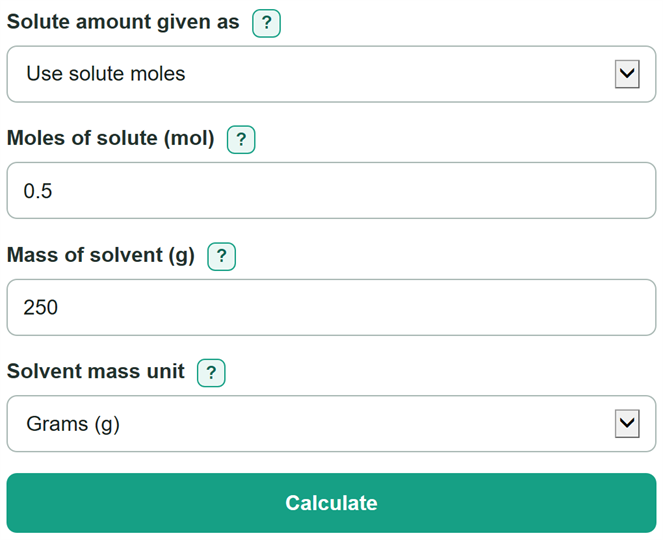
- Choose whether the solute amount in your problem is given in moles or in grams.
- Enter the solute value shown; if you chose grams, enter the solute's molar mass in g/mol too.
- Enter the mass of the solvent only, then choose grams or kilograms to match that number.
- Click Calculate to see the molality, solute moles used, solvent mass in kilograms, and the calculation.
- Sanity-check the displayed solvent mass in kilograms and make sure you did not enter the mass of the whole solution.
Definitions
Molality (m): Moles of solute divided by kilograms of solvent. The unit is mol/kg. [2]
Solute: The substance dissolved in a solution, such as salt dissolved in water.
Solvent: The substance that does the dissolving. Its mass, rather than the mass of the whole solution, is used for molality.
Molar mass: The mass of one mole of a substance, usually written in g/mol.
Mole (mol): A chemistry unit for an amount of substance.
Molarity: A concentration measure based on liters of total solution, not kilograms of solvent.
Common mistakes and quick fixes
Mistake: Entering the mass of the whole solution as the solvent mass.
Fix: Use only the mass of the liquid solvent before the solute is added.
Mistake: Entering solute grams in the Moles of solute field.
Fix: Choose "Mass in grams," then enter both solute mass and molar mass.
Mistake: Selecting kilograms while typing a value measured in grams.
Fix: Match the unit choice to the entered number. For example, 250 g equals 0.250 kg.
Mistake: Confusing molality with molarity.
Fix: Molality uses kilograms of solvent. Molarity uses liters of total solution.
Mistake: Typing a comma as a decimal mark, such as 1,01.
Fix: Use a decimal point for decimals, such as 1.01. Use commas only for thousands groups, such as 1,000.
Limitations & Key Assumptions / Boundary Conditions
- The denominator must be the mass of solvent only; using total solution mass gives the wrong molality.
- The mass-based calculation is only as accurate as the entered solute mass and molar mass.
- This calculator does not determine solubility, pH, boiling point, freezing point, purity, or reaction results.
- Lab measurements can have balance error, transfer loss, or impurities even when the calculation is correct.
- Solute amounts cannot be negative, and molar mass and solvent mass must be greater than zero.
Methodology
Calculation method
Molality is the number of moles of solute divided by the mass of solvent in kilograms. If solute moles are entered directly, the calculator uses them. If solute mass is entered, it divides grams of solute by molar mass in g/mol to find moles. It converts grams of solvent to kilograms by dividing by 1,000. [1]
n (solute moles) = solute mass (g) / molar mass (g/mol)
solvent mass (kg) = solvent mass (g) / 1000
m (molality) = n (solute moles) / solvent mass (kg)
Worked example
For 5.844 g of solute with a molar mass of 58.44 g/mol in 100 g of solvent, the solute amount is 5.844 / 58.44 = 0.1 mol. The solvent mass is 100 / 1,000 = 0.1 kg.
m = 0.1 mol / 0.1 kg = 1 mol/kg
A solute amount of 0 mol is valid and gives 0 mol/kg when solvent mass is positive. A solvent mass of 0 kg makes the expression undefined because it would divide by zero.