
Use this neutralization calculator to find the needed acid or base amount, see what is left over after mixing, and estimate final pH.
Advanced options
Reaction factors (how many H+ or OH-)
pH estimate
How to use our Neutralization Calculator
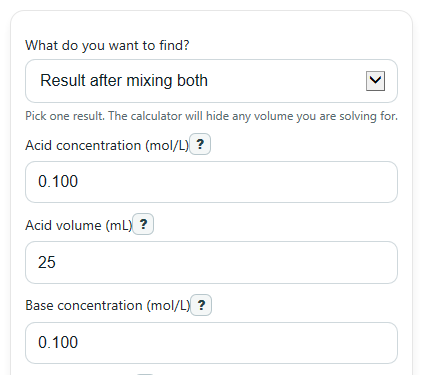
- Choose What do you want to find? and enter the visible concentration and volume fields using the units shown in each label.
- If your acid can give more than one H+ or your base can give more than one OH-, open Advanced options and set Acid H+ per formula unit and Base OH- per formula unit.
- For after-mixing results, choose Chemistry model. Use Strong acid + strong base only when both solutions are strong, or use Stoichiometry only if you only want the neutralization comparison.
- Click Calculate, then read Main result first, followed by What is left after mixing and Leftover reactive amount to see which side is in excess.
- Sanity-check the answer: if Acid reactive amount and Base reactive amount are equal, the leftover should be 0 mmol eq, and in the strong-strong model the final pH should be 7 at 25 C.
Definitions
Acid concentration (mol/L): How many moles of acid are in 1 liter of solution.
Base concentration (mol/L): How many moles of base are in 1 liter of solution.
Acid H+ per formula unit: How many hydrogen ions one formula unit of the acid can donate in the reaction.
Base OH- per formula unit: How many hydroxide ions one formula unit of the base can supply in the reaction.
Acid reactive amount: The total acid reacting capacity, shown here in mmol eq.
Base reactive amount: The total base reacting capacity, shown here in mmol eq.
mmol eq: Millimoles of reacting equivalents. This counts reaction power, not just formula units.
What is left after mixing: Whether the mixture is exactly neutralized, acid is left over, or base is left over.
Final pOH: A measure related to hydroxide concentration. It is most useful when base is left over.
Common mistakes and quick fixes
Mistake: Leaving Acid concentration (mol/L) or Base concentration (mol/L) blank and expecting the calculator to treat it as zero.
Fix: Enter a value greater than 0 in each required concentration field used by your selected mode.
Mistake: Typing liters into Acid volume (mL) or Base volume (mL) without converting.
Fix: Enter volumes in milliliters only. For example, 0.025 L should be entered as 25 mL.
Mistake: Keeping Acid H+ per formula unit or Base OH- per formula unit at 1 for a substance that reacts with 2 or 3 equivalents.
Fix: Open Advanced options and choose the correct factor before calculating.
Mistake: Reading Leftover reactive amount by itself and forgetting to check which side it belongs to.
Fix: Read What is left after mixing together with Leftover reactive amount so you know whether the extra amount is acid or base.
Mistake: Using Strong acid + strong base in Chemistry model for a weak acid or weak base, then trusting the pH value.
Fix: Switch Chemistry model to Stoichiometry only unless both solutions are strong.
Mistake: Expecting Main result to always be a pH number.
Fix: In Base volume needed or Acid volume needed mode, Main result is the required volume in mL, not pH.
Limitations & Key Assumptions / Boundary Conditions
- The final pH estimate is only for the Strong acid + strong base model and assumes aqueous solution at 25 C.
- If you choose Stoichiometry only, the calculator does not give a numeric final pH or pOH after mixing.
- Weak acids and weak bases need equilibrium data such as Ka or Kb, so this calculator does not try to estimate their final pH from stoichiometry alone.
- The result uses the entered concentrations, volumes, and reaction factors exactly as typed, so a wrong factor can change the answer a lot.
- Visible volume and concentration inputs must be greater than 0; otherwise the calculator should stop with an error instead of dividing by zero or using impossible chemistry.
- Near exact equivalence, very tiny rounding differences can appear, so the calculator treats extremely small differences as neutralized.
Methodology
Core idea
Neutralization is based on matching reacting acid equivalents and base equivalents. If both sides match, the mixture is at the neutralization point. If one side is larger, that side is left over.
Formulas used
acid eq = C_acid x V_acid_L x a
base eq = C_base x V_base_L x b
C_acid x V_acid_L x a = C_base x V_base_L x b
V_base_L = (C_acid x V_acid_L x a) / (C_base x b)
V_acid_L = (C_base x V_base_L x b) / (C_acid x a)
C_excess = abs(acid eq - base eq) / V_total_L
pH = -log10([H+])
pOH = -log10([OH-])
pH = 14 - pOH
Helpful unit shortcut
Because 1 mol/L x 1 mL = 1 mmol, the calculator can show reacting amounts in mmol eq directly with concentration x volume in mL x factor. That makes the numbers easier to read for students.
How results are decided
In Base volume needed mode, the calculator uses the entered acid amount and solves for the base volume that makes acid equivalents equal base equivalents.
In Acid volume needed mode, it does the same in reverse using the entered base amount.
In Result after mixing both mode, it compares acid reactive amount and base reactive amount. Equal values mean neutralization. If acid is larger, acid is left over. If base is larger, base is left over.
For the Strong acid + strong base model only, the leftover equivalent amount is divided by total mixed volume to get leftover [H+] or [OH-], then pH or pOH is calculated. If the mixture is exactly neutralized, the calculator reports pH 7 at 25 C.
Mini example
Suppose you mix 50.0 mL of 0.100 mol/L acid with 25.0 mL of 0.100 mol/L base, and both factors are 1.
acid mmol eq = 0.100 x 50.0 x 1 = 5.0
base mmol eq = 0.100 x 25.0 x 1 = 2.5
The acid side is larger, so acid is left over.
leftover = 5.0 - 2.5 = 2.5 mmol eq
V_total = 75.0 mL = 0.0750 L
[H+] = 0.0025 mol / 0.0750 L = 0.03333 mol/L
pH = -log10(0.03333) = 1.176
So the mixture stays acidic, with 2.5 mmol eq of acid left over and a final pH of about 1.176.
Assumptions used in the math
This method assumes the listed acid and base factors correctly represent the number of reacting H+ and OH- units, the mixed volume is the sum of the entered volumes, and the pH relation pH + pOH = 14 is used only at 25 C for the strong acid-strong base model.