
Use this calculator to find how much bleach and water to mix for a target ppm, percent, or 1:x bleach-to-water ratio.
Before you start: “Final mixture amount” means bleach plus water, not water already in a container. For a 1:10 bleach-to-water mix, choose “Bleach to water ratio” and enter 10 in “Water parts for each 1 part bleach”. A percent and a ratio are different; check which one your product instructions specify.
Before mixing: Use bleach and water only, following the bottle’s dilution and contact-time directions. Do not combine bleach with other cleaning or disinfecting products: dangerous fumes can result. Ventilate the area and use the protection specified on the label. CDC bleach safety guidance
How to use our Bleach Dilution Calculator
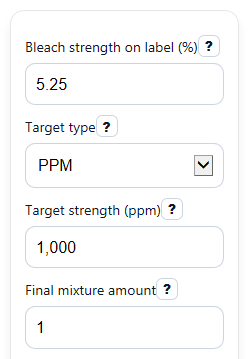
- Enter the bottle value in Bleach strength on label (%), then choose your Target type: PPM, Percent, or Bleach to water ratio.
- Fill in only the matching target field: Target strength (ppm), Target strength (%), or Water parts for each 1 part bleach.
- Enter Final mixture amount (L), pick the Final mixture unit you want to work in, and choose an option for Round measured bleach to if you want an easier measuring amount shown.
- Click Calculate to see Bleach needed, Water to add, both forms of Final strength, and the Mix ratio.
- Sanity-check the result before mixing: Bleach needed should be smaller than Final mixture amount, Water to add should stay positive, and the shown Final strength should match the target type you entered.
Definitions
Bleach strength on label (%): The percent sodium hypochlorite printed on the bottle. This is the starting strength of the bleach before you add water.
Target type: The way you want to enter your goal: by ppm, by percent, or by a bleach:water mixing ratio.
PPM: Parts per million. In this calculator, it is another way to describe bleach strength. A common conversion used here is 1% = 10,000 ppm [4].
Target strength (ppm): The final bleach strength you want, written in parts per million.
Target strength (%): The final bleach strength you want, written as a percent.
Water parts for each 1 part bleach: The water number in a 1:x bleach:water mix. If the mix is 1:49, the water part is 49.
Final mixture amount: The total amount you want after combining bleach and water, not just the water amount.
Bleach needed: How much bleach to measure from the bottle.
Water to add: How much water to add so the total reaches your chosen final amount.
Mix ratio: The finished bleach:water relationship shown as about 1:x.
Common mistakes and quick fixes
Mistake: Typing the wrong bottle value in Bleach strength on label (%) , such as entering 0.525 instead of 5.25.
Fix: Enter the percent exactly as it appears on the bleach label, usually values like 5.25, 6, or 8.25.
Mistake: Choosing Target type as PPM but filling in Target strength (%) or Water parts for each 1 part bleach instead.
Fix: Match the field to the selected Target type . Only the visible target input is used in the calculation.
Mistake: Entering a target in Target strength (ppm) or Target strength (%) that is equal to or stronger than Bleach strength on label (%) .
Fix: Use a target weaker than the stock bleach. If the target is too strong, the mix is impossible because Water to add would be zero or negative.
Mistake: Using Water parts for each 1 part bleach as the total number of parts instead of the water part only.
Fix: For a 1:49 bleach:water mix, enter 49, not 50. The Mix ratio result will confirm the finished 1:x relationship.
Mistake: Forgetting to match Final mixture amount (L) with the chosen Final mixture unit .
Fix: If you want 1 gallon, enter 1 and choose US gallons. If you want 1 liter, enter 1 and choose L.
Mistake: Relying only on a rounded kitchen amount from Round measured bleach to when the batch is very small.
Fix: Check the exact Bleach needed value too. If rounding makes the amount look like 0, use a larger batch or more precise measuring tools.
Limitations & Key Assumptions / Boundary Conditions
- This calculator assumes the label percent is sodium hypochlorite strength and uses that entered value directly for dilution math.
- It calculates concentration only. It does not determine contact time, required dwell time, surface compatibility, ventilation needs, or whether a product is approved for a specific disinfecting claim.
- Results are only valid when the target strength is lower than Bleach strength on label (%) and the calculated Water to add stays above zero.
- For ratio mode, the calculator treats the entry as 1 part bleach to x parts water. Entering total parts instead of water parts will give the wrong answer.
- Rounded kitchen measures are display helpers only. The exact calculation is more accurate, especially for very small batches.
- Real-world bleach solutions can weaken over time or differ from what a user assumes from an old bottle, so actual strength in use may not match the simple math exactly.
- Unit conversions are exact within the constants used here, but practical measuring tools may still add small mixing errors.
Methodology
How the calculator works
The calculator uses the standard dilution relationship to find how much stock bleach is needed for a weaker final mix.
C1 x V1 = C2 x V2
Here, C1 is the starting bleach concentration, V1 is the bleach volume used, C2 is the target concentration, and V2 is the final total mixture volume.
Percent and ppm conversion
When you enter a label percent or a percent target, the calculator can also show the same strength in ppm. It uses the standard conversion 1% = 10,000 ppm [4].
stock_ppm = stock_percent x 10000
final_ppm = final_percent x 10000
If target type is PPM
The calculator converts the stock bleach percent to ppm, then solves for the bleach amount needed.
V1 = (target_ppm / stock_ppm) x V2
water = V2 - V1
If target type is Percent
The calculator keeps both concentrations in percent and solves the same dilution equation.
V1 = (target_percent / stock_percent) x V2
water = V2 - V1
If target type is Bleach to water ratio
For a 1:x bleach:water mix, there are 1 + x total parts.
V1 = V2 / (1 + x)
water = V2 - V1
After that, the calculator also works out the resulting percent and ppm from the bleach fraction used.
Worked mini-example
Suppose the bottle says 5.25%, the target is 1000 ppm, and the final mixture amount is 1 L. First convert 5.25% to ppm.
stock_ppm = 5.25 x 10000 = 52500 ppm
Now solve for bleach needed.
V1 = (1000 / 52500) x 1 L = 0.019047619 L
That is about 19.05 mL of bleach. Water is the rest.
water = 1 - 0.019047619 = 0.980952381 L
So the mix is about 19.05 mL bleach plus 980.95 mL water, which is about a 1:51.5 bleach:water ratio.
Rounding and unit handling
The main calculation is done before display rounding. If you choose a kitchen rounding option, "Bleach needed" still shows the calculated dose. "Rounded measuring comparison" separately shows the measuring approximation and how it differs from the target when combined with the displayed water amount. Volume units are converted using fixed constants for mL, L, US cups, US fluid ounces, and US gallons.
Validation and assumptions
The calculator rejects blank, zero, or negative required inputs. It also rejects targets that are equal to or stronger than the entered stock bleach, because a dilution cannot make a stronger solution from a weaker one. Hidden target fields are ignored so only the selected target mode affects the result. Safe use still depends on following the product label and the needed contact time for the job [1].
Sources
- Cleaning and Disinfecting with Bleach | Water, Sanitation, and Environmentally Related Hygiene (WASH) - CDC
- Stanford Environmental Health & Safety (PDF) - Sodium Hypochlorite (Bleach) Safety Fact Sheet (dilution stability; incompatibilities) - Stanford
- Mixing of Chlorine Bleach Solution for Disinfecting | HealthUnit Haldimand-Norfolk - HNHU
- Arizona State University EH&S: Disinfecting with bleach (percent sodium hypochlorite and ppm equivalence) - ASU