
Choose a transformer kVA size from load power or voltage and amps, with room for loading limits and future growth.
Table of contents
How to use our Transformer Sizing Calculator
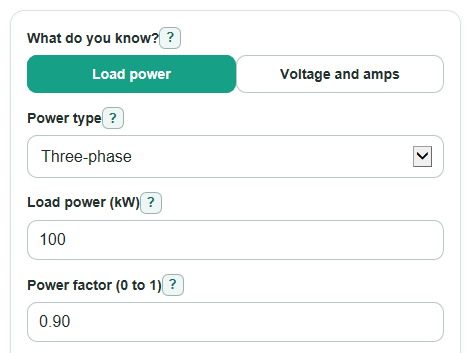
- Choose What do you know?: Load power if you know Load power and Power factor, or Voltage and amps if you know Load voltage and Load current.
- Pick Power type. For three-phase, enter Load voltage as line-to-line voltage, such as 208 V or 480 V.
- Open Advanced options if needed, then set Planned loading limit, Extra future load, Primary voltage, rounding, and Number display.
- Click Calculate and check the Recommended transformer size first, then compare Room before your loading limit to see whether the chosen size still has spare capacity.
- Sanity-check the amps results against known panel ratings or nameplate current. If the Transformer full-load amps at load voltage looks far off, recheck phase, voltage, and power factor.
Definitions
kVA: Kilovolt-amperes. This is the transformer size rating and means apparent electrical power, not the same thing as kW when power factor is below 1.
Load power: The real power in kilowatts that the load uses to do work, make heat, turn motors, or run equipment.
Power factor: A number from greater than 0 to 1 that tells how much of the electrical power does useful work. Lower power factor needs more kVA for the same kW.
Load voltage: The voltage at the transformer secondary side that feeds the load. For three-phase, this means line-to-line voltage unless your project says otherwise.
Load current: The current in amps that the transformer must supply. For three-phase, use line current.
Planned loading limit: The highest percent of the transformer rating you plan to use. An 80 percent limit means the planned load should be no more than 80 percent of the selected kVA.
Extra future load: Added percent for likely future equipment before the transformer size is chosen.
Room before your loading limit: Signed spare kVA before the planned loading limit is reached. Positive means spare room remains. Negative means the selected size is below your chosen limit.
Full-load amps: The current a transformer can supply at its rated kVA and voltage.
Common mistakes and quick fixes
Mistake: Entering a motor horsepower value or a simple nameplate total in Load power when you really need demand load.
Fix: Use the actual Load power in kW, or switch What do you know? to Voltage and amps if current is the better known value.
Mistake: Typing Power factor as 90 instead of 0.90.
Fix: Enter Power factor as a number from greater than 0 to 1, such as 0.90.
Mistake: Using line-to-neutral voltage for Load voltage on a three-phase load.
Fix: For three-phase Power type, enter line-to-line Load voltage, such as 208 V, 240 V, 480 V, or 600 V.
Mistake: Adding all three phase currents together for Load current.
Fix: For three-phase, enter the line current the transformer supplies, not three times that value.
Mistake: Leaving Planned loading limit at 100 when the design goal is to load the transformer only to 80 percent.
Fix: Set Planned loading limit to the percent of transformer kVA you are willing to use.
Mistake: Turning Round up to a common size off and treating the exact Minimum size before rounding as a stocked transformer.
Fix: Use Round up to a common size when you want a practical standard-size estimate, then confirm available sizes for the job.
Limitations & Key Assumptions / Boundary Conditions
- This calculator is an estimating aid for transformer kVA size. It does not size breakers, fuses, conductors, grounding, disconnects, or code-required protection.
- Three-phase calculations assume a balanced load and use line-to-line Load voltage with line current.
- Load power mode assumes the entered Load power is real demand load in kW and the Power factor is a reasonable estimate for that load.
- The built-in common size list is 15, 30, 45, 75, 112.5, 150, 225, 300, 500, 750, 1000, 1500, 2000, and 2500 kVA. Actual stocked or specified sizes can differ by manufacturer, project, and transformer type.
- If the calculated need is above 2500 kVA with rounding turned on, the calculator shows the exact need and a Size note instead of pretending there is a built-in standard size.
- Primary full-load amps uses the same Power type as the load side. It is only an estimate and does not include transformer impedance, inrush, tap setting, or efficiency effects.
- The calculator does not check motor starting voltage drop, harmonic K-factor, ambient temperature, altitude derating, temperature rise, enclosure type, utility requirements, or stamped engineering requirements.
Methodology
Base load
The calculator first converts the known load information into base load kVA. In Load power mode, it divides real power by power factor.
base_load_kva = load_kw / power_factor
In Voltage and amps mode, the formula depends on Power type. For a balanced three-phase load, apparent power uses line-to-line voltage and line current [2].
single_phase_base_load_kva = load_voltage_v * load_current_a / 1000
three_phase_base_load_kva = sqrt(3) * load_voltage_v * load_current_a / 1000
Size choice
Extra future load is added before the loading limit is applied.
planned_load_kva = base_load_kva * (1 + future_growth_percent / 100)
required_kva = planned_load_kva / (loading_limit_percent / 100)
If Round up to a common size is Yes, the calculator picks the next built-in common size at or above the required kVA. If Round up to a common size is No, the recommended size is the exact required kVA.
recommended_kva = next_common_size_at_or_above(required_kva)
Room before the loading limit is signed, so it can be positive, zero, or negative.
room_before_limit_kva = recommended_kva * (loading_limit_percent / 100) - planned_load_kva
Full-load amps
The selected transformer kVA is converted back to current at the load voltage. If Primary voltage is entered, the same formula is also used for the primary side.
single_phase_amps = recommended_kva * 1000 / voltage_v
three_phase_amps = recommended_kva * 1000 / (sqrt(3) * voltage_v)
Worked example
For a 100 kW load, 0.90 power factor, 80 percent Planned loading limit, 0 percent Extra future load, three-phase 208 V Load voltage, and rounding on, the base load is 111.11 kVA.
base_load_kva = 100 / 0.90 = 111.11 kVA
required_kva = 111.11 / 0.80 = 138.89 kVA
The next built-in common size is 150 kVA. The room before the 80 percent limit is 8.89 kVA.
room_before_limit_kva = 150 * 0.80 - 111.11 = 8.89 kVA
At 208 V three-phase, the selected 150 kVA transformer has about 416.35 A of full-load current on the load side.
secondary_amps = 150 * 1000 / (sqrt(3) * 208) = 416.35 A