
Choose what you know to calculate average speed, distance, travel time, or the time difference between two speeds.
Table of contents
How to use our Speed Calculator
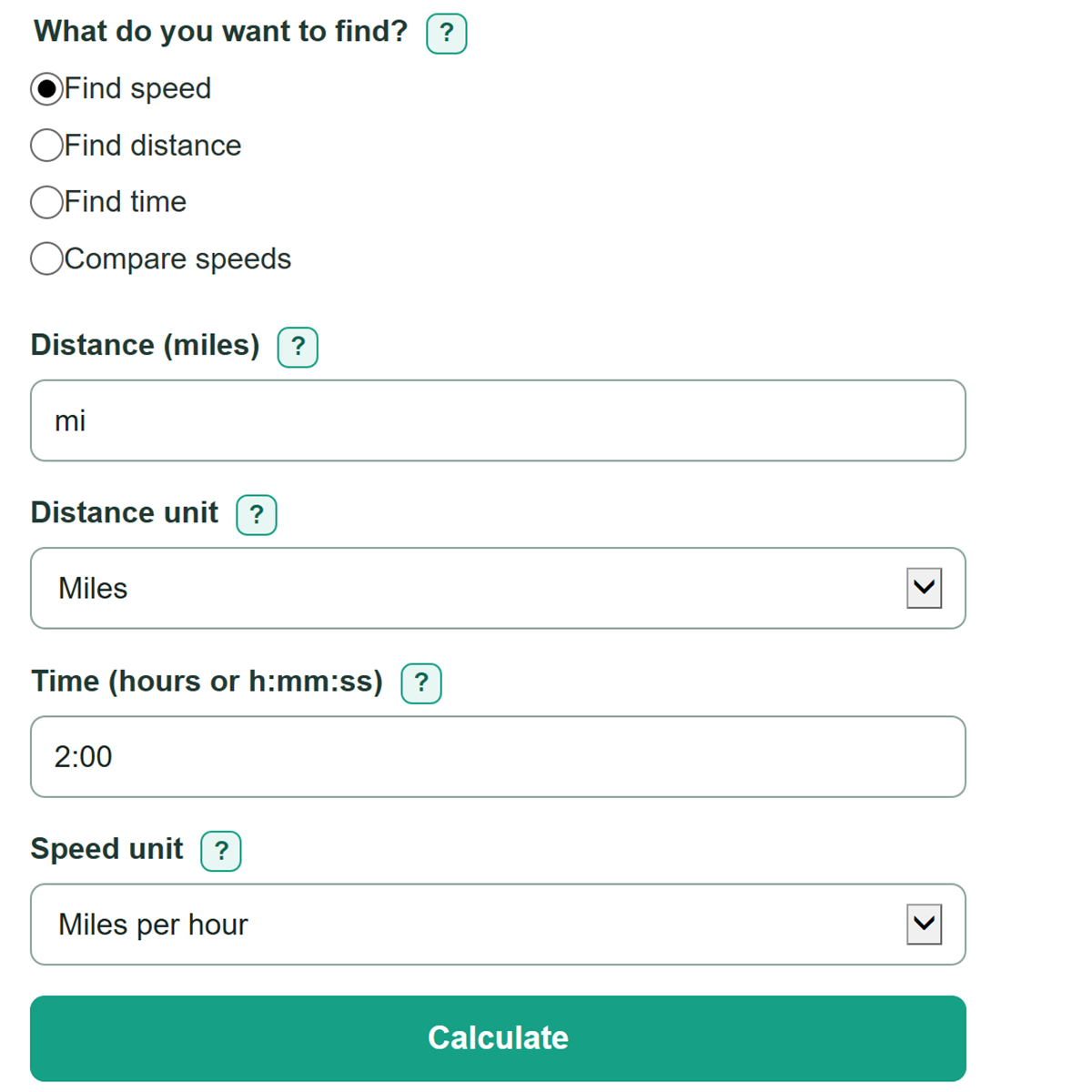
- Choose whether to find speed, distance, travel time, or compare two speeds over the same distance.
- Enter the known distance, time, or speed, and choose the unit printed with each measurement.
- For time, enter decimal hours such as 1.5, or clock-style time such as 1:30 or 0:05:30.
- For Compare speeds, enter the distance, first speed, and second speed. Both speeds use the selected speed unit.
- Click Calculate, then check that the result unit matches what you need and that average speed makes sense for the distance and moving time entered.
Definitions
Average speed: Total distance divided by total moving time. It can differ from a speedometer reading at one moment.
Clock-style duration: Time written as h:mm or h:mm:ss. For example, 1:30 means 1 hour 30 minutes.
Distance unit: The unit used for distance, such as miles, kilometers, meters, feet, yards, or nautical miles.
Speed unit: Distance covered per unit of time, such as miles per hour, kilometers per hour, or meters per second.
Travel time change: The second travel time minus the first travel time for the same distance. A negative value means the second speed saves time.
Common mistakes and quick fixes
Mistake: Entering 1.30 to mean 1 hour 30 minutes.
Fix: Check What do you want to find? and then recalculate. Enter 1:30 or 1.5. A decimal time entry is measured in hours.
Mistake: Leaving Distance unit set to miles when the map gives kilometers.
Fix: Choose the unit shown with the distance before calculating.
Mistake: Reading average speed as the speed at every moment of a trip.
Fix: Average speed is total distance divided by total moving time. Traffic and stops can make moment-by-moment speed different.
Mistake: Entering a running pace, such as 8 minutes per mile, as a speed.
Fix: Check What do you want to find? and then recalculate. Convert the pace to a speed first, then enter it with the correct speed unit.
Mistake: Treating a negative travel time change as an error.
Fix: Check What do you want to find? and then recalculate. A negative change means the second speed takes less time than the first speed over the same distance.
Limitations & Key Assumptions / Boundary Conditions
- The calculation assumes a constant speed when finding distance or travel time.
- Average speed uses total distance and total moving time, so it does not model acceleration, traffic, hills, or changing pace.
- Travel time is moving time only. Add breaks, fuel stops, waiting, and other delays separately.
- Each distance, speed, second speed, or time value used by the selected calculation must be greater than zero.
- Running pace in minutes per mile is not a speed unit in this calculator and must be converted before entry.
Methodology
Calculation method
The calculator converts the selected distance and speed units to meters and meters per second, applies the matching equation, and converts the answer to the unit you selected. The length and speed conversion relationships follow NIST SI guidance [1].
average speed = distance / elapsed time
distance traveled = speed x elapsed time
travel time = distance / speed
Time can be decimal hours, h:mm, or h:mm:ss. Decimal hours are multiplied by 3,600 to get seconds. In clock-style time, minutes and seconds must each be from 0 through 59.
Comparing speeds
For the same distance, the calculator finds the travel time at each entered speed, then subtracts the first time from the second time.
travel time change = second travel time - first travel time
Mini-example
A trip of 120 miles in 2:00 has an average speed of 60 miles per hour. For the same 120 miles, traveling at 75 miles per hour takes 1:36, which is 24 minutes less than traveling at 60 miles per hour.