
Calculate hydraulic motor running torque, speed, and power from motor displacement, pressure drop, branch flow, and separate efficiency values.
Advanced options
Calculation details
Table of contents
How to use our Hydraulic Motor Torque, Speed, Flow and Power Calculator
- Choose Units that match the motor catalog, pressure gauges, and flow reading.
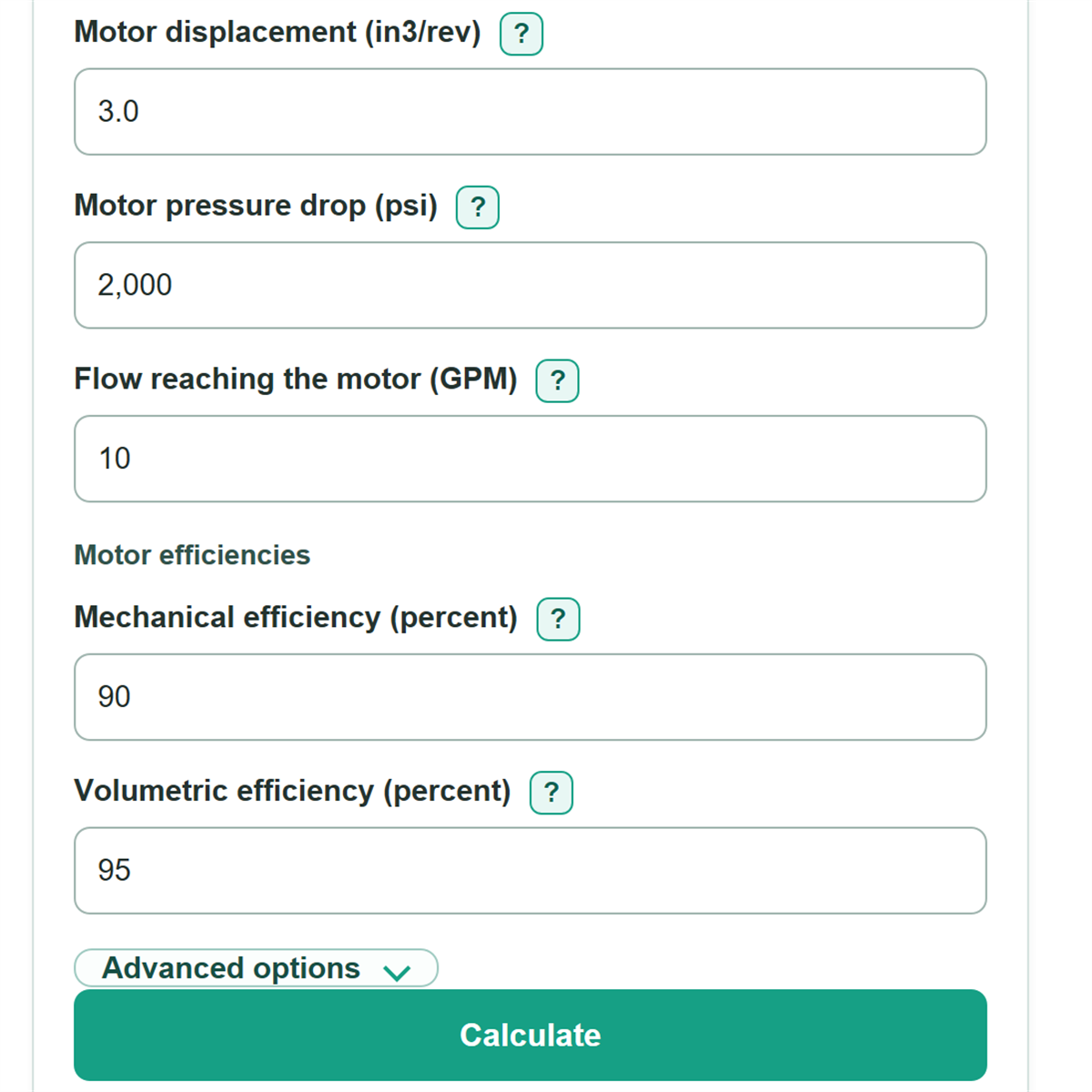
- Enter Motor displacement, then enter Motor pressure drop as inlet pressure minus outlet or return pressure.
- Enter Flow reaching the motor, not total pump flow if another branch, bypass, or valve takes part of the flow.
- Enter Mechanical efficiency and Volumetric efficiency as percentages, then select Calculate.
- Check that estimated speed, torque, and shaft power fit the application; if available, add continuous limits and make sure the closest margin is not negative.
Definitions
Motor displacement: The fluid volume needed for one motor revolution. It is entered as in3/rev in US units or cc/rev in metric units.
Motor pressure drop: Pressure at the motor inlet minus pressure at the motor outlet or return line. This pressure difference produces torque.
Flow reaching the motor: The actual fluid flow through this motor branch. It determines motor speed and hydraulic input power.
Mechanical efficiency: The percent of theoretical torque left after mechanical losses. It changes estimated running shaft torque.
Volumetric efficiency: The percent of theoretical speed left after internal leakage. It changes estimated motor speed.
Hydraulic input power: Power carried by the fluid at the motor from the entered pressure drop and flow, before motor losses.
Continuous-limit margin: The percent difference between a calculated operating value and an entered continuous catalog limit. Positive is below the limit; negative is above it.
US and metric conversions: The calculator converts bar and L/min to psi and GPM for the equations, then converts displayed torque and power back to the selected unit system.
Common mistakes and quick fixes
Mistake: Entering pump pressure as Motor pressure drop even though the motor has return-line pressure.
Fix: Subtract motor outlet or return pressure from inlet pressure before entering Motor pressure drop.
Mistake: Using total pump flow for Flow reaching the motor when flow splits between circuit branches.
Fix: Enter only the flow that actually goes through the motor branch.
Mistake: Typing 0.90 for Mechanical efficiency or Volumetric efficiency.
Fix: Enter 90 for 90 percent. Each efficiency must be more than 0 and no more than 100 percent.
Mistake: Treating Estimated running shaft torque as startup or breakaway torque.
Fix: Use this running estimate only; check the motor catalog for breakaway, starting, and intermittent ratings.
Mistake: Comparing hydraulic input power with the catalog's Continuous output power limit.
Fix: Compare the catalog shaft-power rating with Estimated shaft output power, which is after motor losses.
Mistake: Ignoring a negative Closest continuous-limit margin.
Fix: A negative margin means at least one entered continuous limit is exceeded; reduce the operating point or choose a motor with a suitable rating.
Limitations & Key Assumptions / Boundary Conditions
- Results describe one steady running operating point. They do not predict startup, breakaway torque, shock loads, or rapid changes in pressure and flow.
- Pressure must be the drop across the motor. Upstream pump, hose, valve, and other circuit losses are not included unless they are already reflected in the entered motor pressure drop.
- Mechanical and volumetric efficiency can change with pressure, speed, fluid temperature, viscosity, motor wear, and motor design. Use manufacturer curves for the expected operating point when available.
- A zero-flow calculation can show pressure-based torque but shows zero speed and power. Actual stalled operation can create heat and may violate motor or system limits.
- Continuous-limit screening uses only the limits entered. A passing margin does not verify duty cycle, temperature, fluid condition, case-drain plumbing, mounting loads, or other catalog requirements.
- The calculation estimates running shaft torque, not a guaranteed delivered torque at the driven machine after coupling, gearbox, or drivetrain losses.
Methodology
Calculation method
The calculator first converts the selected inputs to US base units: in3/rev, psi, and GPM. It keeps mechanical efficiency and volumetric efficiency separate because they affect different parts of motor performance.
T_theoretical (in-lb) = pressure_drop (psi) * displacement (in3/rev) / (2 * π)
Mechanical efficiency reduces theoretical torque to estimated running shaft torque.
T_running (in-lb) = T_theoretical * mechanical_efficiency / 100
Flow divided by displacement gives theoretical speed. Volumetric efficiency reduces that speed for internal leakage.
RPM_running = flow (GPM) * 231 / displacement (in3/rev) * volumetric_efficiency / 100
Hydraulic input power is calculated from motor pressure drop and motor branch flow. Shaft output power applies both efficiency factors.
Hydraulic hp = pressure_drop (psi) * flow (GPM) / 1714.285714
Shaft hp = hydraulic hp * mechanical_efficiency / 100 * volumetric_efficiency / 100
For example, a 3.0 in3/rev motor at 2,000 psi with 10 GPM, 90% mechanical efficiency, and 95% volumetric efficiency produces about 71.62 lb-ft running torque, 731.5 RPM, 11.67 hydraulic hp, and 9.98 shaft hp.
Continuous-limit screen
For each supplied continuous limit, the calculator finds the signed percent margin. It then reports the smallest available margin.
Margin (%) = 100 * (continuous_limit - operating_value) / continuous_limit
A negative margin means the operating value exceeds that entered limit. Blank optional limits are ignored.
Assumptions and limits
The equations assume steady operation and use the entered efficiencies at that operating point. Unit conversions for pressure and flow are applied consistently before the calculation. The result does not include pump, plumbing, valve, gearbox, or load-side losses.