
Estimate whether cleaning a heat exchanger before the next outage can repay its direct and downtime costs through recovered thermal value.
Advanced options
Table of contents
How to use our Heat Exchanger Cleaning Payback Calculator
- Choose the Performance records available option that matches your report: clean and current U-values or clean and current duty.
- Enter clean and current performance from comparable operating conditions. In U-value mode, also enter Heat-transfer area and Effective temperature difference.
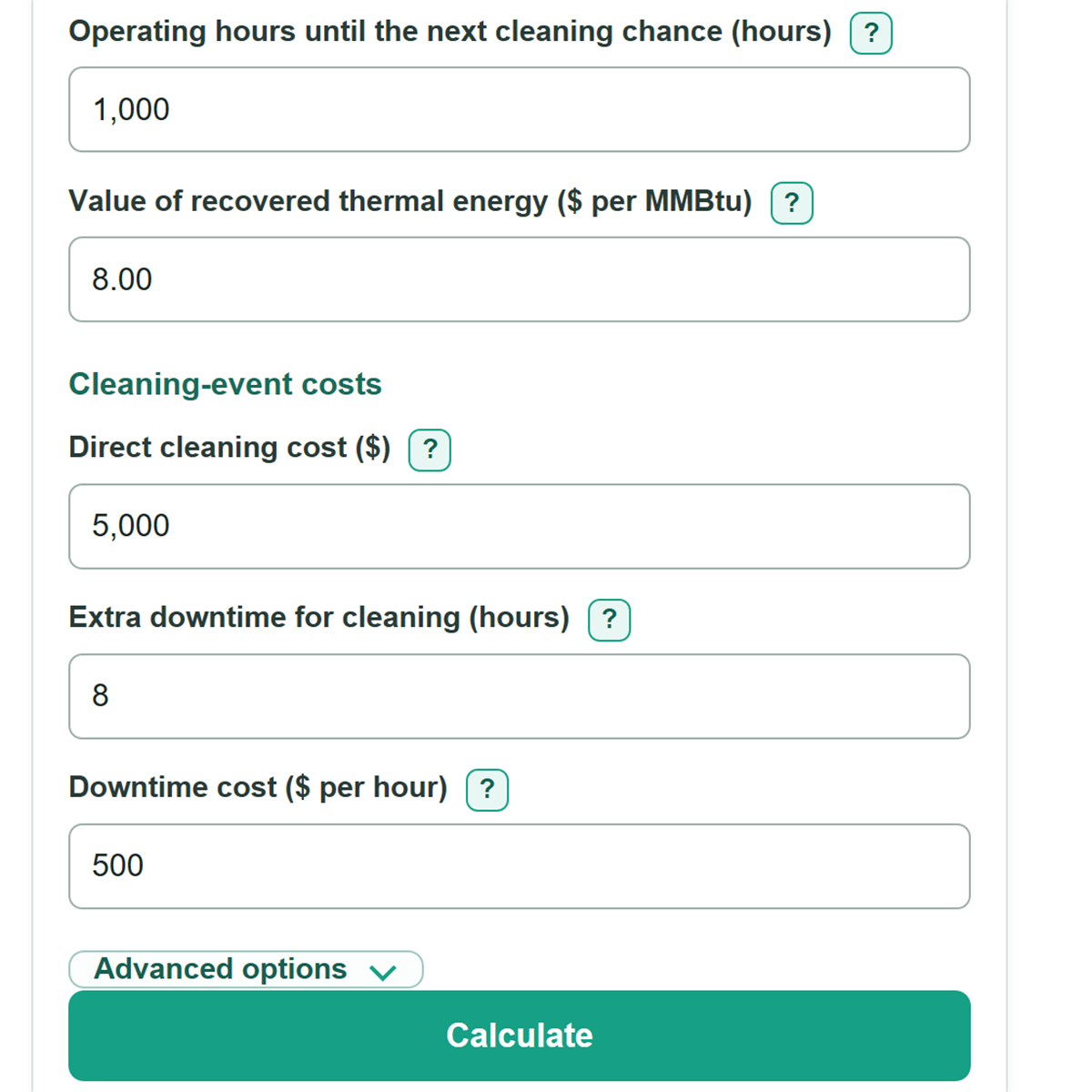
- Enter Expected duty recovery, then set Operating hours until the next cleaning chance and Value of recovered thermal energy using a marginal cost per MMBtu.
- Enter Direct cleaning cost, Extra downtime for cleaning, and Downtime cost without counting the same downtime expense twice.
- Calculate, then check that Clean-condition duty used and Current duty used match your source records before using Net benefit through the next cleaning chance for a decision.
Definitions
U-value: Overall heat-transfer coefficient. In this calculator it is entered as Btu per hour per square foot per degree F. A larger U-value means more heat transfer under the same conditions.
Effective temperature difference: The temperature driving force used with U-value and Heat-transfer area to estimate duty. It is a temperature difference, not an inlet temperature.
Thermal duty: The rate of heat transferred by the exchanger, shown in MMBtu per hour.
MMBtu: One million Btu. The calculator divides Btu per hour by 1,000,000 to display MMBtu per hour.
Expected duty recovery: The percentage of the measured clean-to-current duty loss expected to return after cleaning.
Marginal thermal-energy value: The avoided cost or useful value of one additional MMBtu of recovered heat or cooling, excluding fixed utility charges.
Operating day: A 24-hour block of exchanger runtime used to express Operating hours to repay cleaning. It is not a calendar day.
Common mistakes and quick fixes
Mistake: Entering a current Clean U-value that is higher than the clean baseline.
Fix: Compare like-for-like tests and make sure Current U-value is no greater than Clean U-value.
Mistake: Using building floor area for Heat-transfer area.
Fix: Use the exchanger's effective surface area from its data sheet, drawing, or asset record.
Mistake: Entering total monthly utility spending as Value of recovered thermal energy.
Fix: Enter the marginal value in $/MMBtu for useful recovered heat or cooling, excluding fixed account charges.
Mistake: Counting production loss in both Direct cleaning cost and Downtime cost.
Fix: Put quoted cleaning work in Direct cleaning cost and only the separate time-based loss in Extra downtime for cleaning and Downtime cost.
Mistake: Assuming Expected duty recovery will be 100 percent without evidence.
Fix: Use post-cleaning history, a vendor basis, or a conservative estimate for Expected duty recovery.
Limitations & Key Assumptions / Boundary Conditions
- This is a screening calculation based on clean and current performance measured under reasonably comparable flow rates, temperatures, loads, and fluid properties.
- A lower Current U-value or Current duty can result from fouling, but it can also result from bypassing, changed flow, air binding, sensor error, or changed process conditions.
- Expected duty recovery is an entered estimate. Cleaning may restore less than the assumed share of lost duty.
- Value of recovered thermal energy must be a defensible marginal value in $/MMBtu. Fixed account charges, taxes, demand charges, and unrelated facility spending are excluded.
- Pressure-drop, pump-power, fan-power, emissions, production-quality, and reliability effects are not modeled. Do not infer them from thermal duty loss.
- Payback uses operating hours, not calendar time. A unit that runs intermittently can take longer in calendar days to reach the stated operating payback.
- Direct cleaning cost and downtime inputs must not include the same expense twice.
Methodology
Calculation method
The calculator first determines clean-condition and current duty. With U-value records, it multiplies U-value by Heat-transfer area and Effective temperature difference, then converts Btu per hour to MMBtu per hour. With duty records, it uses the entered clean and current duties directly.
clean_duty = clean_u * heat_transfer_area * effective_lmtd / 1000000
current_duty = current_u * heat_transfer_area * effective_lmtd / 1000000
The current duty loss is the clean-condition duty minus current duty. Expected duty recovered is that loss multiplied by Expected duty recovery as a percentage.
current_duty_loss = clean_duty - current_duty
recovered_duty = current_duty_loss * cleaning_effectiveness / 100
Avoided thermal cost is the recovered thermal rate multiplied by the selected operating horizon and the entered marginal energy value. The cleaning-event cost adds the direct event cost and the separate cost of cleaning-related downtime.
avoided_cost = recovered_duty * operating_hours * energy_value
downtime_cost = downtime_hours * downtime_cost_rate
total_cleaning_event_cost = direct_cleaning_cost + downtime_cost
net_benefit = avoided_cost - total_cleaning_event_cost
Operating payback divides total cleaning-event cost by avoided thermal cost per operating hour. Break-even thermal-energy value divides event cost by recovered duty over the selected operating hours.
payback_operating_hours = total_cleaning_event_cost / (recovered_duty * energy_value)
break_even_energy_value = total_cleaning_event_cost / (recovered_duty * operating_hours)
Worked example
With clean U-value 200, current U-value 150, area 1,000 sq ft, and effective temperature difference 50 F, clean duty is 10 MMBtu/h and current duty is 7.5 MMBtu/h. The loss is 2.5 MMBtu/h. At 80% Expected duty recovery, recovered duty is 2 MMBtu/h. Over 1,000 operating hours at $8 per MMBtu, avoided thermal cost is $16,000. A $5,000 Direct cleaning cost plus 8 hours at $500 per hour gives a $9,000 event cost, so net benefit is $7,000.
Assumptions and limits
The calculation treats recovered thermal value as proportional to recovered duty and assumes the entered energy value stays constant through the chosen operating period. It does not prove that fouling caused the measured performance gap or estimate hydraulic penalties, future fouling growth, taxes, discounting, or changes in production value.