
Estimate how many miles your EV adds per hour and how long a chosen charge from one battery percent to another may take.
Advanced options
Table of contents
How to use our EV Charging Speed Calculator
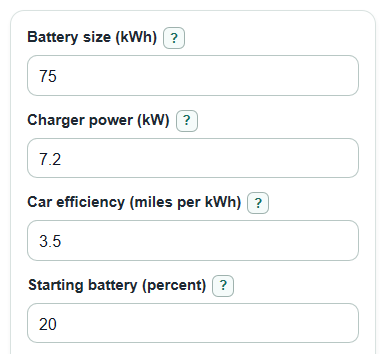
- Enter Battery size (kWh), using usable battery size if you know it.
- Enter Charger power (kW) and Car efficiency (miles per kWh). If you only have kWh per 100 miles, divide 100 by that number.
- Enter Starting battery (percent) and Target battery (percent). The target must be higher than the starting battery.
- Open Advanced options if you want to change Charging efficiency (percent), add Car max charging power (kW, optional), enter Electricity price ($ per kWh), or change Number display.
- Click Calculate, then sanity-check the results: Power reaching the battery should be lower than the charger rating when efficiency is below 100 percent, and a high Target battery (percent) may make real charging slower.
Definitions
Battery size (kWh): The amount of energy the EV battery can store. A kilowatt-hour is the energy from using 1 kilowatt for 1 hour.
Charger power (kW): The power rating of the charger. Higher kW can charge faster only if the car can accept that much power.
Car efficiency (miles per kWh): How many miles the car can drive from 1 kWh of battery energy. A higher value means more range from the same charge.
Charging efficiency (percent): The share of charger energy that reaches the battery after losses in the charger, wiring, and battery system.
Car max charging power (kW, optional): The highest charging power the car can accept for this kind of charging. If it is lower than Charger power (kW), it caps the estimate.
Power reaching the battery: The effective battery charging power after the car power cap and Charging efficiency (percent) are applied.
Energy used from charger: The estimated kWh pulled from the wall or public charger. It is higher than Energy added to battery when efficiency is below 100 percent.
Common mistakes and quick fixes
Mistake: Entering the full advertised Battery size (kWh) when the usable battery size is known.
Fix: Use the usable Battery size (kWh) for a better estimate, because the calculator treats that value as the energy range from 0 to 100 percent.
Mistake: Putting kWh per 100 miles directly into Car efficiency (miles per kWh).
Fix: Convert first by using 100 divided by kWh per 100 miles, then enter the miles per kWh value.
Mistake: Assuming Charger power (kW) is always the same as Power reaching the battery.
Fix: Use Charging efficiency (percent) and Car max charging power (kW, optional) so losses and the car's limit are included.
Mistake: Entering Target battery (percent) that is equal to or lower than Starting battery (percent).
Fix: Make Target battery (percent) higher than Starting battery (percent), with both values from 0 to 100.
Mistake: Entering 0.90 in Charging efficiency (percent) when you mean 90 percent.
Fix: Enter 90, not 0.90, because the calculator expects a percent from more than 0 to 100.
Mistake: Adding parking, idle, tax, or session fees into Electricity price ($ per kWh).
Fix: Enter only the per-kWh energy price; add fixed fees separately after you see Estimated charging cost.
Limitations & Key Assumptions / Boundary Conditions
- The calculator uses an average constant-power estimate. Real EV charging can speed up or slow down during a session.
- Charging above about 80 percent can be slower in real life, especially with DC fast charging, so high target estimates can be too short.
- Battery temperature, weather, battery preconditioning, shared public chargers, and charger faults can change the actual time.
- Car efficiency (miles per kWh) depends on speed, tires, hills, cabin heat, air conditioning, and driving style.
- Battery size (kWh) should be usable battery size when possible. Gross battery size can overstate range added and time needed.
- Estimated charging cost uses only Electricity price ($ per kWh). It does not include parking fees, idle fees, taxes, membership discounts, or fixed session fees.
- Car max charging power (kW, optional) is treated as one steady cap. Some vehicles change their limit as the battery fills or warms up.
Methodology
Formula steps
The calculator first finds how much battery energy is needed to move from Starting battery (percent) to Target battery (percent).
energy_added_to_battery = battery_kwh * (target_percent - start_percent) / 100
It then limits charger power if Car max charging power (kW, optional) is entered. Charging time can depend on battery state of charge, battery capacity, vehicle charging capacity, and charging equipment power [2].
limited_power_kw = min(charger_power_kw, vehicle_max_power_kw_if_entered)
If Car max charging power (kW, optional) is blank, the calculator uses Charger power (kW) as the limited power.
effective_battery_power = limited_power_kw * charging_efficiency_percent / 100
Range added per hour uses the effective battery power and the car efficiency.
range_added_per_hour = effective_battery_power * efficiency_mi_kwh
Time comes from energy divided by power. Since 1 kW for 1 hour equals 1 kWh, kWh divided by kW gives hours.
charge_time_hours = energy_added_to_battery / effective_battery_power
The calculator also estimates session range, wall energy, and cost.
range_added_miles = energy_added_to_battery * efficiency_mi_kwh
wall_energy_used = energy_added_to_battery / (charging_efficiency_percent / 100)
estimated_cost = wall_energy_used * electricity_price
Mini example
With Battery size (kWh) = 75, Charger power (kW) = 7.2, Car efficiency (miles per kWh) = 3.5, Starting battery (percent) = 20, Target battery (percent) = 80, and Charging efficiency (percent) = 90, the battery energy needed is 75 * (80 - 20) / 100 = 45 kWh.
The power reaching the battery is 7.2 * 90 / 100 = 6.48 kW. Range added per hour is 6.48 * 3.5 = 22.68 miles per hour. Time to reach target is 45 / 6.48 = 6.94 hours. Range added is 45 * 3.5 = 157.5 miles. Energy used from charger is 45 / 0.90 = 50 kWh. At $0.16 per kWh, Estimated charging cost is 50 * 0.16 = $8.00.
Validation rules
Battery size (kWh), Charger power (kW), and Car efficiency (miles per kWh) must be more than 0. Starting battery (percent) and Target battery (percent) must be from 0 to 100, and the target must be higher than the starting value. Charging efficiency (percent) must be more than 0 and no more than 100. Car max charging power (kW, optional) can be blank, but if entered it must be more than 0.