
Estimate your true road speed, speedometer error, and odometer change after switching tire sizes.
Table of contents
How to use our Tire Speedometer Error Calculator
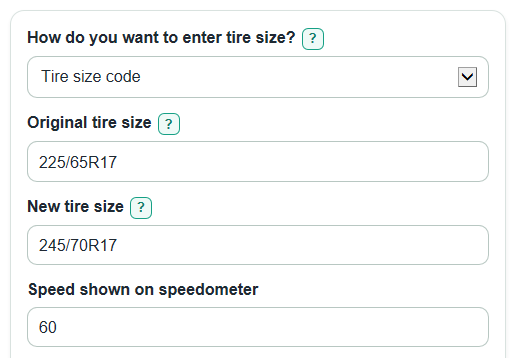
- Pick How do you want to enter tire size? based on what you have: Tire size code for sidewall codes like 225/65R17, or Measured tire diameter for known outside diameters.
- Enter Original tire size and New tire size, or enter Original tire diameter and New tire diameter if you chose measured diameter mode.
- Enter Speed shown on speedometer, choose Speed unit, and open Advanced options only if you have Known speedometer bias before tire change or an Odometer or trip distance shown.
- Select Calculate, then read True road speed first and Speedometer error next; positive error means you are going faster than the dash says.
- Sanity-check the result by comparing Original tire diameter and New tire diameter: a larger new tire should usually make True road speed higher than the shown speed when bias is 0.
Definitions
Tire size code: A sidewall code such as 225/65R17 or 33x12.50R15.
Width: In a metric tire code, the first number is tire width in millimeters.
Aspect ratio: In a metric tire code, the middle number is sidewall height as a percent of width.
Rim size: The wheel diameter in inches, such as 17 in 225/65R17.
Original tire diameter: The outside diameter of the factory tire, in inches.
New tire diameter: The outside diameter of the replacement tire, in inches.
Speed shown on speedometer: The speed displayed by the vehicle's dash speedometer.
Speedometer error: True road speed minus the speed shown on speedometer, written as a percent of the shown speed.
Known speedometer bias before tire change: A correction from a GPS or measured test before changing tires; positive means true speed was higher than shown.
Odometer or trip distance shown: The distance your vehicle displayed; an odometer records distance traveled [3].
Common mistakes and quick fixes
Mistake: Leaving How do you want to enter tire size? on Tire size code, then typing a diameter like 28.5 into Original tire size.
Fix: Change How do you want to enter tire size? to Measured tire diameter, then use Original tire diameter and New tire diameter.
Mistake: Entering wheel rim size as Original tire diameter, such as 17 for a 225/65R17 tire.
Fix: Use the full outside tire diameter in Original tire diameter, or use Original tire size so the calculator can estimate it.
Mistake: Typing an unreadable New tire size, such as 225R17 with no aspect ratio.
Fix: Enter a complete code like 225/65R17, LT265/70R17, or 33x12.50R15.
Mistake: Reversing the sign for Known speedometer bias before tire change.
Fix: Enter a positive number if true speed was higher than the dash, and a negative number if true speed was lower than the dash.
Mistake: Mixing units by choosing Speed unit as mph but entering Odometer or trip distance shown in kilometers.
Fix: Use miles with mph and kilometers with km/h.
Mistake: Reading Speedometer error backwards.
Fix: Positive Speedometer error means True road speed is higher than the dash speed; negative means it is lower.
Limitations & Key Assumptions / Boundary Conditions
- Tire size code entry uses nominal tire size math. Real rolling diameter can change with tire model, pressure, vehicle load, tread depth, and wear.
- Measured tire diameter mode is only as accurate as the Original tire diameter and New tire diameter you enter.
- Known speedometer bias before tire change should come from a real GPS or measured comparison on the original tire setup. Guessing can make the correction worse.
- The calculator estimates speedometer and odometer effects only. It does not check tire fitment, ABS or traction-control calibration, gearing, inspection rules, or legal compliance.
- Use consistent distance units: miles with mph and kilometers with km/h. The Speed unit controls the labels for true speed and distance.
- Large tire changes should be checked against vehicle maker guidance or a qualified tire shop before driving.
Methodology
How tire diameter is found
For a metric tire code, the first number is width in millimeters, the middle number is aspect ratio, and the last number is rim diameter in inches. The calculator first finds one sidewall height, converts it to inches, then adds two sidewalls to the rim size.
sidewall_in = (width_mm * aspect_percent / 100) / 25.4
diameter_in = rim_in + 2 * sidewall_in
For a flotation size such as 33x12.50R15, the first number is used as the nominal outside tire diameter in inches.
diameter_in = first_number_in_code
How speed and distance are corrected
The calculator compares new tire diameter with original tire diameter. Diameter ratio is enough because tire circumference changes by the same ratio as diameter.
tire_ratio = new_diameter_in / original_diameter_in
If Known speedometer bias before tire change is blank, it is treated as 0 percent. If it is entered, it is combined with the tire-size change.
total_factor = (1 + stock_speed_bias_percent / 100) * tire_ratio
actual_speed = indicated_speed * total_factor
speed_error_percent = (total_factor - 1) * 100
diameter_change_percent = (tire_ratio - 1) * 100
actual_distance = odometer_shown_distance * total_factor
Quick speed checks use the same total_factor for common dash speeds in the selected Speed unit.
Worked example
With Original tire size 225/65R17, New tire size 245/70R17, Speed shown on speedometer 60 mph, and Known speedometer bias before tire change 0 percent, the original diameter is about 28.5157 inches and the new diameter is about 30.5039 inches. The tire ratio is about 1.06972, so True road speed is 60 * 1.06972 = 64.18 mph. Speedometer error is +6.97 percent, meaning the vehicle is moving faster than the dash says. If Odometer or trip distance shown is 100 miles, the true distance is about 106.97 miles.
How to read the sign
A positive Speedometer error means True road speed is higher than the speed shown on speedometer. A negative Speedometer error means True road speed is lower than the speed shown on speedometer. Tire diameter change shows only the tire-size effect before any known stock bias is added.