
Enter a tire sidewall code to find its overall diameter, width, sidewall height, circumference, and revolutions per mile, then compare another tire if needed.
Advanced options
Calculation details
Table of contents
How to use our Tire Size Calculator
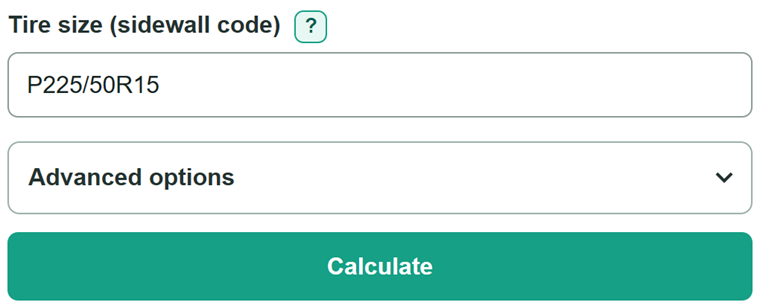
- Enter the complete code from the current tire sidewall in Tire size, such as 225/45R17, P225/50R15, or 31x10.50R15.
- Click Calculate to see the tire's overall diameter and other calculated dimensions.
- To check a possible replacement, open Advanced options and enter its full code in Comparison tire size.
- Enter the dashboard reading in Speedometer reads (mph), or leave it blank to check the comparison at 60 mph.
- Sanity-check the comparison: a positive Overall diameter change means the replacement is larger, so estimated actual speed should be higher than the dashboard reading.
Definitions
Tire size: The code printed on a tire sidewall, such as 225/45R17 or 31x10.50R15.
Section width: The tire's nominal widest width. Metric codes give it in millimeters; flotation codes give it in inches.
Aspect ratio: The height of one sidewall as a percentage of section width. In 225/45R17, it is 45%.
Rim diameter: The wheel diameter in inches shown after the R in a radial tire code.
Flotation size: A code such as 31x10.50R15 that gives nominal overall diameter, nominal width, and rim diameter in inches.
Revolutions per mile: The theoretical number of tire turns in one mile. A larger tire has fewer revolutions per mile.
Indicated speed: The speed shown on the dashboard before a tire-diameter change is considered.
Common mistakes and quick fixes
Mistake: Entering an incomplete code such as 225/45-17.
Fix: Check Tire size and then recalculate. Include the radial R marker, as in 225/45R17.
Mistake: Reading the 45 in 225/45R17 as a sidewall height in millimeters.
Fix: Check Tire size and then recalculate. It is an aspect ratio. The sidewall height is 45% of the 225 mm section width.
Mistake: Putting the possible replacement in Tire size and the current tire in Comparison tire size.
Fix: Enter the current, calibrated tire first. Enter the possible replacement as the comparison tire.
Mistake: Reading a positive diameter change as a smaller tire.
Fix: Check Tire size and then recalculate. A positive change means the comparison tire is larger. A negative change means it is smaller.
Mistake: Using a negative dashboard speed.
Fix: Check Tire size and then recalculate. Enter 0 mph or more. Leave the field blank to use 60 mph when comparing tires.
Mistake: Treating the clearance estimate as proof that a tire will fit.
Fix: Check Tire size and then recalculate. Check actual tire specifications and vehicle clearance, wheel, load, and speed requirements before purchase or installation.
Limitations & Key Assumptions / Boundary Conditions
- Results use nominal tire-code geometry. Actual mounted dimensions can vary by tire model, wheel width, load, inflation pressure, tread wear, and measurement method.
- Speed and distance estimates assume the speedometer and odometer remain calibrated for the tire entered as Tire size.
- Estimated ground-clearance change is half of the diameter difference. It does not check clearance at fenders, suspension, brakes, steering, or wheels.
- A calculated size match does not confirm wheel fit, bolt pattern, load capacity, speed rating, recommended pressure, drivetrain compatibility, or vehicle approval.
- The calculator accepts complete radial metric codes with optional P or LT prefixes and flotation codes such as 31x10.50R15. It does not calculate non-radial, temporary-spare, or incomplete codes.
Methodology
Reading the tire code
A metric radial code has section width, aspect ratio, and rim diameter. In 225/45R17, the width is 225 mm, the sidewall height is 45% of that width, and the rim diameter is 17 in. A flotation code such as 31x10.50R15 gives nominal overall diameter, width, and rim diameter in inches.
Single-tire calculations
sidewall height (mm) = width (mm) x aspect ratio / 100
overall diameter (in) = (2 x sidewall height (mm) + rim diameter (in) x 25.4) / 25.4
circumference (in) = π x overall diameter (in)
revolutions per mile = 63,360 / circumference (in)
The calculator uses 25.4 mm per inch and 63,360 inches per mile. It keeps unrounded values during the calculation, then rounds the displayed results.
Comparison calculations
diameter change (%) = (comparison diameter / current diameter - 1) x 100
ground-clearance change (in) = (comparison diameter - current diameter) / 2
actual speed (mph) = indicated speed (mph) x comparison diameter / current diameter
distance per 100 indicated miles = 100 x comparison diameter / current diameter
For example, P225/50R15 has a sidewall height of 112.5 mm because 225 x 50 / 100 = 112.5. Its calculated overall diameter is about 23.858 in, circumference is about 74.953 in, and revolutions per mile are about 845.3.