
Compare all-weather tires with winter and non-winter tire sets using your mileage, tire quotes, wheel setup, and seasonal service costs.
Tire set quotes and usable life
Seasonal setup
Advanced options
Calculation details
Table of contents
How to use our Winter vs All-Weather Tires Lifetime Cost Calculator
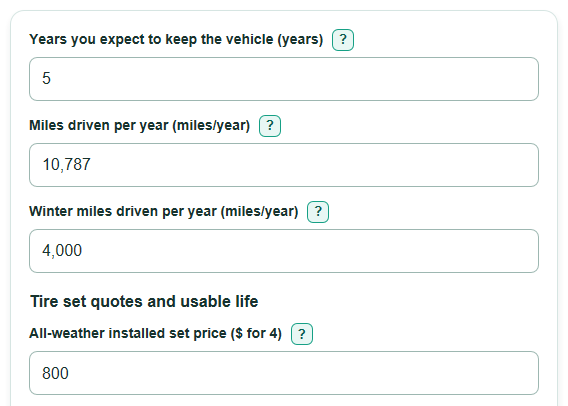
- Enter the Years you expect to keep the vehicle, Miles driven per year, and Winter miles driven per year. Winter miles must be included in annual miles.
- Copy set-of-four installed quotes and usable mileage into the all-weather, winter, and non-winter tire fields. Use the miles driven on each tire set, not a calendar estimate.
- Choose How will the seasonal tires be changed?. Enter the matching service quote for either the same wheels or dedicated winter wheels.
- Open Advanced options only if you pay for storage or expect a changeover schedule other than two visits per year.
- Click Calculate, then compare the lifetime savings with both cash-cost totals. Sanity-check that the calculated non-winter miles per year equals your annual miles minus winter miles.
Definitions
All-weather tires: One tire set used through the full year in this comparison.
Winter plus non-winter tires: Two separate tire sets, with winter tires used only for the entered winter miles and a companion set used for the remaining miles.
Usable life: The miles you expect a tire set to provide before replacement. It is a planning input, not a guaranteed replacement date.
Same-wheel changeover: A service where tires are removed from and mounted onto the same four wheels.
Complete wheel swap: A service where complete wheel-and-tire assemblies are exchanged.
Wear-based break-even: The estimated time and distance needed for lower seasonal running costs to recover the dedicated winter wheel purchase. It uses proportional tire wear, not whole replacement-set timing.
Common mistakes and quick fixes
Mistake: Entering a per-tire amount in All-weather installed set price.
Fix: Enter the installed price for all four tires, not the price of one tire.
Mistake: Making Winter miles driven per year larger than Miles driven per year.
Fix: Winter miles are part of annual driving. Reduce Winter miles driven per year or correct Miles driven per year.
Mistake: Using total vehicle miles for Winter tire usable life.
Fix: Enter the miles driven while the winter tire set is installed.
Mistake: Entering a same-wheel remounting quote in Complete wheel swap price.
Fix: Match the price field to How will the seasonal tires be changed? A complete wheel swap uses mounted wheel-and-tire assemblies.
Mistake: Adding storage costs to Off-season storage price when tires are stored at home.
Fix: Leave Off-season storage price blank or enter 0 when there is no direct storage charge.
Mistake: Reading a negative Lifetime savings with all-weather tires as an error.
Fix: A negative amount means the winter plus non-winter strategy has the lower calculated cash cost.
Limitations & Key Assumptions / Boundary Conditions
- The model compares only the listed tire, wheel, changeover, and storage costs. It excludes fuel, repairs, rotations, taxes, disposal fees, rebates, road-hazard plans, and other vehicle costs.
- Each tire price must be an installed set-of-four quote. Mixing per-tire prices, installation charges, or fees already included in a quote can double count costs.
- Whole tire replacement sets are counted with rounding up. A set is purchased when the calculated mileage needs another full set, so cash costs can change suddenly at a replacement point.
- The break-even result uses steady yearly driving and proportional tread wear. It can differ from the cash-cost crossover because cash costs use whole replacement sets.
- Usable life and mileage warranties are planning estimates. Actual replacement timing can change with wear, alignment, inflation, road conditions, damage, and the tire maker's warranty terms.
- A positive storage price requires a positive paid storage frequency. Blank or zero storage cost is treated as no direct storage charge.
- When winter miles are 0 or equal all annual miles, only one seasonal tire type is used. Changeover, storage, and dedicated-wheel costs are then excluded because there is no two-set seasonal swap.
Methodology
How the cost comparison works
The calculator first splits yearly driving into winter and non-winter miles. The 10,787-mile default is a 2024 US light-duty vehicle planning estimate; replace it with your own records when possible. [1]
Non-winter miles per year = Miles driven per year - Winter miles driven per year
Total ownership miles = Miles driven per year x Years you expect to keep the vehicle
For each tire type, the calculator divides miles driven on that set by its usable life and rounds up to a whole set. A partial need still requires buying a full replacement set.
All-weather sets needed = ceil(Total ownership miles / All-weather usable life)
Winter sets needed = ceil(Winter miles over ownership period / Winter tire usable life)
Non-winter sets needed = ceil(Non-winter miles over ownership period / Non-winter tire usable life)
The seasonal total includes the tire sets actually used. Changeover service, optional storage, and a dedicated winter wheel purchase are included only when both winter and non-winter miles are greater than 0; otherwise there is no two-set seasonal swap.
Seasonal setup costs = 0 when winter miles = 0 or non-winter miles = 0
Lifetime savings with all-weather tires = Winter plus non-winter cash cost - All-weather cash cost
A positive savings value means all-weather tires cost less. A negative value means the seasonal strategy costs less.
Break-even calculation
The break-even estimate compares proportional yearly tire wear plus yearly seasonal service and storage. It uses the dedicated wheel price as the starting cost to recover. If seasonal yearly running cost is not lower than all-weather yearly wear cost, no break-even is shown.
Break-even years = Dedicated winter wheel set price / (All-weather yearly wear cost - Seasonal yearly running cost)
Break-even miles = Break-even years x Miles driven per year
Mini-example
For 5 years at 12,000 miles per year, with 4,000 winter miles per year, an $800 all-weather set lasting 60,000 miles needs one set and costs $800. With the example seasonal quotes, one $700 winter set, one $600 non-winter set, and $100 changeovers twice yearly cost $2,300. The calculated all-weather savings is $1,500.