
Compare two tire sizes to estimate speedometer error, tire height change, ride height change, odometer shift, and fitment clues.
Table of contents
How to use our Tire Size Comparison Calculator
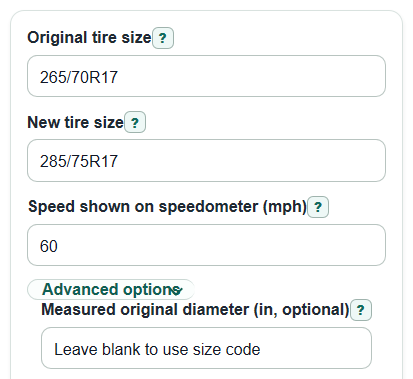
- Enter the Original tire size exactly like the sidewall or listing shows it, such as 265/70R17 or 31x10.50R15.
- Enter the New tire size, then type the Speed shown on speedometer you want to check.
- Open Advanced options only if you have a Measured original diameter, Measured new diameter, or an Odometer distance shown to compare.
- Click Calculate and read Real speed at that dashboard reading first, then check Tire height change, Ride height change, and Tire width change.
- Sanity-check the result: a taller New tire size should usually raise Real speed at that dashboard reading and lower tire turns per mile.
Definitions
Original tire size: The tire size currently on the vehicle, used as the baseline for all changes.
New tire size: The replacement tire size you want to compare against the original.
Metric tire size: A size like 265/70R17. The first number is width in millimeters, the second is aspect ratio, and the last number is rim diameter in inches.
Flotation tire size: A size like 33x12.50R15. It gives overall tire diameter in inches, tire width in inches, and rim diameter in inches.
Aspect ratio: The sidewall height as a percent of the tire width. A 70 aspect ratio means the sidewall height is 70 percent of the tire width.
Measured diameter: A real or manufacturer-listed tire diameter in inches. When entered, it replaces the sidewall-code diameter for speed, odometer, revs per mile, and ride-height math.
Tire turns per mile: The estimated number of tire rotations needed to travel one mile. Taller tires turn fewer times per mile.
Speedometer change: Real speed minus the dashboard speed. A positive value means the vehicle is moving faster than the speedometer shows.
Ride height change: Half of the tire height change, because the axle sits one tire radius above the ground.
Common mistakes and quick fixes
Mistake: Typing an unclear Original tire size, such as only 265 or 17.
Fix: Enter the full Original tire size, such as 265/70R17 or 31x10.50R15.
Mistake: Putting the vehicle's actual road speed into Speed shown on speedometer.
Fix: Use the dashboard reading for Speed shown on speedometer; the calculator estimates Real speed at that dashboard reading.
Mistake: Entering a Measured new diameter that is from a different tire model or not mounted the same way.
Fix: Use Measured new diameter only when it comes from the tire maker's spec or your mounted tire measurement.
Mistake: Comparing Tire height change but ignoring Tire width change.
Fix: Check Tire width change too, because a wider tire may rub even when the height looks acceptable.
Mistake: Treating Fitment reminder as proof that the New tire size will fit.
Fix: Use Fitment reminder as a checklist prompt, then confirm clearance, wheel width range, load rating, and vehicle guidance.
Limitations & Key Assumptions / Boundary Conditions
- The calculator estimates tire geometry from size codes and optional measured diameters. It does not prove the tire will fit your vehicle.
- Actual mounted diameter can differ from the sidewall code because of tire model, tread depth, air pressure, load, wheel width, and measuring method.
- Measured original diameter and Measured new diameter affect diameter, circumference, speed, odometer, tire turns per mile, and ride height. Tire width change and sidewall height change still come from the size code.
- Speedometer and odometer estimates assume the vehicle was calibrated for the Original tire size and that no recalibration was done after the tire change.
- Fitment also depends on wheel offset, wheel width, suspension travel, steering angle, fender clearance, brake clearance, load rating, and speed rating.
- Negative changes are valid. A negative Tire height change, Ride height change, Tire width change, or Speedometer change means the new tire is smaller, lower, narrower, or slower than the original baseline.
Methodology
How the tire code is read
For a metric size such as 265/70R17, the calculator reads 265 as width in millimeters, 70 as aspect ratio percent, and 17 as rim diameter in inches. Common prefixes such as P, LT, ST, and T are accepted, but they do not change the geometry math.
sidewall_in = width_mm * (aspect_percent / 100) / 25.4
diameter_in = rim_in + 2 * sidewall_in
For a flotation size such as 33x12.50R15, the calculator reads 33 as overall diameter in inches, 12.50 as tire width in inches, and 15 as rim diameter in inches.
sidewall_in = (diameter_in - rim_in) / 2
Size changes
The calculator compares the new tire to the original tire. Negative values are kept because a smaller replacement tire is a real result, not an error.
diameter_change_in = new_diameter_in - original_diameter_in
diameter_change_percent = (new_diameter_in / original_diameter_in - 1) * 100
ride_height_change_in = diameter_change_in / 2
Speed, odometer, and tire turns
Circumference is based on the tire diameter used for the calculation. If a measured diameter is entered for either tire, that measured value is used for circumference, speed, odometer distance, tire turns per mile, and ride height for that tire.
circumference_in = pi * diameter_in
revs_per_mile = 63360 / circumference_in
actual_speed_mph = speed_shown_mph * (new_circumference_in / original_circumference_in)
speed_error_mph = actual_speed_mph - speed_shown_mph
odometer_actual_miles = odometer_shown_miles * (new_circumference_in / original_circumference_in)
Mini-example
With an Original tire size of 265/70R17 and a New tire size of 285/75R17, the original calculated diameter is about 31.61 in and the new calculated diameter is about 33.83 in. At a Speed shown on speedometer of 60 mph, the estimated Real speed at that dashboard reading is about 64.22 mph, so the Speedometer change is about +4.22 mph. The Tire height change is about +2.22 in, so the Ride height change is about +1.11 in.