
Enter moles or solute mass, then the final solution volume, to calculate molarity in M (mol/L) and mM.
Table of contents
How to use our Molarity Calculator
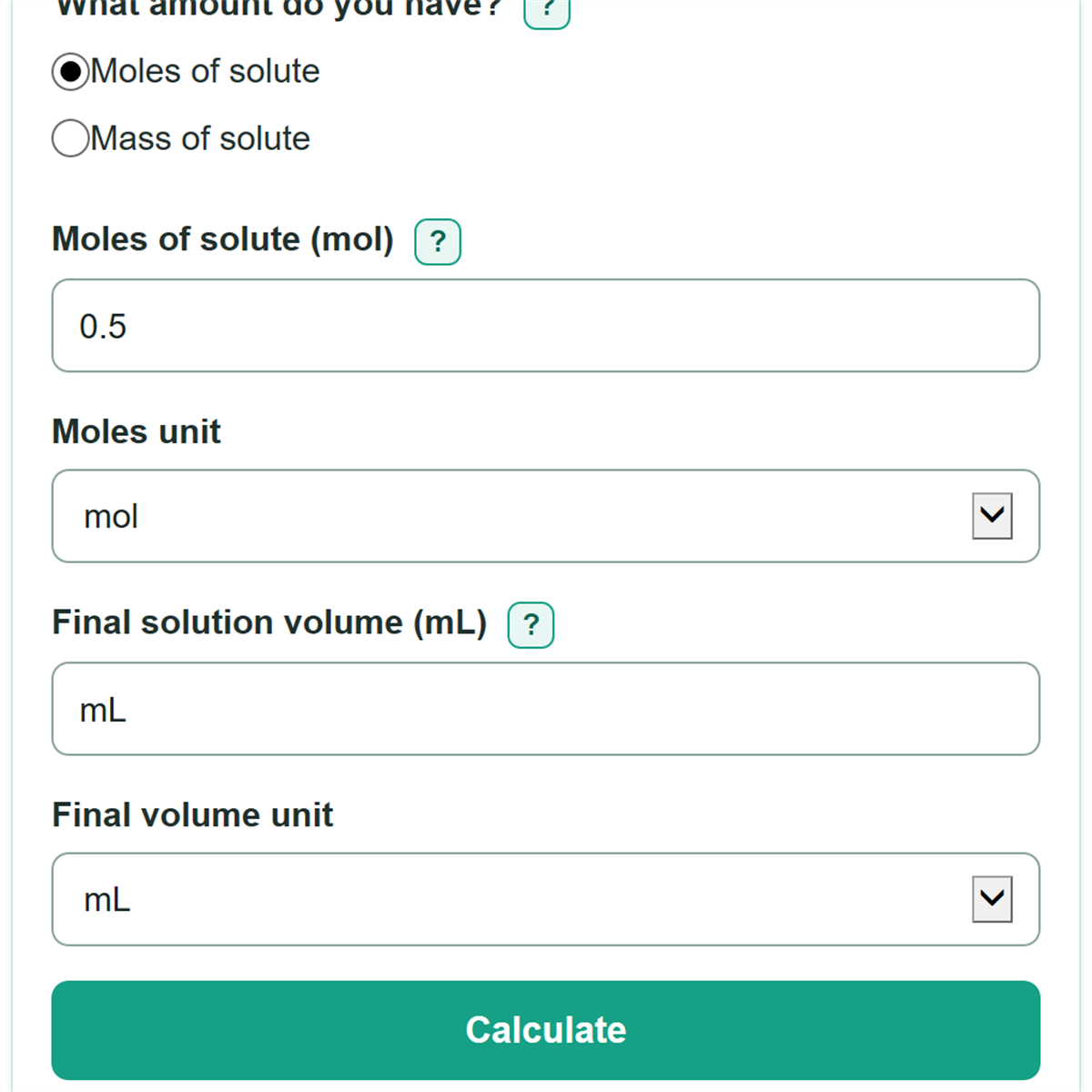
- Choose "Moles of solute" when your problem or lab record gives mol, mmol, or umol. Choose "Mass of solute" when you weighed the material.
- For the mass choice, enter the net solute mass and the molar mass for the exact material you weighed.
- Enter the final solution volume and choose its unit. Use the total volume after dissolving the solute, not the amount of water added.
- Click "Calculate" to see the solution molarity, converted moles, converted final volume, and the calculation using your values.
- Check the answer by keeping the solute amount the same: a smaller final volume should produce a higher molarity.
Definitions
Molarity (M): The amount of solute, in moles, divided by the final solution volume in liters. M and mol/L have the same numeric value. [2]
Mole (mol): A unit for an amount of substance.
Molar mass (g/mol): The mass of one mole of a specific substance. It converts a measured mass into moles.
Final solution volume: The total volume after the solute has dissolved, not the starting solvent volume.
Millimolar (mM): One thousandth of a molar; 1 mM = 0.001 M.
Common mistakes and quick fixes
Mistake: Entering the water added instead of the final solution volume.
Fix: Check What amount do you have? and then recalculate. Enter the total volume after the solute dissolves and the solution reaches its final mark.
Mistake: Selecting mol when the given amount is in mmol or umol.
Fix: Check What amount do you have? and then recalculate. Keep the number as written and choose the unit printed with it.
Mistake: Including the container in the mass of solute.
Fix: Check What amount do you have? and then recalculate. Enter only the net mass of the weighed solute.
Mistake: Using the molar mass for an anhydrous material after weighing a hydrate.
Fix: Check What amount do you have? and then recalculate. Match the molar mass to the exact chemical form on the reagent label or in the stated formula.
Mistake: Treating the mM value as a different concentration from the M value.
Fix: Check What amount do you have? and then recalculate. They are the same concentration in different units: 1 M equals 1,000 mM.
Limitations & Key Assumptions / Boundary Conditions
- The calculation uses the final solution volume you enter. It does not estimate volume changes caused by dissolving a solute.
- For the mass path, the molar mass must match the exact reagent form weighed, including a hydrate or salt form when applicable.
- The calculator converts mol, mmol, umol, g, mg, ug, L, mL, and uL, but it does not identify a chemical formula or check reagent purity.
- Solute amount, molar mass, and final solution volume must be greater than zero for a positive molarity calculation.
- Displayed values are rounded for reading. Report a lab result with precision that fits the measurements used.
Methodology
Calculation method
Molarity is the amount of dissolved solute in moles divided by the final solution volume in liters. [2]
M = moles of solute (mol) / final solution volume (L)
For a mass entry, the calculator first converts the entered mass to grams when needed, then divides by molar mass to find moles.
moles of solute = solute mass (g) / molar mass (g/mol)
Milli means one thousandth and micro means one millionth, so the calculator converts mmol, mg, and mL by 0.001 and umol, ug, and uL by 0.000001. [1]
concentration (mM) = molarity (M) x 1000
Worked example
If 5.844 g of a substance with a molar mass of 58.44 g/mol is made into 500 mL of final solution, the amount is 0.1 mol and the final volume is 0.5 L.
M = 0.1 mol / 0.5 L = 0.2 M
The same concentration is 200 mM.