
Enter two known values to find weight force, mass, or gravitational acceleration with the correct units.
Advanced options
This is a mathematical outcome, not an input error.
Table of contents
How to use our Weight Calculator
- Select the missing quantity in "What do you want to find?".
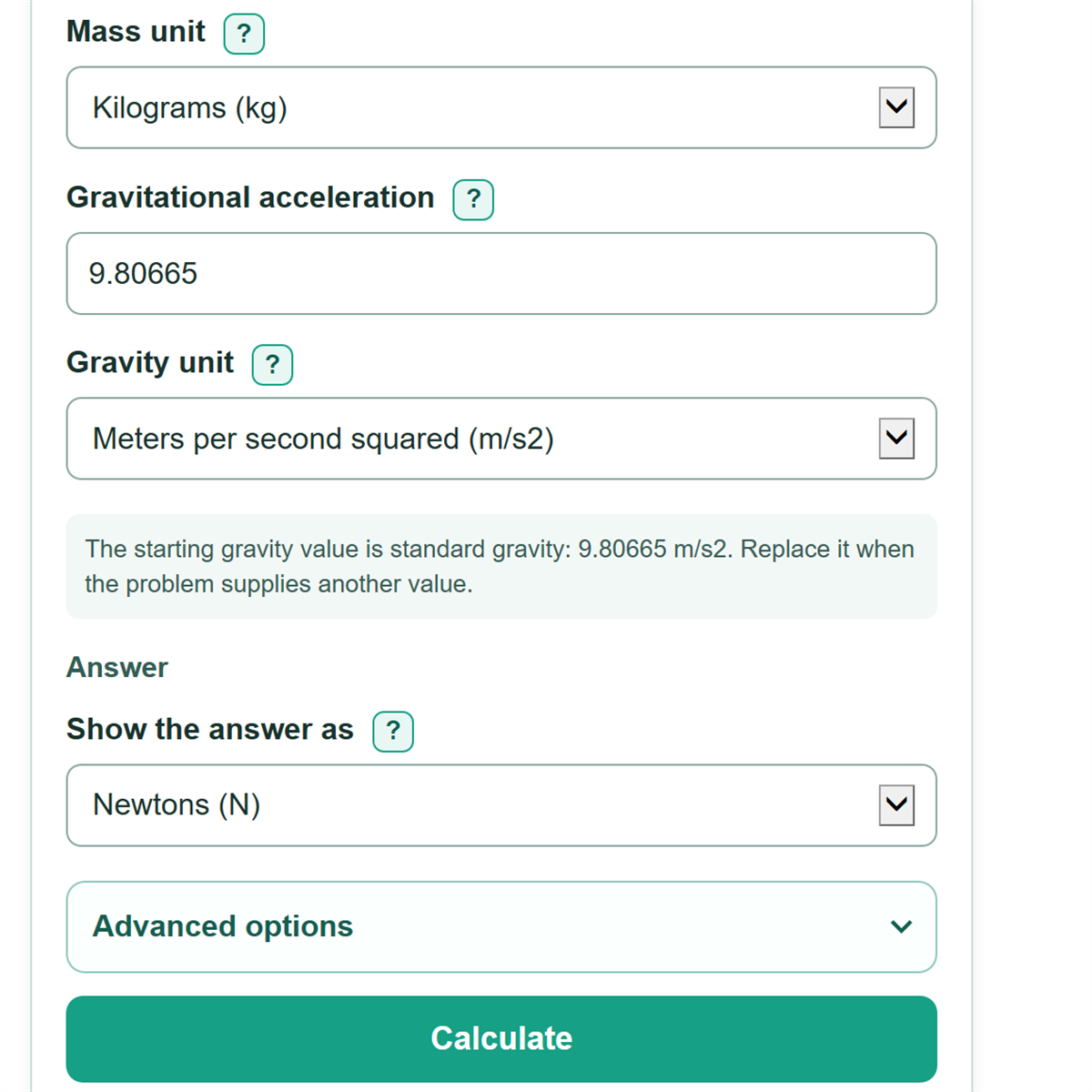
- Enter the two visible known quantities and select the unit printed in your problem, lab record, or specification.
- For a calculation using mass and gravity, keep 9.80665 m/s2 for standard gravity or replace it with the acceleration stated in the problem.
- Choose the requested unit in "Show the answer as" and select "Calculate".
- Check the supporting SI values: weight force in newtons should equal mass in kilograms multiplied by gravitational acceleration in meters per second squared.
Definitions
Mass: The amount of matter in an object. This calculator accepts kilograms (kg) and pound-mass (lbm).
Weight force: The force of gravity acting on a mass. It is measured in newtons (N) or pound-force (lbf).
Gravitational acceleration: The acceleration caused by gravity, measured in meters per second squared (m/s2) or feet per second squared (ft/s2).
Standard gravity: The conventional reference value of 9.80665 m/s2 used as the starting gravity value. [1]
Significant figures: The meaningful digits shown in a measured or calculated value. This setting changes only the displayed rounding.
Common mistakes and quick fixes
Mistake: Entering kilograms as a weight force.
Fix: Enter kilograms or pound-mass in "Mass". Enter newtons or pound-force in "Weight force".
Mistake: Treating lbm and lbf as the same unit.
Fix: Select "Pound-mass (lbm)" for mass and "Pound-force (lbf)" for force. They measure different physical quantities.
Mistake: Using standard gravity when the problem gives another acceleration.
Fix: Replace "Gravitational acceleration" with the value and unit stated in the problem.
Mistake: Reporting zero or infinity after dividing by zero.
Fix: Read the equation outcome. With zero mass or zero gravity, the equation may have no solution or infinitely many solutions instead of one number.
Mistake: Typing a comma as a decimal mark, such as 1,01.
Fix: Use a decimal point for decimals. Use commas only for thousands, such as 1,000.
Limitations & Key Assumptions / Boundary Conditions
- The calculator uses nonnegative magnitudes. It does not show force direction or handle vector components.
- The starting gravity value is standard gravity, not a local measurement. Replace it when a problem states a different acceleration.
- Air resistance, buoyancy, rotation, and other forces are outside the model.
- A bare pound is ambiguous. Select lbm for mass and lbf for force.
- When solving for mass with zero gravity, or gravity with zero mass, a unique numeric answer may not exist.
- Significant figures affect displayed rounding only. Follow the rounding rule required by your class, lab, or report.
Methodology
Calculation method
The calculator converts entered values to kilograms, newtons, and meters per second squared before solving the requested form of the same equation. The starting gravity value is standard gravity, 9.80665 m/s2. [1]
W = m x g
m = W / g
g = W / m
In these equations, W is weight force in newtons, m is mass in kilograms, and g is gravitational acceleration in meters per second squared. The unit conversions are 1 lbm = 0.45359237 kg, 1 lbf = 4.4482216152605 N, and 1 ft/s2 = 0.3048 m/s2.
Worked example
A 10 kg mass under standard gravity has a weight force of 98.0665 N.
W = 10 kg x 9.80665 m/s2 = 98.0665 N
Zero-value cases
Zero mass gives a valid weight force of zero for any finite gravity. When solving for gravity, zero mass with nonzero force has no solution, while zero mass with zero force has infinitely many finite gravity solutions. The same pattern applies when solving for mass with zero gravity.