
Compare a single mortgage with PMI against a piggyback loan using monthly payments and estimated sell-or-refinance cost.
Table of contents
How to use our PMI vs Piggyback Loan Calculator
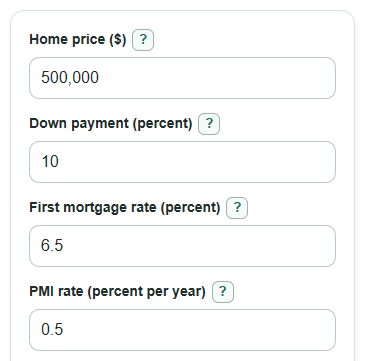
- Enter the Home price ($), Down payment (percent), First mortgage rate (percent), PMI rate (percent per year), Second loan rate (percent), and Time to compare (months).
- Open Advanced options if you need to change Loan term (months), First loan cap (percent of home price), When to stop PMI, Second loan payment style, or extra one-time costs.
- Click Calculate and read Lower cost over your time first, then check PMI option cost minus piggyback cost to see the signed dollar difference.
- Sanity-check the result by comparing Months with PMI included, PMI option balance at compare month, and Piggyback balance at compare month. A lower payment can still leave a higher balance.
- Use First-month payment difference for cash-flow planning, but use the net cost outputs for a sell-or-refinance style decision.
Definitions
PMI: Private mortgage insurance is an added cost on some conventional loans when the down payment is small. It protects the lender, not the buyer.
Piggyback loan: A setup with a main mortgage plus a second mortgage, often used so the main mortgage is near 80% of the home price and PMI can be avoided [1].
First loan cap: The largest first mortgage this calculator allows in the piggyback setup, entered as a percent of the home price.
Loan-to-price: The loan balance divided by the original home price. The PMI stop rules use 80% and 78% balance levels as simple estimates [2].
Cash paid: Monthly payments made during the comparison period plus any extra one-time costs for that option.
Net cost at compare month: Cash paid plus the remaining loan balance at the month you choose. This is meant for a sell-or-refinance comparison.
Interest-only second loan: A second loan payment style where the payment covers interest only, so the second loan balance does not go down in this estimate.
Common mistakes and quick fixes
Mistake: Typing a dollar down payment into Down payment (percent).
Fix: Enter the down payment as a percent of Home price ($), such as 10 for 10% down.
Mistake: Leaving PMI rate (percent per year) blank because you do not know the quote yet.
Fix: Enter a real estimate, or enter 0 only if the PMI option truly has no PMI charge.
Mistake: Using years in Time to compare (months).
Fix: Convert years to months, such as 60 for 5 years and 120 for 10 years.
Mistake: Setting When to stop PMI to Request at 80% balance and treating it as guaranteed.
Fix: Use it as an estimate, and compare it with Do not stop during comparison if you want a more cautious PMI cost.
Mistake: Choosing Interest-only payment for Second loan payment style when the second loan quote is a fixed payoff loan.
Fix: Choose Fixed payoff payment unless your quote says the second loan charges interest only during the comparison period.
Mistake: Looking only at Piggyback first-month payment or PMI option first-month payment.
Fix: Also compare PMI option net cost at compare month and Piggyback net cost at compare month because remaining balances matter.
Limitations & Key Assumptions / Boundary Conditions
- The calculator ignores taxes, homeowners insurance, HOA dues, escrow changes, lender fees shared by both options, tax effects, and home price changes.
- PMI cancellation is estimated from the original home price and normal amortization. Real approval can depend on loan type, payment history, property value rules, and servicer requirements.
- The piggyback setup is modeled as a closed second loan amount. Some second mortgages, such as HELOCs, can have draw rules, rate changes, or repayment phases that this calculator does not model.
- Second loan rates and PMI rates can vary by credit score, lender, occupancy, loan program, and market conditions. Use quoted rates when possible.
- If Time to compare (months) is longer than Loan term (months), payoff math is capped at the loan term.
- The net cost comparison assumes both choices buy the same home at the same price, so home value is not added to either side.
Methodology
How the loans are built
The calculator first turns the down payment percent into dollars, then builds two borrowing setups: one single mortgage with PMI and one piggyback setup with a first loan and possible second loan.
down_payment = home_price * down_payment_percent / 100
single_loan = home_price - down_payment
first_loan = min(single_loan, home_price * first_ltv_limit_percent / 100)
second_loan = single_loan - first_loan
The default First loan cap (percent of home price) is 80, matching the common 80/10/10 piggyback idea described by the CFPB [1].
Monthly payments and balances
Each fixed-payment loan uses the standard amortizing loan payment formula. The monthly rate is the annual percent rate divided by 100 and then divided by 12.
payment = principal * monthly_rate / (1 - (1 + monthly_rate)^(-term_months))
if monthly_rate = 0, payment = principal / term_months
Remaining balance is calculated after the number of months being compared. The calculator uses the smaller of Time to compare (months) and Loan term (months).
balance_m = principal * (1 + monthly_rate)^m - payment * (((1 + monthly_rate)^m - 1) / monthly_rate)
if monthly_rate = 0, balance_m = max(0, principal - payment * m)
If Second loan payment style is Interest-only payment, the second loan payment is interest only and the second loan balance is kept unchanged during the comparison period.
second_payment = second_loan * second_monthly_rate
PMI cost and stopping rule
PMI is estimated as a yearly percent of the single loan amount. If the single loan is 80% or less of the home price, the PMI monthly cost is set to 0.
pmi_monthly = single_loan * pmi_rate_percent / 100 / 12
For Request at 80% balance or Automatic at 78% balance, the calculator checks each month for the first time the remaining single-loan balance is at or below the selected threshold. The 80% and 78% thresholds follow common PMI cancellation concepts described by the CFPB [2].
pmi_months_charged = compare_months_used when stop rule is keep_full
otherwise, pmi_months_charged = first month k where balance_k <= home_price * threshold_percent / 100
Net cost comparison
Cash paid counts monthly payments during the comparison period plus any option-specific one-time costs. Net cost then adds the remaining loan balance, because a buyer who sells or refinances would still need to deal with that balance.
pmi_cash_paid = single_pi_payment * compare_months_used + pmi_monthly * pmi_months_charged + pmi_one_time_cost
piggyback_cash_paid = (first_payment + second_payment) * compare_months_used + piggyback_one_time_cost
pmi_option_net_cost = pmi_cash_paid + remaining_balance_single
piggyback_option_net_cost = piggyback_cash_paid + remaining_balance_first + remaining_balance_second
pmi_minus_piggyback_net_cost = pmi_option_net_cost - piggyback_option_net_cost
A positive PMI option cost minus piggyback cost means the PMI option costs more. A negative number means the PMI option costs less.
Mini-example
With a $500,000 home, 10% down, a 6.5% first mortgage rate, a 0.5% yearly PMI rate, an 8.5% second loan rate, 360-month terms, a 60-month comparison, an 80% first loan cap, and fixed payoff payments, the single loan is $450,000. The piggyback setup is $400,000 on the first loan and $50,000 on the second loan.
In that example, the PMI option first-month payment is about $3,031.81 and the piggyback first-month payment is about $2,912.73. After 60 months, the PMI option net cost is about $603,157.76 and the piggyback net cost is about $596,952.77, so the PMI option costs about $6,204.99 more in this estimate.
Sources
- What is a "piggyback" second mortgage? | Consumer Financial Protection Bureau - Consumerfinance
- When can I remove private mortgage insurance (PMI) from my loan? | Consumer Financial Protection Bureau - Consumerfinance
- What is a second mortgage loan or "junior-lien"? | Consumer Financial Protection Bureau - Consumerfinance