
Check whether your conventional PMI may be ready for removal and compare the original-value and current-value routes.
Table of contents
How to use our PMI Removal Calculator
- Choose your Mortgage type first. If it is not a conventional loan with borrower-paid PMI, use the result as a prompt to call your servicer instead of assuming these PMI rules apply.
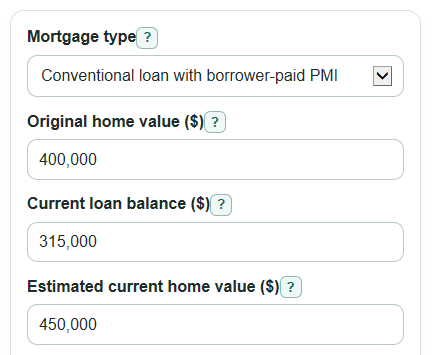
- Enter Original home value, Current loan balance, Estimated current home value, Loan age, Recent payment history, and Monthly PMI payment from your mortgage statement or loan documents.
- Open Advanced options if you want to set Property type, explain Why current value may be higher, add a Planned extra principal payment, or estimate an appraisal fee.
- Click Calculate and read Best route to check first before the dollar gaps. A negative gap means you are already past that target, while a positive gap means more paydown or value may be needed.
- Sanity-check the result by comparing Loan-to-value using original value with Loan-to-value using estimated current value. If the current value estimate is only a guess, treat the appraisal route as less certain.
Definitions
PMI: Private mortgage insurance, a charge on many conventional loans when the loan balance is high compared with the home value.
Original home value: The property value used when the mortgage started. It is often the lower of the purchase price or closing appraisal, depending on the loan documents.
Current loan balance: The unpaid principal balance on the mortgage. It does not include escrow, unpaid interest, or payoff fees.
Loan-to-value: The loan balance divided by the home value, shown as a percent. Lower loan-to-value means more equity.
Original-value request route: A PMI cancellation path that compares the loan balance with 80% of the original home value for covered conventional loans [1].
Current-value appraisal route: A PMI removal path that compares the balance with a current property value, often using servicer rules for loan age, property type, and improvements [3].
Appraisal fee payback: The valuation fee divided by the Monthly PMI payment. It estimates how many months of PMI equal the fee.
Common mistakes and quick fixes
Mistake: Using today's home estimate for Original home value.
Fix: For Original home value, use the value from when the loan started, usually from the closing appraisal or purchase documents.
Mistake: Entering a payoff quote in Current loan balance.
Fix: For Current loan balance, enter the unpaid principal balance, not interest, escrow, or payoff fees.
Mistake: Treating Estimated current home value as the number your servicer must accept.
Fix: Use Estimated current home value as a planning number only, because the servicer may require its own valuation.
Mistake: Leaving Recent payment history as good when you had a recent late payment.
Fix: Set Recent payment history to Recent late payment or Not sure so the Best route to check first warns you to confirm timing.
Mistake: Entering a Planned extra principal payment that is bigger than Current loan balance.
Fix: Keep Planned extra principal payment at zero or a positive amount no larger than Current loan balance.
Mistake: Using total mortgage payment for Monthly PMI payment.
Fix: For Monthly PMI payment, enter only the PMI part so Possible monthly PMI savings and Months of PMI equal to valuation fee are not overstated.
Limitations & Key Assumptions / Boundary Conditions
- This calculator is built for conventional loans with borrower-paid PMI. FHA, VA, USDA, lender-paid mortgage insurance, and some older or special loans can follow different rules.
- The result is a planning estimate, not approval. Your servicer can require a written request, a good payment record, proof of no junior liens, and its own valuation.
- The 78% automatic termination mark is shown as a balance reference. Actual automatic termination is usually tied to the scheduled amortization date and being current, not only today's balance.
- The current-value route uses the loan age, Property type, and Why current value may be higher settings. If those details do not match your loan investor's rules, the appraised value needed can differ.
- Estimated current home value can be wrong. A servicer appraisal or broker price opinion may come in higher or lower than your estimate.
- Months of PMI equal to valuation fee is a simple fee divided by Monthly PMI payment. It does not include taxes, interest changes, time value of money, or any change in escrow.
Methodology
Core balance math
The calculator first subtracts any Planned extra principal payment from Current loan balance. This adjusted balance is used in every loan-to-value and gap result.
adjusted_balance = current_loan_balance - planned_extra_principal
Loan-to-value means the adjusted balance compared with a home value, shown as a percent.
ltv_original_percent = adjusted_balance / original_home_value * 100
ltv_current_percent = adjusted_balance / estimated_current_home_value * 100
Original-value route
For the borrower-requested original-value route, the calculator uses 80% of Original home value as the target balance. For the 78% automatic termination reference, it uses 78% of Original home value [1].
balance_for_80_original = 0.80 * original_home_value
original_value_request_gap = adjusted_balance - balance_for_80_original
balance_for_78_auto = 0.78 * original_home_value
A positive Principal gap for 80% original-value request means more principal paydown may be needed. A zero or negative gap means the adjusted balance is at or below that 80% target.
Current-value route
The calculator selects a current-value threshold from the Advanced options. For a one-unit primary home or second home, substantial improvements use an 80% threshold. Without that improvement setting, a loan age from 2 through 5 years uses 75%, and a loan age over 5 years uses 80%. For an investment property or 2- to 4-unit property, a loan age over 2 years uses 70% [3].
appraised_value_needed_current_path = adjusted_balance / current_value_threshold
current_value_appraisal_gap = appraised_value_needed_current_path - estimated_current_home_value
A positive Current-value appraisal gap means your Estimated current home value is below the value needed for that route. A negative gap means your estimate is above the needed value.
Savings and route choice
Possible monthly PMI savings equals the Monthly PMI payment you enter. When Monthly PMI payment is greater than zero, the calculator also estimates how many months of PMI equal the valuation fee.
appraisal_fee_payback_months = appraisal_fee / monthly_pmi
Best route to check first favors the original-value request route when Mortgage type is conventional, Recent payment history is good, and the original-value gap is zero or negative. If that does not pass, it checks whether the current-value route is supported and the current-value appraisal gap is zero or negative. If payment history is late or not sure, the math still displays, but the route text tells you that payment history may block or delay removal.
Mini-example
Suppose Original home value is $400,000, Current loan balance is $315,000, Planned extra principal payment is $0, and Estimated current home value is $450,000. The 80% original-value balance is $320,000, so the original-value gap is $315,000 - $320,000 = -$5,000. Loan-to-value using original value is 78.75%, and loan-to-value using estimated current value is 70.00%. If the loan is over 5 years old on a one-unit primary home or second home, the current-value threshold is 80%, so the appraised value needed is $315,000 / 0.80 = $393,750.