
Compare an assumable mortgage with a new mortgage, including the equity gap and any second-loan payment.
Advanced options
Loan terms
Upfront cost
Table of contents
How to use our Assumable Mortgage Savings Calculator
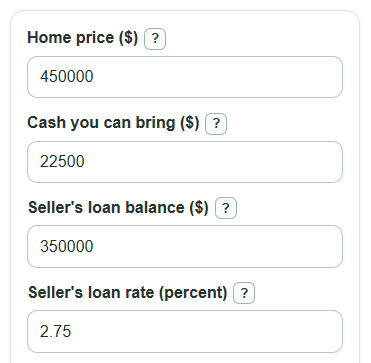
- Enter the Home price ($), Cash you can bring ($), and Seller's loan balance ($) from the deal terms you have.
- Enter the Seller's loan rate (percent), Months left on seller's loan (months), and New mortgage rate (percent).
- Open Advanced options if you want to change the New mortgage term (months), Gap loan rate (percent), Gap loan term (months), or Assumption costs paid upfront ($).
- Click Calculate and read Monthly savings with the assumable option first. A positive number means the assumable option is lower each month; a negative number means it costs more each month.
- Sanity-check the Cash gap check and Gap amount still needing financing. If the gap is large, the low seller rate may not help unless your cash or second-loan terms are realistic.
Definitions
Assumable mortgage: A home loan that a buyer may be able to take over from the seller, keeping the existing loan balance, rate, and remaining term if the lender allows it [2].
Equity gap before your cash: Home price minus the seller's loan balance. It is the seller's equity that must be covered by your cash, seller help, or other financing.
Gap amount still needing financing: The part of the equity gap left after your cash is applied. It is floored at zero because a loan amount cannot be negative.
Gap loan: A second loan used to cover the equity gap when your cash does not cover it.
Blended rate for assumed debt: A balance-weighted average of the seller's loan rate and gap loan rate. It is not APR and does not include fees.
Principal and interest: The loan payment parts that pay down the balance and pay interest. This calculator does not include taxes, insurance, HOA dues, or mortgage insurance.
Common mistakes and quick fixes
Mistake: Entering the original loan amount instead of Seller's loan balance ($).
Fix: Use the current unpaid balance from the seller's payoff statement or loan servicer estimate.
Mistake: Putting closing costs into Cash you can bring ($) when that cash is not available for the equity gap.
Fix: Enter only the cash you can apply to the purchase gap before separate closing costs.
Mistake: Using the original 30-year term for Months left on seller's loan (months).
Fix: Enter the number of payments left on the seller's existing loan.
Mistake: Leaving Gap loan rate (percent) at a low guess when Gap amount still needing financing is large.
Fix: Use a realistic second-loan quote or test a higher rate to see if the assumable option still saves money.
Mistake: Treating Total interest savings over each loan's term as a same-date payoff comparison.
Fix: Remember it compares each loan over its own term, so different terms can change the interest result.
Mistake: Ignoring Assumption costs paid upfront ($) when checking Months to earn back assumption costs.
Fix: Add expected assumption fees paid in cash so the break-even months are not too low.
Limitations & Key Assumptions / Boundary Conditions
- The results are principal and interest only. Property taxes, homeowners insurance, HOA dues, mortgage insurance, and escrow changes are not included.
- The calculator does not decide whether a lender will approve the assumption, release the seller from liability, or approve a second loan.
- costs paid upfront ($) are used only for the break-even calculation. They are not added to the loan balances.
- If Gap amount still needing financing is greater than zero, the deal may require a second loan, more cash, seller concessions, or a different purchase structure.
- Total interest savings over each loan's term compares each loan over its own term. It is not a same-month horizon or present-value comparison.
- The blended rate is a simple weighted average of balances and rates. It is not APR, and it does not include points, fees, or different payoff timing.
- Zero percent interest is allowed. Negative rates, terms under 1 month, buyer cash above the home price, and a seller loan balance above the home price are treated as input errors.
Methodology
Payment math
The calculator uses the standard fixed-payment mortgage formula for each loan. A mortgage payment is set so the loan is paid off by the end of the term, with early payments containing more interest because the balance is higher [1].
monthly_rate = annual_rate_percent / 100 / 12
payment = principal * monthly_rate / (1 - (1 + monthly_rate)^(-months))
If the annual rate is 0 percent, the payment is calculated as principal divided by months.
Loan amounts
new_loan_amount = home_price - buyer_cash
equity_gap = home_price - assumable_balance
gap_financed = max(0, equity_gap - buyer_cash)
The new mortgage uses the home price minus your cash. The assumable path keeps the seller's loan balance and adds a gap loan only if your cash does not cover the equity gap.
Side-by-side comparison
combined_assumable_payment = assumed_payment + gap_payment
monthly_savings = new_monthly_payment - combined_assumable_payment
Monthly savings is signed. Positive means the assumable option costs less per month. Negative means the assumable option costs more per month.
total_interest_savings = (new_monthly_payment * new_loan_term_months - new_loan_amount) - ((assumed_payment * assumable_months_left - assumable_balance) + (gap_payment * gap_loan_term_months - gap_financed))
blended_rate_percent = 100 * ((assumable_balance * assumable_rate_percent / 100) + (gap_financed * gap_loan_rate_percent / 100)) / (assumable_balance + gap_financed)
break_even_months = assumption_costs / monthly_savings when monthly_savings > 0, else N/A
Mini-example
Suppose the home price is $450,000, your cash is $22,500, the seller's loan balance is $350,000, the seller's rate is 2.75 percent with 300 months left, and a new mortgage rate is 6.50 percent for 360 months. The equity gap is $100,000, and $77,500 still needs financing after your cash. With an 8.50 percent gap loan for 360 months, the new mortgage payment is about $2,702.09 per month, the combined assumable payment is about $2,210.50 per month, and the monthly savings is about $491.59. If assumption costs are $2,500, the monthly-payment break-even is about 5.1 months.
Calculation choices
Money inputs are parsed after removing commas and spaces. Percent inputs are annual rates, then divided by 100 and 12 for monthly payment math. Gap loan rate and term affect the result only when the gap financed amount is greater than zero.