
Compare a new car and a used car by total cost, monthly loan payment, resale value, and loan payoff when sold.
Advanced options
Table of contents
How to use our New Car vs Used Car Calculator
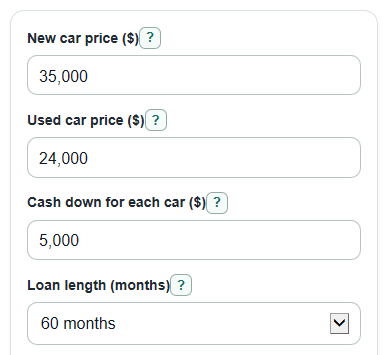
- Enter the New car price ($), Used car price ($), Cash down for each car ($), Loan length (months), both APR fields, and Time you plan to own it (years).
- Open Advanced options if you want to replace the defaults for taxes, insurance, upkeep, fuel, mpg, value loss, or exact value when sold.
- Use New car value when sold ($, optional) or Used car value when sold ($, optional) only when you have a trade-in, resale, or pricing-guide estimate.
- Click Calculate, then read Lower-cost choice first and Cost gap: new minus used next; a positive cost gap means the new car costs more.
- Sanity-check the result by comparing New car loan still owed when sold and Used car loan still owed when sold, especially if your ownership time is shorter than the loan length.
Definitions
APR: Annual percentage rate. It is the yearly borrowing cost shown as a percent and used to estimate the monthly loan payment.
Cash down: Money paid at purchase before the loan amount is set. This calculator tests the same Cash down for each car ($) against both cars.
Loan length: The number of months used to spread out the car loan payments.
Resale value: What the car may be worth when you sell or trade it later. A higher resale value lowers total cost.
Loan still owed when sold: The estimated payoff balance left on the loan at the end of your ownership time.
Cost gap: new minus used: New car total cost minus Used car total cost. Positive means the new car costs more; negative means the new car costs less.
Common mistakes and quick fixes
Mistake: Putting the down payment inside New car price ($) or Used car price ($).
Fix: Enter the negotiated price before tax and fees, then put the cash amount only in Cash down for each car ($).
Mistake: Comparing only New car loan payment and Used car loan payment.
Fix: Use New car total cost and Used car total cost because they include resale value, running costs, and any loan still owed when sold.
Mistake: Leaving New car APR (%) or Used car APR (%) blank because you have not applied for financing yet.
Fix: Enter a realistic estimate, or enter 0 only if the loan truly has no interest.
Mistake: Using monthly insurance in New car insurance ($ per year) or Used car insurance ($ per year).
Fix: Multiply the monthly quote by 12 before entering it.
Mistake: Treating New car value when sold or Used car value when sold as the original purchase price.
Fix: Enter what the car may be worth when you sell or trade it later, or leave the optional resale field blank to use the value-loss estimate.
Mistake: Ignoring New car loan still owed when sold or Used car loan still owed when sold for a short ownership plan.
Fix: If that output is above $0, remember that selling the car still requires paying off the remaining loan balance.
Limitations & Key Assumptions / Boundary Conditions
- The loan math assumes a fixed APR, equal monthly payments, and no late fees, extra payments, or refinancing.
- Taxes and required fees are estimated as a percent of price. Real title, registration, dealer, state, and local charges may not follow one flat percent.
- Insurance, upkeep and repairs, fuel price, miles driven, and mpg are estimates. Quotes and repair history can change the comparison a lot.
- Resale value is uncertain. Exact resale value inputs should come from a current trade-in offer, private-sale estimate, or pricing guide when possible.
- The value-loss estimates use smooth yearly rates. Real car values can change faster after accidents, mileage jumps, market changes, or major repairs.
- The calculator does not include rebates, warranties, financing add-ons, parking, tolls, inspection fees, electric charging, opportunity cost of cash, or income tax effects.
- If ownership time is longer than the loan length, the calculator counts payments only through the loan term and sets the remaining loan balance to $0.
Methodology
How the comparison is built
The calculator turns each car into the same set of costs: price with taxes and required fees, cash down, loan payments made before sale, loan payoff still owed at sale, insurance, upkeep, fuel, and resale value. It then subtracts the resale value because selling or trading the car gives value back.
cash_price = purchase_price * (1 + tax_fee_percent / 100)
starting_cash = min(down_payment, cash_price)
loan_principal = max(0, cash_price - starting_cash)
Loan payment and payoff
APR is converted to a monthly rate by dividing the percent by 100 and then by 12. If the APR is 0, the loan payment is the amount financed divided by the loan length. Otherwise, the calculator uses the standard fixed-payment loan formula.
monthly_rate = APR_percent / 100 / 12
if monthly_rate = 0, payment = loan_principal / loan_term_months
otherwise payment = loan_principal * monthly_rate / (1 - (1 + monthly_rate)^(-loan_term_months))
The sale-date payoff check uses the number of payments made before sale, capped at the loan length. This matters when Time you plan to own it (years) is shorter than Loan length (months).
pay_months = min(ownership_years * 12, loan_term_months)
if monthly_rate = 0, balance = max(0, loan_principal - payment * pay_months)
otherwise balance = max(0, loan_principal * (1 + monthly_rate)^pay_months - payment * (((1 + monthly_rate)^pay_months - 1) / monthly_rate))
Resale, fuel, and total cost
If an exact value when sold is entered, it replaces the value-loss estimate for that car. Otherwise, the new car uses a first-year value-loss rate followed by a later yearly rate, and the used car uses one yearly value-loss rate.
new_resale = new_price * (1 - new_year1_value_loss_percent / 100)^min(ownership_years, 1) * (1 - new_later_value_loss_percent / 100)^max(ownership_years - 1, 0)
used_resale = used_price * (1 - used_annual_value_loss_percent / 100)^ownership_years
fuel_cost = (annual_miles / mpg) * gas_price * ownership_years
payments_made = monthly_payment * pay_months
total_cost = starting_cash + payments_made + remaining_loan_balance + insurance_cost + maintenance_cost + fuel_cost - resale_value
cost_gap_new_minus_used = new_total_cost - used_total_cost
average_monthly_gap = cost_gap_new_minus_used / (ownership_years * 12)
Mini-example
With the default 5-year setup, the new car payment is about $641.77 per month and the used car payment is about $429.21 per month. Because the ownership time equals the 60-month loan length, both remaining loan balances are $0. After resale value and yearly costs are counted, the estimated totals are about $45,214.71 for the new car and $36,580.59 for the used car, so the cost gap is about $8,634.12. That means the used car is lower by about $143.90 per month on average.