
Enter your lease and purchase quotes to compare net costs over the same months and see whether leasing or buying costs less.
Lease quote
Purchase and loan offer
Advanced options
Lease mileage
Costs that differ between choices
Calculation details
Table of contents
How to use our Car Lease vs Buy Calculator
- Enter the number of months until you expect to return the lease or sell or trade the car you buy.
- Copy the monthly lease payment and other cash due at signing from the lease quote. Do not include the first monthly payment in signing cash.
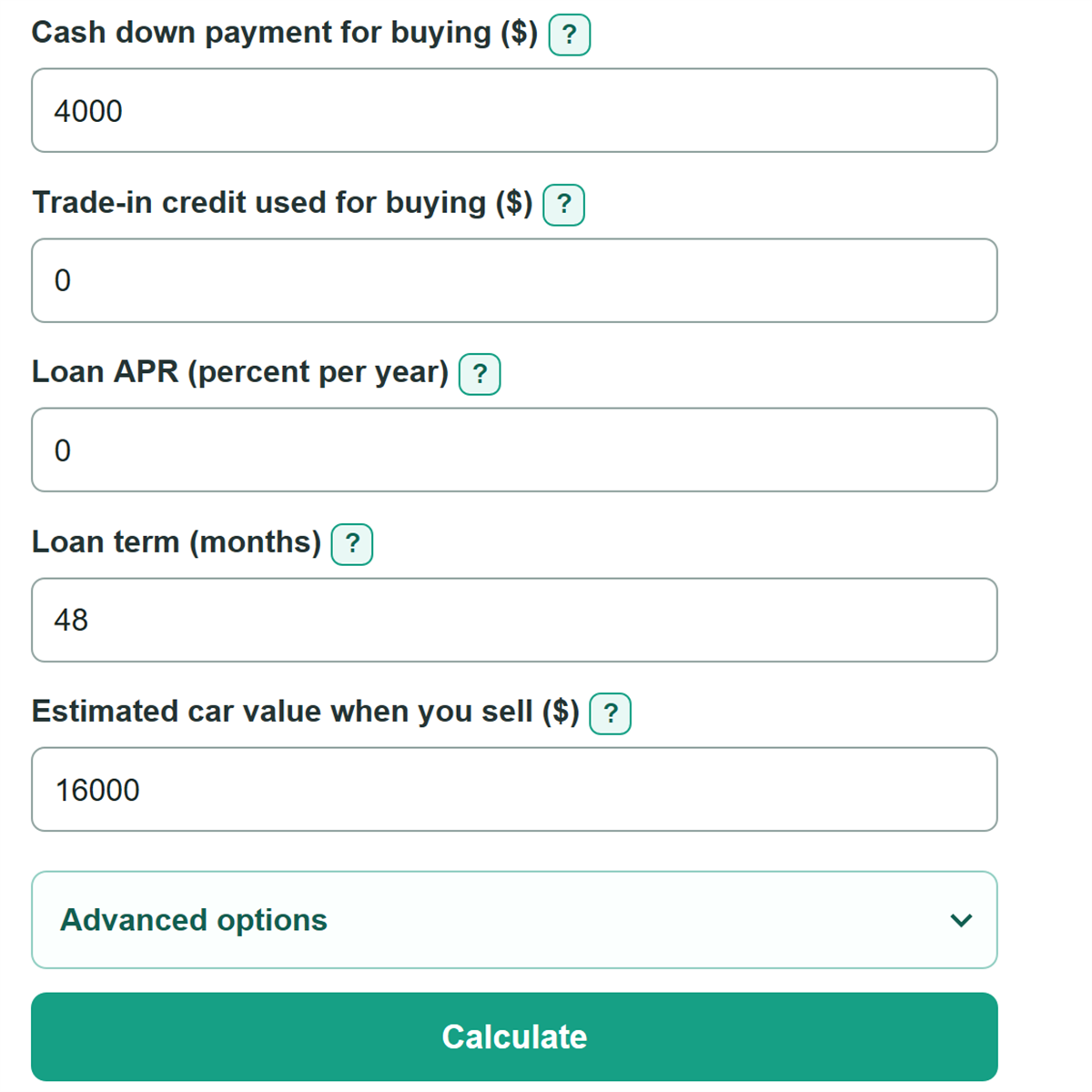
- Enter the out-the-door purchase price, cash down payment, trade-in credit, loan APR, loan term, and estimated car value at the time you plan to sell.
- Open Advanced options only if you know lease mileage, return, wear, or other costs that apply to just one choice. Then select Calculate.
- Check that both net costs cover the same number of months and review the loan balance and car equity before using the lower-cost choice to guide your decision.
Definitions
APR: Annual percentage rate. This is the yearly interest rate on the car loan. The calculator converts it to a monthly rate.
Out-the-door purchase price: The written vehicle price including taxes and required dealer or official fees.
Other cash due at signing: Lease cash paid upfront other than the first monthly payment. The first payment is counted with the regular lease payments.
Net cost: The modeled cost through the selected comparison date. For buying, the estimated car value is subtracted and any remaining loan balance is included.
Car equity: Estimated car value minus the loan balance still owed. Negative equity means the loan balance is higher than the estimated car value.
Excess mileage charge: A lease charge for driving above the annual mileage allowance, usually quoted as dollars per mile.
Common mistakes and quick fixes
Mistake: Including the first lease payment in other cash due at signing.
Fix: Check How long will you keep the car? and then recalculate. Enter only the other upfront cash. The calculator already counts one monthly lease payment for every comparison month.
Mistake: Comparing a short lease with all payments on a longer loan.
Fix: Check How long will you keep the car? and then recalculate. Use the same planned number of months for both choices, even when the loan term is longer.
Mistake: Subtracting the estimated resale value without considering the unpaid loan.
Fix: Check How long will you keep the car? and then recalculate. Enter the car value without subtracting debt. The calculator uses the remaining loan balance to calculate equity.
Mistake: Adding taxes or fees a second time after they are included in the quote.
Fix: Check How long will you keep the car? and then recalculate. Use other lease-only or buy-only costs only for charges not already included in the lease payment or out-the-door purchase price.
Mistake: Entering only part of the mileage information.
Fix: Check How long will you keep the car? and then recalculate. Enter allowed miles, expected miles, and the excess-mile charge together, or leave all three fields blank.
Limitations & Key Assumptions / Boundary Conditions
- This is a quote-based estimate, not a dealer, lease, or lender disclosure. Lender rounding and charges not entered can change actual amounts.
- The lease quote must cover the full comparison period. The calculator does not model early termination, lease extensions, lease buyouts, or a replacement lease after the first lease ends.
- The estimated resale value is uncertain. Each $1 change in that estimate changes buy net cost and estimated equity by $1.
- Only entered costs that differ between leasing and buying affect the comparison. Fuel and costs that are the same for both choices are excluded.
- Mileage charges are estimated from annual mileage values and the entered per-mile charge. Contract terms can use different mileage rules.
- A negative buy net cost or negative equity follows from the values entered. It does not guarantee sale proceeds or the amount needed to pay off a loan.
Methodology
Matched-period comparison
The calculator measures both choices through the same date: when you expect to return the lease or sell or trade the purchased car. This helps prevent a lower monthly payment from being mistaken for a lower overall cost. APR, loan term, total financing cost, and the written offer also matter when comparing auto loans. [1][2]
Loan calculation
Amount financed is the out-the-door purchase price minus cash down and trade-in credit.
amount financed = out-the-door purchase price - cash down payment - trade-in credit
The calculator converts APR from a yearly percent to a monthly decimal rate. It models equal payments made at the end of each month. At 0% APR, the financed amount is divided evenly over the loan term.
monthly rate = loan APR / 1200
monthly payment = amount financed * monthly rate / (1 - (1 + monthly rate)^(-loan term))
Payments stop when the loan term ends. At the comparison date, estimated car equity equals estimated resale value minus the loan balance still owed.
car equity = estimated car value when you sell - remaining loan balance
Lease and buy costs
Lease net cost adds signing cash, monthly lease payments, and entered lease-only charges. Lease disclosures separate amounts due at signing, periodic payments, and other charges, so the calculator keeps them separate. [3]
lease net cost = signing cash + monthly lease payment * comparison months + mileage charge + return fee + wear charges + other lease-only costs
Buy net cost adds cash down, trade-in credit, loan payments through the comparison date, any remaining loan balance, and other buy-only costs. It then subtracts the estimated car value. Including the remaining balance prevents resale value from overstating the value retained by the buyer.
buy net cost = cash down + trade-in credit + loan payments made + remaining loan balance + other buy-only costs - estimated car value
If all three mileage fields are filled in, the calculator charges expected miles above the annual allowance for the selected period. Expected driving at or below the allowance produces a $0 mileage charge.
mileage charge = max(0, expected annual miles - allowed annual miles) * comparison months / 12 * excess-mile charge
Worked example
For 24 months, a $300 monthly lease payment plus $1,200 in other signing cash gives a lease net cost of $8,400 when no extra charges apply. A $24,000 purchase with $4,000 down, 0% APR, and a 48-month loan has a $416.67 monthly payment. After 24 payments, $10,000 remains owed. If the car is worth $16,000 then, buy net cost is $8,000, so buying costs $400 less.
Calculation boundaries
Enter taxes and fees once only: inside the quoted payment or out-the-door price, or as an option-specific extra cost. The calculator does not predict depreciation, insurance, repairs, future loan terms, or lease wear assessments. It uses the values you enter, including your resale estimate.