
Estimate your likely car lease early-end cost using a lender balance or remaining payments, a vehicle offer, and separate contract charges.
Advanced options
Table of contents
How to use our Car Lease Early Termination Cost Calculator
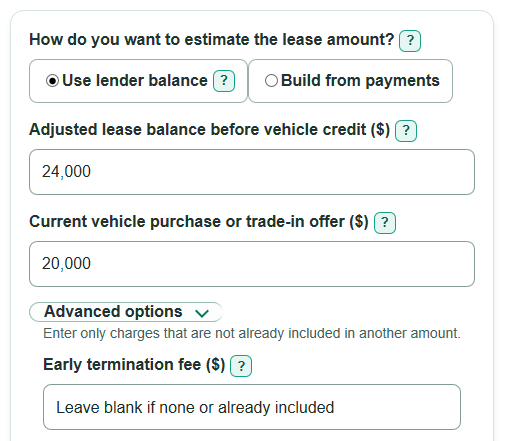
- Choose "Use lender balance" if your lender gave you an adjusted lease balance before vehicle credit. Choose "Build from payments" only when you need a planning estimate from your payment schedule.
- Enter the visible lease amount fields for your chosen path, then enter your Current vehicle purchase or trade-in offer from a written dealer or buyer offer if possible.
- Open Advanced options and enter only charges that are separate from the lease amount, such as an Early termination fee or Wear or damage estimate. Leave a field blank if it is already included.
- Click Calculate. A positive Estimated amount due or possible credit at early end means an estimated amount due; a negative amount means a possible credit or surplus.
- Sanity-check the Lease amount minus vehicle offer and compare it with your lender quote. A much lower vehicle offer should raise the estimated amount due by the same difference.
Definitions
Adjusted lease balance: A lender-provided amount owed to end the lease before applying the vehicle-value credit. It can differ from a buyout price.
Contractual residual value: The vehicle value set in the signed lease for its scheduled end. It is used in the payment-based planning estimate.
Vehicle offer: A current purchase or trade-in amount from a dealer or buyer. It is used as an estimated credit against the lease amount.
Disposition or turn-in fee: A contract fee that may apply when the vehicle is returned. It can be separate from an early termination fee.
Value gap: The lease amount before vehicle credit minus the vehicle offer. A positive gap means the offer is lower than the lease amount.
Possible credit or surplus: A negative estimated early-end amount. The lender may use different valuation and contract rules, so it does not promise a payment to you.
Common mistakes and quick fixes
Mistake: Entering remaining payments along with an Adjusted lease balance before vehicle credit.
Fix: Choose one calculation path. Use the lender balance path when that amount already covers the lease obligation.
Mistake: Using a buyout price as the Current vehicle purchase or trade-in offer.
Fix: Enter an actual purchase or trade-in offer for the vehicle, not the amount you would pay to buy the lease vehicle.
Mistake: Treating Contractual residual value as the vehicle's current value.
Fix: Use Contractual residual value only in the payment-based path, and enter the current offer separately.
Mistake: Adding an Early termination fee that is already included in the lender balance.
Fix: Leave Early termination fee blank unless the lender lists it as a separate charge.
Mistake: Entering 3.5 for Scheduled payments left.
Fix: Enter a whole number of scheduled payments, such as 3 or 4.
Mistake: Guessing Tax or government charges from quote from a local sales tax rate.
Fix: Leave it blank until you have a dollar amount from the lender, dealer, or official quote.
Limitations & Key Assumptions / Boundary Conditions
- This is a planning estimate. Your signed lease, the lender's early termination quote, and the lender's vehicle valuation control the final amount.
- The lender balance path assumes the Adjusted lease balance before vehicle credit does not already include any optional charge you enter. Do not enter a fee twice.
- The payment-based path estimates the lease amount as scheduled payments left plus Contractual residual value. A lender may use a different early-termination method.
- The Current vehicle purchase or trade-in offer may differ from the value the lender credits after inspection, sale, or other contract steps.
- Blank optional charges are treated as $0. This calculator does not estimate mileage, repairs, taxes, title fees, waived fees, rebates, or credits that you have not entered.
- Negative results remain negative because they can indicate a possible surplus. They are not guaranteed cash back.
Methodology
Calculation method
Choose one lease-obligation path. The lender-balance path uses the entered adjusted balance and does not use the payment-plan fields. The payment-plan path is a simple planning proxy based on scheduled payments and the contractual residual value.
remaining scheduled payments = monthly payment * scheduled payments left
payment-plan lease amount = remaining scheduled payments + contractual residual value
lease amount before vehicle credit = lender balance OR payment-plan lease amount
lease amount minus vehicle offer = lease amount before vehicle credit - vehicle offer
entered fees, condition charges, and tax = early termination fee + disposition fee + wear or damage estimate + past-due or other account charges + quoted tax amount
estimated early-end amount = lease amount minus vehicle offer + entered fees, condition charges, and tax
Worked example
With a $24,000 adjusted lease balance, a $20,000 vehicle offer, and $1,445 in separately entered charges, the value gap is $4,000 and the estimated early-end amount is $5,445. If the same $1,445 charge is already included in the lender balance, it must be left blank instead.
Assumptions and limits
The calculator keeps negative differences instead of changing them to zero. A negative estimated early-end amount is shown as a possible credit or surplus. Lease contracts can set early termination conditions, return charges, and other amounts differently, so review the contract and request a lender quote before making a decision. [1]