
Enter your car's price, expected resale value, and driving costs to estimate its total ownership cost, yearly cost, monthly cost, and cost per mile.
Table of contents
How to use our Car Total Cost of Ownership Calculator
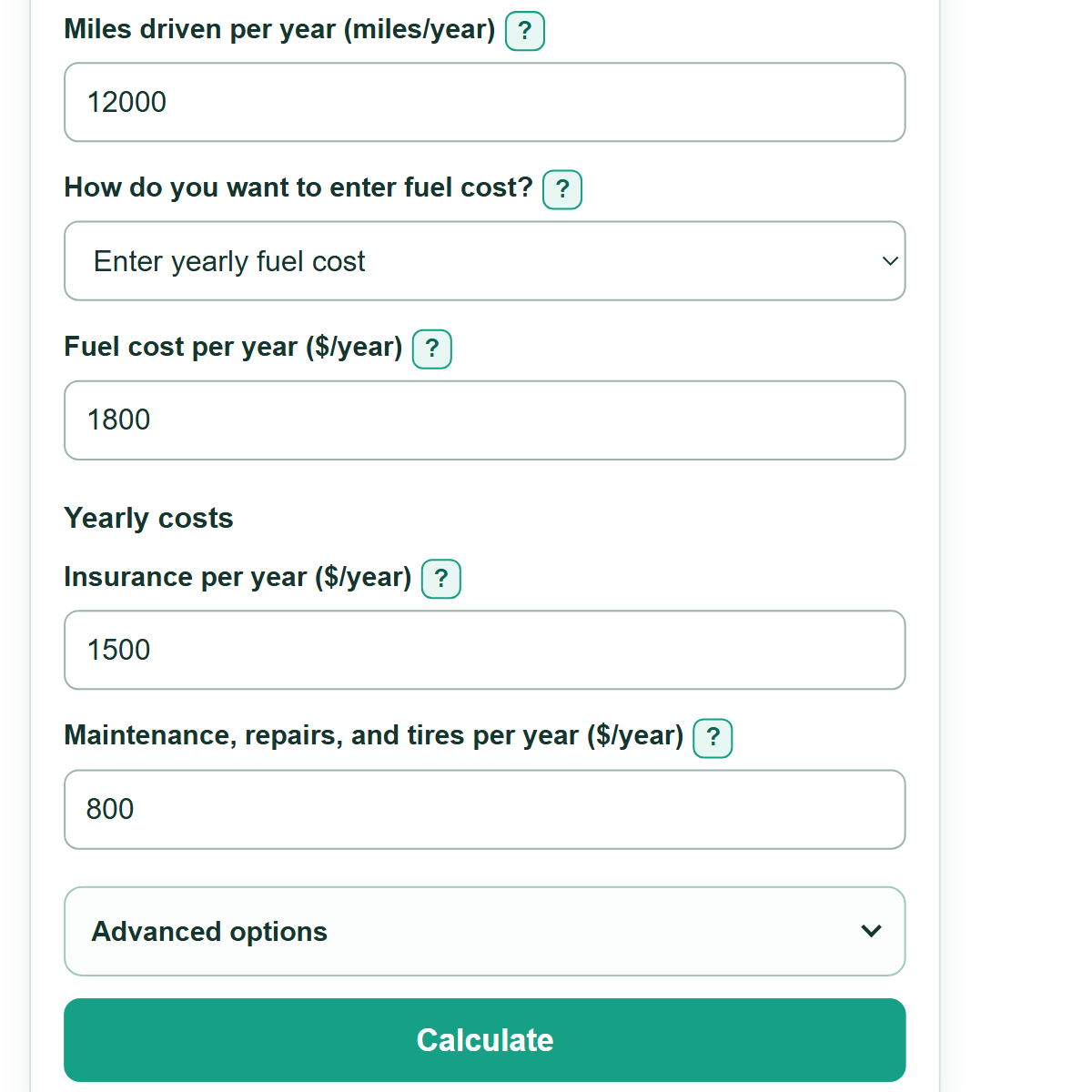
- Choose "Enter yearly fuel cost" if you know your yearly fuel spending, or choose "Calculate from mpg" if you know annual miles, combined mpg, and gas price.
- Enter the purchase price, expected resale or trade-in value, years you will keep the car, and miles driven per year.
- Add yearly insurance and yearly maintenance, repair, and tire costs.
- Open "Advanced options" to include loan interest, purchase sales tax, registration, parking, or tolls when they apply to your car.
- Select "Calculate," then check that the resale value fits the date you plan to sell or trade the car and that every included cost is one you expect to pay.
Definitions
Total cost of ownership: The estimated cost of having and using the car during the years entered, including vehicle value loss and every cost included in the calculator.
Vehicle value loss: Purchase price minus expected resale or trade-in value. A negative amount means the entered resale value is higher than the purchase price.
Combined mpg: Miles per gallon for mixed city and highway driving. It is used with annual miles and gas price to estimate yearly fuel cost.
One-time ownership costs: Vehicle value loss plus any entered loan interest and purchase sales tax.
Recurring costs: Yearly fuel, insurance, maintenance, registration, parking, and tolls multiplied by the ownership period.
Cost per mile: Total included ownership cost divided by the miles expected during the ownership period.
Common mistakes and quick fixes
Mistake: Adding the full loan payment or loan principal as an extra cost.
Fix: Enter only interest in "Loan interest paid while you own the car ($)", or select "Estimate from loan terms". The calculator adds the interest, not the loan principal, to ownership cost. Purchase price minus resale value already measures the vehicle value used up.
Mistake: Entering fuel costs in both fuel paths.
Fix: Choose one fuel method. The calculator uses either "Fuel cost per year ($/year)" or the mpg and gas-price fields, never both.
Mistake: Using the loan balance as the expected resale value.
Fix: Enter the amount you expect to receive from a sale or trade-in. The loan balance and the car's market value are different amounts.
Mistake: Counting purchase sales tax as a yearly registration cost.
Fix: Enter purchase sales tax once in its own field. Put recurring registration, inspection, and required vehicle fees in "Registration and fees per year ($/year)."
Mistake: Treating fuel cost per mile as the full ownership cost per mile.
Fix: The displayed ownership cost per mile includes value loss, insurance, maintenance, and every other entered cost divided by all planned miles.
Limitations & Key Assumptions / Boundary Conditions
- Yearly fuel, insurance, maintenance, registration, parking, and toll costs are assumed to stay the same in every ownership year.
- The expected resale or trade-in value is an estimate and can differ from the actual offer when the car is sold.
- The calculator uses your supplied costs and assumptions. It can estimate loan interest from fixed loan terms, but does not predict market value, repair needs, fuel prices, taxes, rebates or incentives.
- Loan principal is not added separately because purchase price minus resale value already measures vehicle value loss. Use "Enter known interest (or zero)" for a known interest total, or "Estimate from loan terms" to calculate it from the amount financed, interest rate and term.
- Cost per mile requires annual miles greater than zero and includes fixed costs, so it can be high for a car driven few miles.
- Costs without a matching field are excluded, such as crash damage, tickets, lender fees, and income lost while the car cannot be used.
In "Advanced options", choose "Estimate from loan terms" to enter "Amount financed ($)", "Annual loan interest rate (%)" and "Loan term (months)". The estimate assumes a fixed rate and equal monthly payments starting one month after purchase. Interest is included only through the ownership period or the end of the loan, whichever is earlier. A partial final month uses prorated interest on the remaining balance; actual daily-interest loans may differ.
Monthly payment is P × r ÷ (1 − (1 + r)−n), where P is the amount financed, r is annual interest rate ÷ 1200 and n is the term in months. At zero interest, payment is P ÷ n and interest is zero. Each month, interest is remaining balance × r; the rest of the payment reduces principal. Fees, extra payments and early-payoff charges are excluded.
For example, a $10,000 loan at 12% annual interest over 12 monthly payments has about $888.49 monthly payments and $661.85 total interest if held for the full year. Only $661.85 is added to ownership cost. CFPB: how auto-loan amortization works.
Methodology
Calculation method
The calculator separates one-time ownership costs from recurring yearly costs, then adds them for the selected ownership period.
vehicle_value_loss = purchase_price - expected_resale_value
annual_fuel_cost_used = entered_annual_fuel_cost OR (annual_miles / combined_mpg) * gas_price
Only the selected fuel method is used. With yearly fuel spending, mpg and gas price are ignored. With the mpg method, annual miles divided by combined mpg estimates gallons used per year.
one_time_costs = vehicle_value_loss + loan_interest_paid + purchase_sales_tax_paid
recurring_costs = years * (annual_fuel_cost_used + annual_insurance + annual_maintenance + annual_registration + annual_parking + annual_tolls)
total_ownership_cost = one_time_costs + recurring_costs
average_annual_cost = total_ownership_cost / years
average_monthly_cost = total_ownership_cost / (years * 12)
cost_per_mile = total_ownership_cost / (years * annual_miles)
Worked example
A car bought for $24,000 and expected to sell for $12,000 has $12,000 in vehicle value loss. If yearly fuel is $1,600, insurance is $1,200, maintenance is $600, and the car is kept for 4 years, yearly recurring costs are $3,400 and recurring costs over 4 years are $13,600. With no optional costs, total ownership cost is $25,600, or $6,400 per year, $533.33 per month, and $0.6400 per mile at 10,000 miles per year.
Calculation choices
Blank optional costs count as $0. Calculations use unrounded values, and displayed amounts are rounded at the end. A resale value above purchase price is allowed, so vehicle value loss and total ownership cost can be negative if the expected value gain is larger than all included costs.