
Estimate motor running amps from horsepower, voltage, efficiency, and power factor for DC, single-phase AC, or three-phase AC motors.
Table of contents
How to use our Motor Horsepower to Amps Calculator
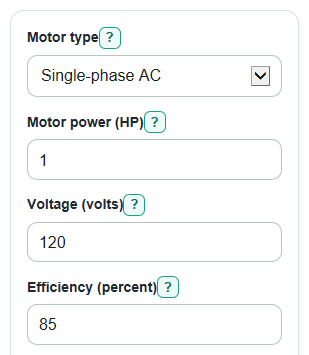
- Choose Motor type: Single-phase AC, Three-phase AC, or DC.
- Enter Motor power (HP), Voltage (volts), and Efficiency (percent) from the motor label when possible.
- For AC motors, enter Power factor; for DC motors, the calculator hides Power factor because it is not used.
- Open Advanced options only if you want to compare the estimate with Nameplate full-load current (A) or Measured running current (A).
- Sanity-check Estimated running current against the motor label or a clamp meter reading; a large gap often means the voltage, phase, efficiency, or power factor was entered wrong.
Definitions
Motor power (HP): The rated mechanical output power at the motor shaft, in horsepower.
Voltage (volts): The electrical supply voltage used by the motor. For three-phase AC, this means line-to-line voltage.
Efficiency (percent): The percent of electrical input power that becomes useful shaft output power.
Power factor: For AC motors, the ratio of real power to apparent power. Lower power factor means more amps are needed for the same real work.
Nameplate full-load current (A): The full-load amps printed on the motor label for its rated voltage and phase.
Measured running current (A): A real amp reading taken while the motor is running, often with a clamp meter.
Estimated input power: The estimated real electrical power going into the motor before efficiency losses.
Estimated AC apparent power: The volt-amp load for an AC motor after power factor is included.
Common mistakes and quick fixes
Mistake: Entering three-phase Voltage (volts) as line-to-neutral voltage.
Fix: For Three-phase AC, enter the line-to-line Voltage (volts), such as 208, 230, 460, or 575.
Mistake: Treating Motor power (HP) as electrical input power.
Fix: Use Motor power (HP) from the motor label; it is usually shaft output power, so Efficiency (percent) is needed to estimate input power.
Mistake: Typing Efficiency (percent) as 0.85 instead of 85.
Fix: Enter Efficiency (percent) as a percent from 0.1 to 100, such as 85 for 85 percent.
Mistake: Using Power factor for a DC motor.
Fix: Choose DC under Motor type; the Power factor row will be hidden and ignored.
Mistake: Comparing Estimated running current to Nameplate full-load current (A) without checking voltage and phase.
Fix: Make sure Motor type and Voltage (volts) match the motor label before using Calculated vs nameplate.
Mistake: Entering Measured running current (A) when the motor is starting or unloaded.
Fix: Use Measured running current (A) from a steady running condition under the load you care about.
Limitations & Key Assumptions / Boundary Conditions
- This calculator estimates running current from horsepower, voltage, efficiency, and power factor. It is not a code-sizing tool.
- Do not use Estimated running current alone to size breakers, fuses, wires, overloads, disconnects, or motor controllers.
- Motor starting current can be much higher than running current, and this calculator does not estimate starting current.
- Nameplate amps can differ from the formula estimate because real motors have design details, service factor, temperature, loading, and manufacturer test data.
- Measured running current (A) depends on the actual load at the time of measurement. A lightly loaded motor may draw less than its full-load current.
- The three-phase formula assumes a balanced motor and line-to-line Voltage (volts). It does not handle unbalanced phases or voltage drop.
- Power factor is used only for AC motors. It is hidden and ignored when Motor type is DC.
Methodology
Power conversion
The calculator starts by converting Motor power (HP) to motor shaft output in watts. It uses 746 watts per horsepower.
P_out_W = HP * 746
Efficiency and current
Efficiency is entered as a percent, then converted to a decimal before the formulas are used.
Eff = Efficiency_percent / 100
For DC motors, Power factor is not used.
I_A = P_out_W / (V * Eff)
For single-phase AC motors, current uses voltage, efficiency, and Power factor.
I_A = P_out_W / (V * Eff * PF)
For three-phase AC motors, current uses line-to-line voltage and the balanced three-phase factor sqrt(3).
I_A = P_out_W / (sqrt(3) * V_LL * Eff * PF)
Power outputs
Estimated input power is the real electrical power needed before motor losses.
P_in_W = P_out_W / Eff
Estimated AC apparent power is shown only for AC motors.
S_VA = P_in_W / PF
Comparison outputs
If Nameplate full-load current (A) is entered, the calculator shows how far the formula estimate is from the label value.
Calculated_vs_nameplate_percent = (I_A - nameplate_amps) / nameplate_amps * 100
If Measured running current (A) is entered, the calculator shows how far the measured current is from the estimate.
Measured_vs_estimate_percent = (measured_amps - I_A) / I_A * 100
Worked example
For a 1 HP single-phase AC motor at 120 volts, 85 percent efficiency, and 0.85 power factor, shaft output is 746 W. Estimated input power is 746 / 0.85 = 877.65 W. Estimated AC apparent power is 877.65 / 0.85 = 1032.53 VA. Estimated running current is 746 / (120 * 0.85 * 0.85) = 8.60 A. If the nameplate current is 7.5 A, Calculated vs nameplate is +14.7 percent. If the measured current is 9.0 A, Measured vs estimate is +4.6 percent.