
Estimate motor starting amps from nameplate full-load amps or horsepower, voltage, phase, and a NEMA code letter.
Table of contents
How to use our Motor Starting Current Calculator
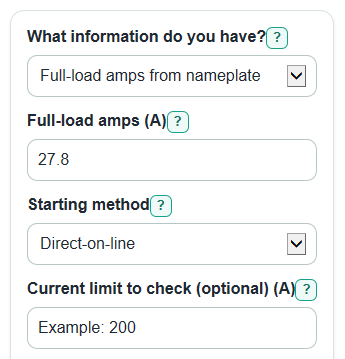
- Choose What information do you have?: use Full-load amps from nameplate if you know the motor FLA, or Horsepower plus NEMA code if you have hp, voltage, phase, and code letter.
- Pick the Starting method, then fill only the fields that appear, such as Full-load amps (A), Motor size (hp), Line voltage (V), NEMA code letter, or Autotransformer tap (percent).
- If you want a quick supply check, enter Current limit to check (optional) (A); leave it blank if you only need the starting-current estimate.
- Click Calculate and read Estimated starting current first, then use Likely starting-current range for planning because real motors do not all start at one exact amp value.
- Sanity-check the output: direct-on-line starts should usually be much higher than running Full-load amps (A), while VFD or soft starter entries should match the settings you typed.
Definitions
Full-load amps (A): The motor's normal running current at rated load, often marked FLA on the nameplate.
Starting current: The temporary current the motor pulls while it speeds up from a stop.
Locked-rotor current: The current at standstill when full voltage is applied. NEMA code letters are tied to locked-rotor kVA per horsepower, not to normal running amps [3].
NEMA code letter: A nameplate letter that gives a range of locked-rotor kVA per horsepower. It is different from a NEMA design letter.
Starting method: The way the motor is energized at start, such as direct-on-line, star-delta, autotransformer, soft starter, VFD, or a custom multiplier.
Autotransformer tap (percent): The reduced-voltage tap used during starting. A 65 percent tap is entered as 65.
Current limit margin: Current limit to check (optional) (A) minus the high starting-current estimate. A negative margin means the high estimate is above the limit.
Common mistakes and quick fixes
Mistake: Entering running watts or horsepower in Full-load amps (A).
Fix: Use the amp value marked FLA or full-load amps on the nameplate, or switch What information do you have? to Horsepower plus NEMA code.
Mistake: Using phase-to-neutral voltage in Line voltage (V) for a 3-phase motor.
Fix: For Motor phase set to 3-phase, enter the line-to-line voltage at the motor terminals.
Mistake: Picking NEMA code letter from the motor design letter.
Fix: Use the locked-rotor code letter on the nameplate; if you only see a design letter, use Full-load amps (A) instead.
Mistake: Choosing Soft starter or VFD while using Horsepower plus NEMA code.
Fix: Switch What information do you have? to Full-load amps from nameplate, then enter Soft starter setting (times full-load amps) or VFD start setting (times full-load amps).
Mistake: Treating Current limit to check (optional) (A) as the normal running current limit.
Fix: Enter the short-time starting limit you want to compare with the high estimate, such as a generator, starter, breaker, or utility limit.
Mistake: Entering 0.65 in Autotransformer tap (percent).
Fix: Enter 65 for a 65 percent tap, because the label asks for percent.
Limitations & Key Assumptions / Boundary Conditions
- The result is an estimate, not a motor test. Real starting current changes with motor design, supply voltage dip, load torque, wiring, temperature, and starter setup.
- Full-load amps mode uses general starting multiplier ranges. Use a motor datasheet or measured locked-rotor amps when an exact protection or generator study is required.
- NEMA code mode uses finite code-letter kVA per horsepower ranges from B through U. Codes with open-ended ranges are not included because this calculator needs low, middle, and high estimates.
- For NEMA code mode, soft starter, VFD, and custom multiplier choices are not guessed from horsepower. Use full-load amps mode for those adjustable-current methods.
- Star-delta results apply only when the motor and wiring are intended for star-delta starting.
- The Current limit check is a simple comparison to the high estimate. It does not model breaker trip curves, voltage drop, generator transient response, or starter protection settings.
Methodology
Calculation path
The calculator uses one of two paths. If you choose Full-load amps from nameplate, it multiplies Full-load amps (A) by a starting-method range. If you choose Horsepower plus NEMA code, it first estimates the full-voltage locked-rotor current from the NEMA code-letter kVA per horsepower range, then applies the selected starting method when supported.
Full-load amps basis
Direct-on-line uses 6 to 8 times full-load amps, with the middle value at 7 times full-load amps [2]. Star-delta uses 2 to 2.7 times full-load amps. Soft starter, VFD, and Custom starting multiplier use the number you enter as the low, middle, and high multiplier.
I_start_low = FLA * multiplier_low
I_start_mid = FLA * multiplier_mid
I_start_high = FLA * multiplier_high
NEMA code basis
Each NEMA code letter has a low and high kVA per horsepower value. The calculator uses the low value, high value, and their average to create locked-rotor low, middle, and high estimates.
Single-phase LRA = kVA_per_hp * hp * 1000 / V
3-phase LRA = kVA_per_hp * hp * 1000 / (1.7320508075688772 * V)
For NEMA code mode, direct-on-line uses the locked-rotor current range as the starting-current range. Star-delta divides that range by 3. Autotransformer multiplies that range by the square of the tap fraction.
star_delta_start = LRA / 3
autotransformer_start = LRA * (tap_percent / 100)^2
Current limit check
If Current limit to check (optional) (A) is filled in, the calculator subtracts the high starting-current estimate from that limit. The sign is kept because a negative value is useful.
margin = current_limit_amps - I_start_high
Mini-example
For Full-load amps (A) = 27.8 and Starting method = Direct-on-line, the range is 27.8 * 6 to 27.8 * 8, or 166.8 A to 222.4 A. The middle estimate is 27.8 * 7 = 194.6 A. If Current limit to check (optional) (A) is 200 A, the margin is 200 - 222.4 = -22.4 A, so the high estimate is 22.4 A above the entered limit.