
Convert kilowatts to horsepower or horsepower to kW and make sure you use the right horsepower standard.
Advanced options
Table of contents
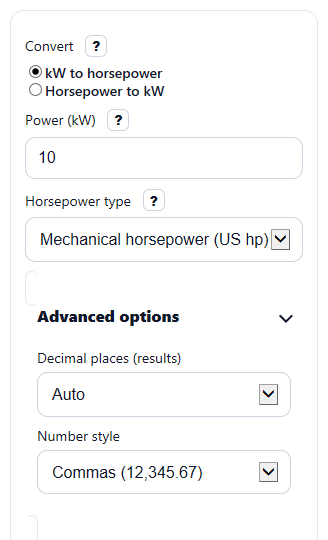
How to use our kW to Horsepower Converter
- Choose Convert: either kW to horsepower or Horsepower to kW.
- Enter your value in Power (kW) or Horsepower (hp), depending on the direction you picked.
- Select the correct Horsepower type: mechanical horsepower (US hp), metric horsepower (PS), or electrical horsepower.
- Click Calculate to see the Converted value, Horsepower type used, Conversion factor used, and Formula used.
- Sanity-check the result by confirming the output unit matches your direction and the Horsepower type used matches the spec sheet or homework problem.
Definitions
kW: Kilowatt, a unit of power. 1 kW = 1000 watts.
Horsepower type: The horsepower standard used for the conversion. Different standards use slightly different watt values.
Mechanical horsepower (US hp): A common US horsepower unit for engines and motors. It is based on about 745.6999 watts per hp [2].
Metric horsepower (PS): A horsepower unit often used in Europe. It is based on 735.49875 watts per hp.
Electrical horsepower: A horsepower standard based on exactly 746 watts per hp [2].
Conversion factor used: The number multiplied or divided to convert between kW and the selected horsepower type.
Common mistakes and quick fixes
Mistake: Entering energy in Power (kW) , such as kWh from an electric bill.
Fix: Use an instant power value in Power (kW) . kWh is energy, not power.
Mistake: Using Mechanical horsepower (US hp) when the source actually lists PS.
Fix: Change Horsepower type to Metric horsepower (PS) and recalculate.
Mistake: Typing a number into Horsepower (hp) while Convert is still set to kW to horsepower .
Fix: Switch Convert to Horsepower to kW before using Horsepower (hp) .
Mistake: Thinking electrical input power always equals shaft output horsepower.
Fix: Read the Quick note . Real machines can lose power, so electrical kW and mechanical output hp may differ.
Mistake: Entering a negative number in Power (kW) or Horsepower (hp) for a rated power conversion.
Fix: Enter zero or a positive value only.
Mistake: Ignoring Conversion factor used and copying only the rounded answer.
Fix: Check Conversion factor used when you need to match a textbook, spec sheet, or worked step.
Limitations & Key Assumptions / Boundary Conditions
- This converter is a unit converter only. It does not estimate motor efficiency, drivetrain losses, or real delivered output.
- The result depends on the selected Horsepower type. Picking the wrong type can change the answer slightly.
- Negative values are blocked because this tool is meant for rated power values of zero or more.
- Very small or very large values still convert normally, but rounded display settings can hide tiny differences.
- When converting equipment specs, make sure the source is comparing the same kind of power, such as electrical input power versus mechanical shaft output.
- This tool does not infer whether a source meant hp, PS, or electrical horsepower. You must choose the correct standard.
Methodology
How the converter works
The calculator first reads the selected Convert direction and Horsepower type. It then uses the matching factor for that horsepower standard.
Formulas
mechanical hp = kW / 0.7456998715822702
metric hp = kW / 0.73549875
electrical hp = kW / 0.746
kW = hp x factor in kW per hp
Factors used
1 mechanical hp = 0.7456998715822702 kW
1 metric hp = 0.73549875 kW
1 electrical hp = 0.746 kW
Mini example
If you enter 10 in Power (kW) and choose Mechanical horsepower (US hp), the calculator uses 10 / 0.7456998715822702 = 13.41022089595. That is about 13.41 hp.
If you switch to Horsepower to kW and enter 100 in Horsepower (hp) with Mechanical horsepower (US hp), the calculator uses 100 x 0.7456998715822702 = 74.56998715822702 kW.
Calculation choices
The hidden input is ignored in the inactive direction, so only the visible active value affects the answer. Blank, non-numeric, and negative active inputs are rejected. Zero is allowed and returns zero in the target unit.
Assumptions that affect real equipment
This math assumes a direct unit conversion only. Real motors, engines, pumps, and HVAC systems may list electrical input power and mechanical output power separately, so a real machine may not convert one-to-one because of efficiency losses.