
Enter a horsepower rating and its type to convert it to the matching number of watts and kilowatts.
Advanced options
Table of contents
How to use our Horsepower to Watts Converter
- Find the horsepower rating on the equipment label, specification, listing, or problem.
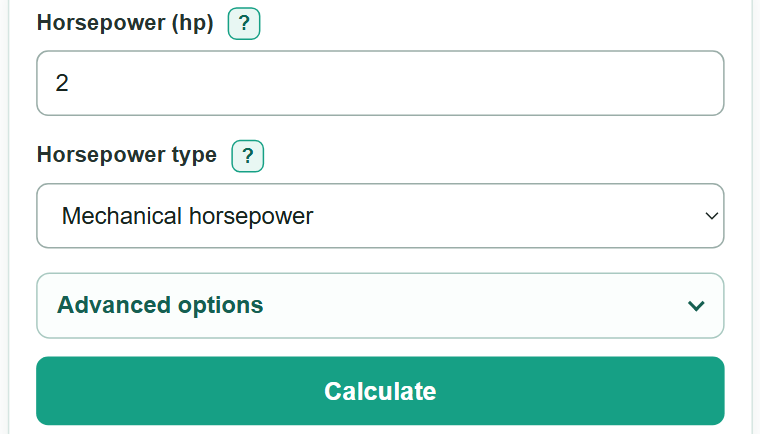
- Enter the number in "Horsepower (hp)." You can enter a decimal or a value such as "2.5 hp."
- Choose "Horsepower type" to match the source. PS and CV usually refer to metric horsepower.
- Select "Calculate" to see the converted power in watts, followed by kilowatts and the factor used.
- Check that the displayed conversion factor matches the selected type. A different horsepower definition gives a different watt result.
Definitions
Horsepower (hp): A unit of power. Its watt equivalent depends on the horsepower definition.
Mechanical horsepower: A horsepower definition equal to 745.699872 W.
Electric horsepower: A horsepower definition equal to 746 W.
Metric horsepower: A horsepower definition equal to 735.49875 W. It may be written as PS or CV. [1]
Boiler horsepower: A power unit equal to 9,809.5 W.
Watt (W): The SI unit of power.
Kilowatt (kW): 1,000 watts.
Common mistakes and quick fixes
Mistake: Treating every hp rating as mechanical horsepower.
Fix: Check whether the source names electric horsepower, metric horsepower, PS, CV, or boiler horsepower before choosing the type.
Mistake: Entering a negative rating.
Fix: Enter 0 or a positive horsepower amount. This converter handles power magnitudes, not power-flow direction.
Mistake: Typing a grouped number such as "1,01."
Fix: Use commas only between full thousands groups, such as "1,000," or enter "1000."
Mistake: Reading watts as energy used over time.
Fix: Watts measure power. Watt-hours and kilowatt-hours measure energy and require a time period.
Mistake: Using converted motor horsepower as electrical input demand.
Fix: Treat the result as a unit conversion of the rating. Electrical input also depends on motor efficiency, load, and operating conditions.
Limitations & Key Assumptions / Boundary Conditions
- This is a unit conversion only. It does not estimate electrical input, circuit load, generator size, heat loss, or energy use over time.
- The result depends on selecting the horsepower definition used by the source. Confirm an unqualified hp rating when the equipment or problem does not identify the type.
- The converter accepts nonnegative power magnitudes only and does not use negative values to show power-flow direction.
- Changing decimal places changes displayed rounding only. Calculations use the unrounded converted value.
- Estimating energy use also requires operating time. Electrical equipment estimates may also require load and efficiency information.
Methodology
Conversion method
The converter selects the watts-per-horsepower factor for the chosen type, then multiplies the entered horsepower by that factor. The mechanical, electric, metric, and boiler factors are standard unit conversions.
watts = horsepower x selected watts-per-horsepower factor
kilowatts = watts / 1000
Worked example
For 2 mechanical hp, the factor is 745.699872 W per hp. Multiplying gives 2 x 745.699872 = 1,491.399744 W. With 3 decimal places selected, the displayed values are 1,491.400 W and 1.491 kW.
Factors used
Mechanical horsepower uses 745.699872 W per hp, electric horsepower uses 746 W per hp, metric horsepower uses 735.49875 W per hp, and boiler horsepower uses 9,809.5 W per hp. Display rounding happens after the conversion.
Practical boundary
A motor's horsepower rating often describes mechanical output power. Converting that rating to watts does not determine wall-outlet electricity demand because input demand changes with motor efficiency and operating load.