
Convert watts, kilowatts, and horsepower types while keeping mechanical hp, electrical hp, and metric PS separate.
Table of contents
How to use our Watts to Horsepower Converter
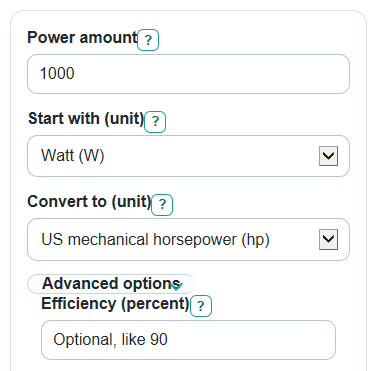
- Enter the known value in Power amount, using commas if needed.
- Choose the current unit in Start with and the unit you want in Convert to.
- Open advanced options only if you need Efficiency, Efficiency direction, or a different Answer detail.
- Click Calculate, then read Converted power first and use Same power in watts to check the base value.
- Sanity-check the output by comparing Same power in other horsepower types; small differences are normal because each horsepower type has its own watt factor.
Definitions
Power amount: The power value you are converting, in the unit picked under Start with.
Watt (W): The base power unit used inside the calculator. One kilowatt is 1,000 watts.
US mechanical horsepower (hp): A common engine horsepower unit. This calculator uses 1 hp = 745.69987158227022 W.
Electrical horsepower (hp): A horsepower unit often used for electric motors. This calculator uses 1 hp(E) = 746 W.
Metric horsepower (PS): A metric horsepower unit. This calculator uses 1 PS = 735.49875 W.
Efficiency: The percent of power that remains after losses. Blank means no efficiency adjustment is used.
Conversion factor used: The number of watts equal to 1 selected answer unit.
Common mistakes and quick fixes
Mistake: Treating Start with and Convert to horsepower choices as the same kind of hp.
Fix: Pick the exact horsepower type shown in the label, such as US mechanical horsepower, electrical horsepower, or metric PS.
Mistake: Entering motor input watts in Power amount and using Converted power as shaft horsepower.
Fix: Add Efficiency and choose the correct Efficiency direction , or leave efficiency blank for a pure unit conversion only.
Mistake: Typing 0 or a value over 100 in Efficiency .
Fix: Use a percent greater than 0 and less than or equal to 100, or clear Efficiency if you do not want losses included.
Mistake: Reading With efficiency included as a replacement for Converted power in every case.
Fix: Use Converted power for straight unit conversion and use With efficiency included only for motor or generator estimates.
Mistake: Setting Answer detail too low and thinking the small rounded difference is a math error.
Fix: Choose more decimal places in Answer detail when you need to compare exact factors or test homework-style answers.
Limitations & Key Assumptions / Boundary Conditions
- The main Converted power result is a unit conversion only. It does not measure a real motor, engine, or generator.
- Efficiency is a simple percent adjustment. Real machines can change efficiency with speed, load, temperature, and control electronics.
- The calculator keeps negative Power amount values negative. A negative sign can mean reverse power flow or a chosen sign direction, depending on your context.
- Horsepower labels matter. US mechanical horsepower, electrical horsepower, and metric PS are close, but they are not identical.
- Rounded display from Answer detail can hide tiny differences. Internal calculations still use the full stored factors.
- Very large or very small values are formatted for readability, but the result is only as good as the entered number and selected units.
Methodology
Calculation path
The calculator first converts the entered value to watts, then converts watts to the selected answer unit. The watt factors used for the horsepower units follow standard conversion-factor practice [1].
base_watts = amount * watts_per_from_unit
answer = base_watts / watts_per_to_unit
The stored factors are 1 W for watt, 1000 W for kilowatt, 745.69987158227022 W per US mechanical hp, 746 W per electrical hp, and 735.49875 W per metric PS. Metric horsepower is derived as 75 * 9.80665 W, which equals 735.49875 W.
Efficiency adjustment
If Efficiency is blank, the calculator ignores efficiency and shows the pure conversion. If efficiency is filled in, it must be greater than 0 and less than or equal to 100.
adjusted_watts = base_watts * (efficiency_percent / 100)
This input-to-shaft formula estimates shaft output after losses.
adjusted_watts = base_watts / (efficiency_percent / 100)
This shaft-to-input formula estimates the input power needed before losses.
Worked mini-example
For 1000 W converted to US mechanical horsepower, the base value is 1000 W. The answer is 1000 / 745.69987158227022 = 1.3410220895950278 hp. If 90 percent efficiency is used with input power to shaft power, adjusted watts are 1000 * 0.90 = 900 W, and the adjusted answer is 900 / 745.69987158227022 = 1.206919880635525 hp.
Rounding and display
Answer detail changes only how many decimal places you see. It does not change the stored math used for Converted power, With efficiency included, Same power in watts, or Same power in other horsepower types.
Sources
- NIST Guide to the SI, Appendix B: Conversion Factors - NIST
- Horsepower | Definition, Unit, and Facts | Britannica - Encyclopedia Britannica
- NIST Guide to the SI, Appendix B.9: Factors for units listed by kind of quantity or field of science - NIST
- Joule | Definition & Formula | Britannica - Encyclopedia Britannica