
Estimate lawn mowing cost per visit and per month using flat or hourly pricing, plus yard adjustments and optional add-ons.
Advanced options
How to use our Lawn Mowing Cost Calculator
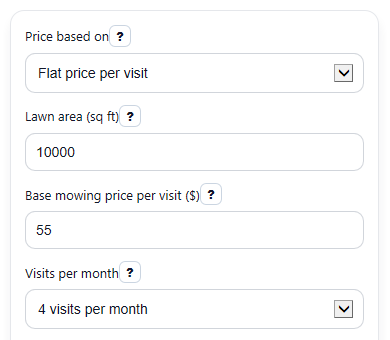
- Choose Price based on, then enter Lawn area (sq ft) and Visits per month.
- If you picked flat pricing, fill in Base mowing price per visit ($). If you picked hourly pricing, fill in Hourly rate ($ per hour) and Time to mow each visit (hours).
- Open Advanced options to enter Yard condition adjustment (%), Edging per visit ($), Blow or cleanup per visit ($), and Other add-ons per visit ($).
- Click Calculate to see Estimated total per visit, Estimated monthly total, and the price breakdown.
- Sanity-check the result: make sure Base mowing cost before adjustments plus Condition adjustment amount plus Optional extras total per visit matches the final visit total, and compare the monthly total to your budget or quote.
Definitions
Price based on: The pricing method the calculator uses. Pick flat price for one quoted visit price, or hourly to build the price from time and rate.
Lawn area (sq ft): The mowable grass area in square feet. It is also used to calculate the area-based reference rate.
Base mowing price per visit ($): The starting mowing charge for one visit when you use flat pricing, before yard adjustments and add-ons.
Hourly rate ($ per hour): The dollar amount charged for one hour of mowing labor when you use hourly pricing.
Time to mow each visit (hours): The number of hours the mowing visit usually takes.
Yard condition adjustment (%): A percent that raises or lowers the base mowing cost for things like hills, obstacles, overgrowth, or easy access.
Condition adjustment amount: The dollar change created by the yard condition adjustment. Positive means the job costs more. Negative means it costs less.
Optional extras total per visit: The combined cost of Edging per visit ($), Blow or cleanup per visit ($), and Other add-ons per visit ($).
Reference cost per 1,000 sq ft: A normalized price that helps compare lawns of different sizes by showing the final visit cost for each 1,000 square feet.
Common mistakes and quick fixes
Mistake: Entering full lot size instead of just mowable grass in Lawn area (sq ft) .
Fix: Enter only the area that actually gets mowed, not the house, driveway, patio, or large beds.
Mistake: Filling in Base mowing price per visit ($) while also expecting Hourly rate ($ per hour) and Time to mow each visit (hours) to affect the result.
Fix: Use the fields that match your selected Price based on method. Hidden mode fields are ignored.
Mistake: Typing a monthly amount into Base mowing price per visit ($) .
Fix: Enter the price for one mowing visit only. The calculator uses Visits per month to build Estimated monthly total .
Mistake: Using a negative number for Edging per visit ($) , Blow or cleanup per visit ($) , or Other add-ons per visit ($) .
Fix: Add-on fields must be zero or more. Use Yard condition adjustment (%) if you need to lower the base mowing price.
Mistake: Entering -150 in Yard condition adjustment (%) and expecting a normal result.
Fix: Negative adjustments are allowed, but less than -100% would reduce the adjusted base below zero, so lower the discount to a realistic value.
Mistake: Thinking a high Reference cost per 1,000 sq ft always means the quote is wrong.
Fix: Very small lawns can show a high normalized rate because setup time and add-ons are spread over fewer square feet. Compare it with Estimated total per visit , not by itself.
Limitations & Key Assumptions / Boundary Conditions
- The calculator assumes each visit in the month uses the same price, time, adjustment, and add-ons.
- Estimated monthly total is simply the per-visit total multiplied by Visits per month. It does not adjust for skipped weeks, seasonal growth, or weather.
- Lawn area (sq ft) must be greater than zero for the area-based reference to make sense.
- Yard condition adjustment (%) can be negative, but values below -100% would push the adjusted base below zero and should be treated as unrealistic.
- The tool uses only the costs you enter. It does not automatically add fuel, travel, equipment wear, taxes, or minimum service charges unless you include them in your pricing inputs.
- Reference cost per 1,000 sq ft can look unusually high on very small lawns because fixed visit costs are spread across a small area.
Methodology
How the calculator works
The calculator first finds the base mowing cost from your chosen pricing method. Then it applies the yard condition adjustment, adds optional services, and multiplies by monthly visit frequency.
Formulas used
base mowing cost = flat price
base mowing cost = hourly rate x labor hours
condition adjustment amount = base mowing cost x (yard condition adjustment / 100)
optional extras total = edging price + blow or cleanup price + other add-ons
estimated total per visit = base mowing cost + condition adjustment amount + optional extras total
estimated monthly total = estimated total per visit x visits per month
reference cost per 1,000 sq ft = estimated total per visit / (lawn area / 1000)
Mode rules
If Price based on is flat, the calculator uses Base mowing price per visit ($) and ignores hourly fields. If it is hourly, the calculator uses Hourly rate ($ per hour) and Time to mow each visit (hours) and ignores the flat-price field.
Mini example
Suppose you use flat pricing with a base mowing price of $55, a yard condition adjustment of 15%, edging of $10, cleanup of $8, other add-ons of $0, and 4 visits per month.
base mowing cost = 55
condition adjustment amount = 55 x 0.15 = 8.25
optional extras total = 10 + 8 + 0 = 18
estimated total per visit = 55 + 8.25 + 18 = 81.25
estimated monthly total = 81.25 x 4 = 325
If the lawn area is 10,000 square feet, the area-based reference is:
reference cost per 1,000 sq ft = 81.25 / (10000 / 1000) = 8.125
Assumptions behind the estimate
The monthly result assumes each visit is priced the same. The calculator also assumes your add-ons are charged per visit and that the yard condition adjustment changes only the base mowing cost, not the add-ons. Real quotes may differ when companies include travel, minimum charges, equipment costs, or seasonal changes in grass growth [1][2][3].