
Estimate a realistic livestock fence budget using fence length, fence type, ground conditions, gates, brace sets, and your build approach.
Advanced options
How to use our Livestock Fence Cost Calculator
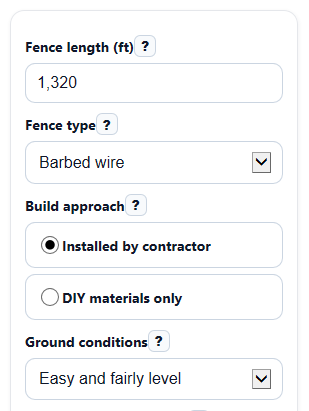
- Enter your Fence length (ft), choose a Fence type, pick your Build approach, and select Ground conditions.
- Enter Number of gates (count) and Corner and end brace sets (count) so the estimate includes big cost items that straight per-foot math often misses.
- Open Advanced options if you want to switch Cost basis, enter your own low, expected, and high prices, change Average gate cost each ($) or Brace set cost each ($), or turn on the yearly ownership estimate.
- Click Calculate, then read Estimated total cost first, compare it with Budget range, and use Estimated cost per foot to compare quotes across jobs.
- Do a quick sanity check: if Gate cost or Brace set cost looks too small for your layout, or if local quotes are outside the Budget range, switch to custom prices and recalculate.
Definitions
Fence length (ft): The total planned fence run in feet. This should include all sides and any interior fence lines.
Fence type: The main fence system you plan to build, such as barbed wire or woven wire. Different types can change both total cost and yearly ownership cost a lot [1].
Build approach: Whether you are pricing an installed job or DIY materials only. DIY usually excludes hired labor unless you build that into custom prices.
Ground conditions: A site difficulty choice that changes the per-foot estimate with a multiplier. Harder ground usually means more time and higher cost.
Corner and end brace sets: Structural support assemblies used at corners, ends, and major direction changes. These are priced separately because they can add a lot to the project.
Cost basis: Whether the calculator uses built-in per-foot cost bands or your own local low, expected, and high prices.
Budget range: The low-to-high total project estimate. It helps you plan for price uncertainty instead of relying on one single number.
Estimated yearly ownership cost: An optional planning estimate that combines yearly replacement spread over useful life with yearly maintenance [1].
Common mistakes and quick fixes
Mistake: Entering only one side of the pasture in Fence length instead of the full run.
Fix: Add every side and any interior runs you want built, then enter the total in Fence length .
Mistake: Leaving out openings and support work, then expecting Estimated total cost to cover them.
Fix: Enter every opening in Number of gates and count all needed corners, ends, and direction changes in Corner and end brace sets .
Mistake: Picking DIY materials only in Build approach but comparing the result to a full installed quote.
Fix: Use Installed by contractor for a quote-style planning number, or keep DIY and raise custom per-foot, gate, and brace costs to include hired work.
Mistake: Choosing Enter my own prices in Cost basis but filling only one or two custom price fields.
Fix: Enter all three fields: Your low cost ($ per ft) , Your expected cost ($ per ft) , and Your high cost ($ per ft) .
Mistake: Entering custom prices in the wrong order, such as a high value below the expected value.
Fix: Make sure Your low cost ($ per ft) is less than or equal to Your expected cost ($ per ft) , and Your expected cost ($ per ft) is less than or equal to Your high cost ($ per ft) .
Mistake: Treating Ground condition multiplier like a small detail on rocky or steep sites.
Fix: If the site is rough, choose the matching Ground conditions option or use custom per-foot prices that already reflect the harder install.
Limitations & Key Assumptions / Boundary Conditions
- Built-in per-foot bands are planning estimates, not contractor quotes. Local material prices, labor rates, fence height, post spacing, wire count, and hardware can move real costs above or below the range.
- Ground conditions uses fixed multipliers of 1.00, 1.15, and 1.35. Real jobs may vary more, so custom per-foot pricing is better when you already have local quotes.
- Estimated total cost includes fence line cost, gates, and brace sets only. It does not separately itemize permits, clearing, utility locating, stream crossings, energizers, or special site work unless you build them into your custom prices.
- DIY materials only does not include unpaid labor value, equipment wear, or hired help unless you include those costs in your custom inputs.
- Estimated yearly ownership cost is a simple planning model based on straight-line replacement and a maintenance percent. Actual annual spending will be uneven from year to year.
- Temporary polywire electric pricing is most useful for temporary interior fencing plans, not heavy permanent perimeter containment.
- Very short fence runs can show a high Estimated cost per foot because gate and brace costs are spread over fewer feet.
Methodology
How the calculator works
The calculator starts with a per-foot cost for the selected Fence type, adjusts that cost for Ground conditions, then adds gate and brace costs. It shows low, expected, and high project totals so you can plan a range instead of one weak single estimate.
Built-in cost bands and multipliers
Built-in fence costs use fixed low, expected, and high per-foot bands for each fence type. The type of fence can strongly affect cost per foot, total cost, and annual ownership cost [1].
adjusted cost per ft = base cost per ft x terrain multiplier
The ground multipliers used here are 1.00 for easy ground, 1.15 for average pasture ground, and 1.35 for difficult or rocky ground. If your local quote already reflects site difficulty, using custom prices is usually better than relying on the built-in multiplier.
Project cost formulas
fence line cost before gates and braces = fence length x adjusted cost per ft
gate cost = number of gates x average gate cost each
brace set cost = corner and end brace sets x brace set cost each
total project cost = fence line cost before gates and braces + gate cost + brace set cost
estimated cost per foot = estimated total cost / fence length
The calculator computes low, expected, and high totals with matching low, expected, and high per-foot values, then reports the expected total as Estimated total cost and the full low-to-high spread as Budget range.
Yearly ownership estimate
If you turn on Show yearly ownership estimate, the calculator uses a simple planning formula based on replacement spread over useful life plus annual maintenance. Extension references discuss annual ownership cost as a useful comparison measure [1].
estimated yearly ownership cost = (estimated total cost / useful life) + (estimated total cost x yearly maintenance percent / 100)
Worked mini-example
Suppose you enter 1,320 ft, choose barbed wire, select easy ground, keep 2 gates at $250 each, and keep 4 brace sets at $150 each. The built-in expected barbed wire cost is about $1.9424 per ft.
adjusted expected cost per ft = 1.9424 x 1.00 = 1.9424
fence line cost before gates and braces = 1,320 x 1.9424 = 2,564
gate cost = 2 x 250 = 500
brace set cost = 4 x 150 = 600
estimated total cost = 2,564 + 500 + 600 = 3,664
estimated cost per foot = 3,664 / 1,320 = 2.7758
That means the fence run itself is most of the budget, but gates and braces still add a meaningful amount.
Assumptions behind the math
This tool assumes one average cost per foot for the main fence line, one average cost for each gate, and one average cost for each brace set. That keeps the estimate easy to use, but real jobs may vary when gate sizes differ, braces are heavier than average, or sections of the site need special construction. The output is best used for planning and quote comparison, not as a binding bid.