
Calculate acres covered per hour from working width and speed, or find your measured rate from completed acres and active work time.
Advanced options
Table of contents
How to use our Acres Per Hour Calculator
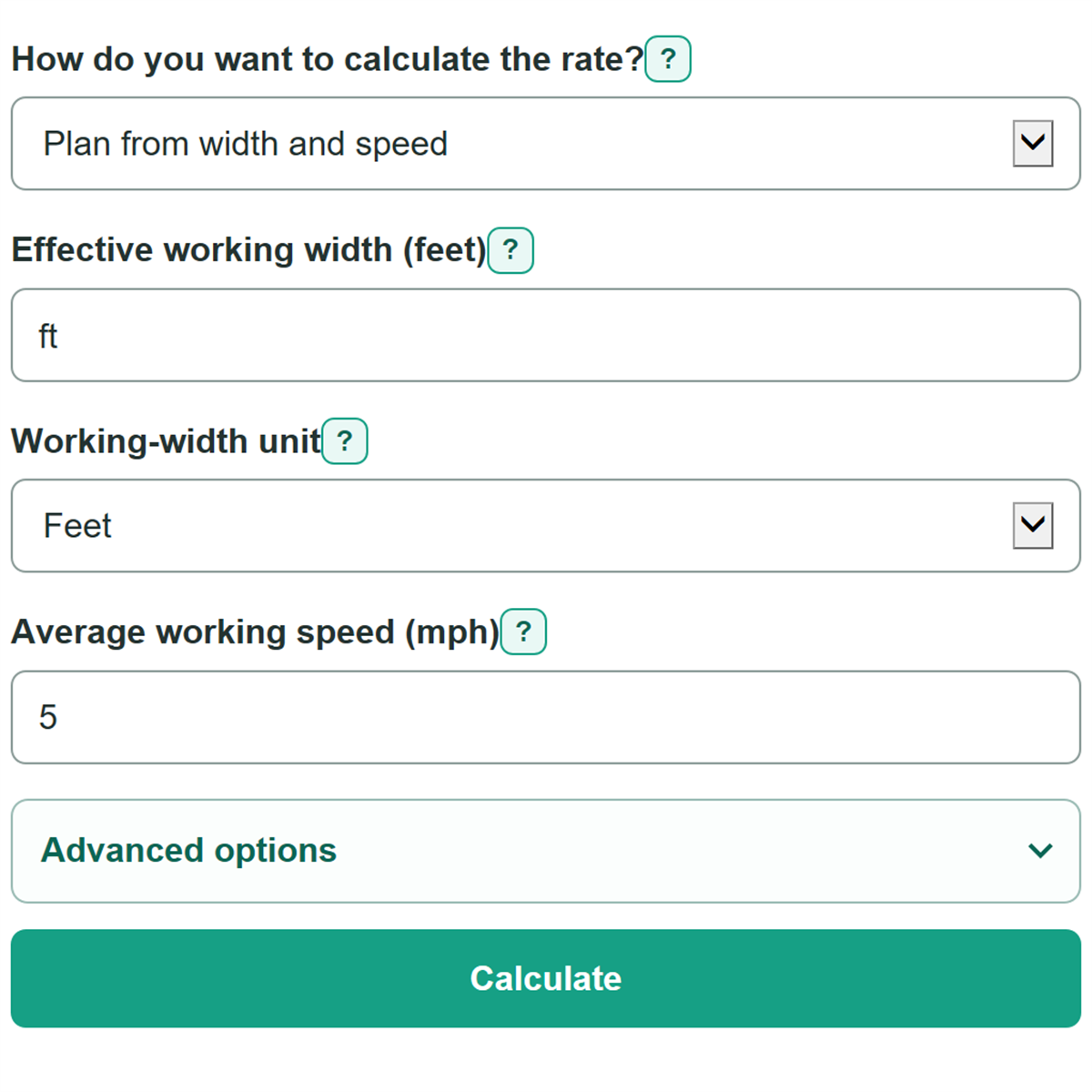
- Choose "Plan from width and speed" before a job, or choose "Use actual job results" when you have a completed-acre record and active work time.
- For a planned rate, enter the effective working width, select feet or inches, and enter the average speed while the equipment is working.
- For an actual rate, enter acres completed and elapsed active work time. Time may be decimal hours, h:mm, or h:mm:ss.
- Open Advanced options to change field efficiency or add field size and active fieldwork hours per day for remaining-time and workday estimates.
- Compare the result with a recent job in similar conditions. If the planned rate seems high, check the actual covered width, working speed, and overlap adjustment.
Definitions
Effective working width: The strip of ground actually covered in one pass, after overlap or unused width is accounted for.
Field efficiency: The percent of ideal width-and-speed capacity achieved after losses from turning, stopping, overlap, refilling, and similar operating delays.
Ideal width-and-speed capacity: The acres per hour calculated from working width and speed before applying field efficiency.
Elapsed active work time: The time counted for a completed job. Enter decimal hours, h:mm, or h:mm:ss.
Minutes per acre: The active work minutes needed to cover one acre at the calculated rate.
Common mistakes and quick fixes
Mistake: Entering the equipment's outside width instead of the ground actually covered in one pass.
Fix: Enter the effective working width after overlap or unused width.
Mistake: Using top road speed for average working speed.
Fix: Use the normal speed while the equipment is doing the job.
Mistake: Reducing working width for overlap and also lowering field efficiency for that same overlap.
Fix: Count each loss once. If width already accounts for overlap, use efficiency for other losses such as turns and stops.
Mistake: Including travel, repairs, weather delays, or breaks in active work time by accident.
Fix: Enter only the time you want included in the measured acres-per-hour rate.
Mistake: Entering a field size smaller than acres already completed.
Fix: Correct the field-size or completed-acre record before estimating acres remaining.
Limitations & Key Assumptions / Boundary Conditions
- The planned rate is an estimate. Field shape, terrain, obstacles, ground conditions, crop or grass conditions, equipment setup, and operator choices can change actual coverage.
- The 80% field-efficiency starting value is a planning assumption, not a measurement for every field or job.
- Do not count overlap twice by reducing effective working width and also reducing field efficiency for the same overlap loss.
- Remaining-time and workday estimates use active operating time and do not separately add travel, repairs, weather delays, trimming, cleanup, or breaks.
- In actual-results mode, zero completed acres over positive active time is a valid zero rate. Minutes per acre and finish time are undefined because they would require division by zero.
- In actual-results mode, entered field size must be at least as large as acres completed.
Methodology
Planned rate
The planning method converts the entered effective working width to feet, calculates ideal capacity from width and average working speed, then applies field efficiency.
width_feet = working_width, or working_width / 12 for inches
ideal_acres_per_hour = width_feet * average_speed_mph / 8.25
estimated_acres_per_hour = ideal_acres_per_hour * field_efficiency_percent / 100
The 8.25 factor converts a width in feet and speed in miles per hour to acres per hour. It comes from 43,560 square feet per acre divided by 5,280 feet per mile.
For example, a 20-foot effective width at 5 mph has an ideal capacity of 20 * 5 / 8.25 = 12.12 acres per hour. At 80% field efficiency, the planned rate is 12.12 * 0.80 = 9.70 acres per hour.
Measured job rate
The actual-results method uses a completed-work record instead of estimating width, speed, and efficiency.
estimated_acres_per_hour = acres_completed / elapsed_active_hours
For example, 24 completed acres in 3:
00 active hours gives 24 / 3 = 8 acres per hour. If the entered field size is 100 acres, 76 acres remain and the estimated active time remaining is 76 / 8 = 9.5 hours.
Time and daily planning
minutes_per_acre = 60 / estimated_acres_per_hour
acres_per_day = estimated_acres_per_hour * fieldwork_hours_per_day
remaining_hours = remaining_acres / estimated_acres_per_hour
remaining_workdays = remaining_acres / acres_per_day
Division-based time estimates appear only when the rate is above zero. A zero observed rate is valid when no acres were completed during positive active time, but it cannot produce a finite time per acre or finish-time estimate. Planned results assume the entered effective width, average working speed, and field efficiency match the job conditions.