
Calculate plants per acre from spacing, estimate an emerged stand from live-plant samples, or plan seeds for a target stand using expected establishment.
Table of contents
How to use our Plant Population Calculator
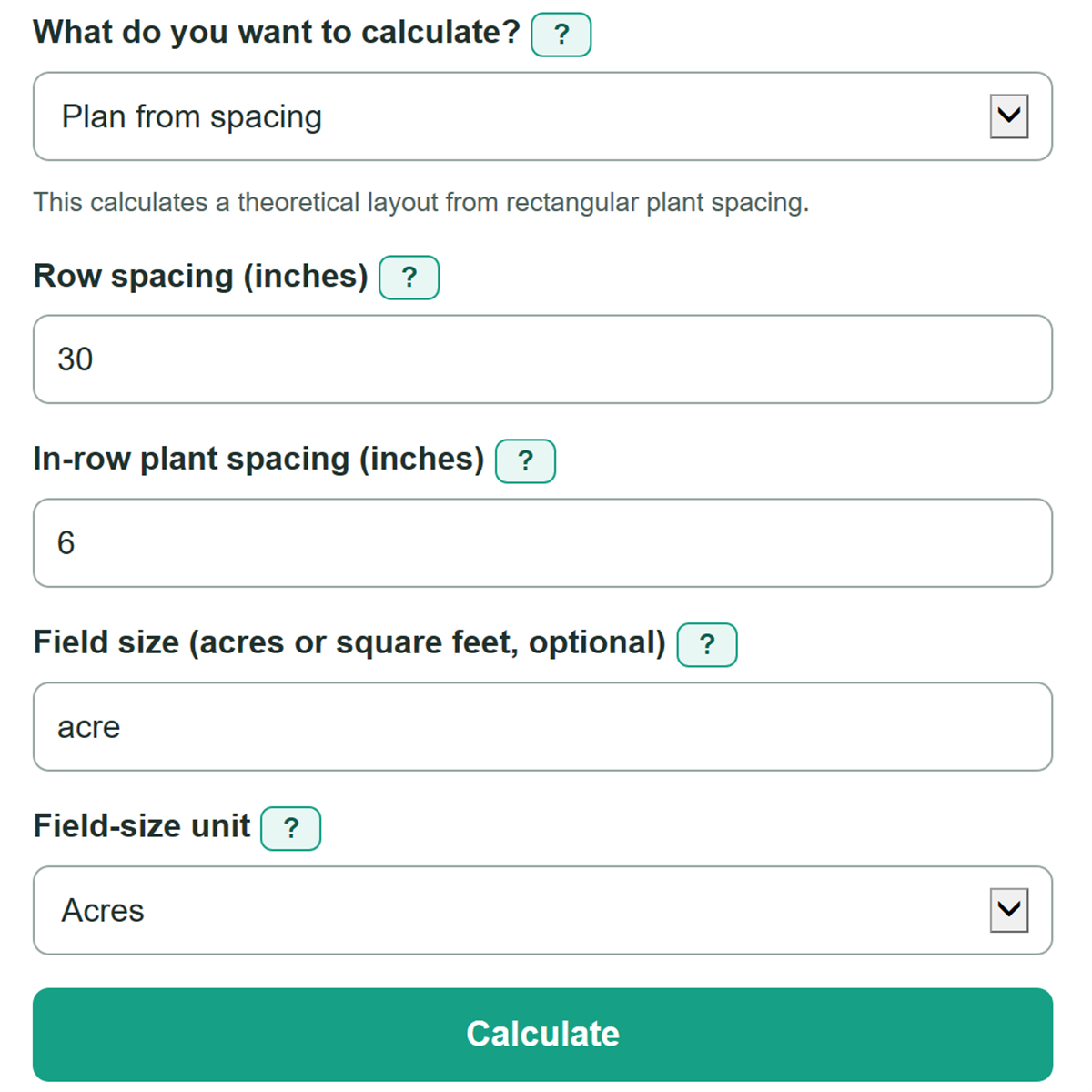
- Select "Plan from spacing" for a planting layout, "Check emerged stand" after emergence, or "Plan seeds for target stand" to estimate a seed rate.
- In "Plan from spacing" and "Check emerged stand", enter "Row spacing (inches)" as the center-to-center distance between neighboring rows. In "Plan seeds for target stand", instead enter "Target established plants per acre" and "Expected establishment (%)".
- For a spacing plan, enter "In-row plant spacing (inches)" and, if needed, add a field or bed size to estimate its theoretical planting positions.
- For an emerged stand check, measure the displayed row length in several representative locations and enter the live-plant count from each section.
- Check the first result against your task: a spacing-plan result is theoretical, while an emerged-stand result is based on your average field count.
Definitions
Row spacing: The center-to-center distance between adjacent rows, measured in inches.
In-row plant spacing: The distance between plants or planting positions along one row, measured in inches.
Theoretical plant population: The number of planting positions per acre calculated from a rectangular row-by-plant spacing pattern.
Emerged stand: An estimate of live plants per acre after emergence, based on live-plant counts from the field.
1/1000-acre sample: A measured section of one row that represents one-thousandth of an acre. Average its live-plant counts, then multiply by 1,000 to estimate plants per acre. [1]
Plants per square foot: The theoretical spacing density expressed for one square foot instead of one acre.
Common mistakes and quick fixes
Mistake: Measuring row spacing from the edge of one row to the edge of another.
Fix: Measure from the center of one row to the center of the next row.
Mistake: Entering across-row distance as "In-row plant spacing (inches)."
Fix: Measure between neighboring plants or planting positions along the same row.
Mistake: Treating a spacing-plan population as the number of plants that emerged.
Fix: Select "Check emerged stand" and count live plants in measured row sections.
Mistake: Using one unusually thin or thick row section to describe the whole field.
Fix: Enter at least two counts from representative locations and use the average.
Mistake: Entering a field size in acres while "Field-size unit" is set to square feet.
Fix: Choose the unit used in your record. Changing the unit converts a valid entered area to preserve the same physical area.
Mistake: Entering part of a plant in a sample count.
Fix: Use whole numbers for live plants. A count of zero is valid when no live plants are present in that sample.
Limitations & Key Assumptions / Boundary Conditions
- The spacing calculation assumes one planting position in every rectangular row-by-plant space.
- The theoretical result does not subtract headlands, drive rows, walkways, borders, irregular edges, skipped positions, or unusable ground.
- The calculator estimates planting positions, not a crop-specific recommended population or seed purchase amount. Germination, emergence, losses, and thinning are not included.
- The emerged-stand estimate depends on representative samples. Counts from only unusually thin or thick areas can misrepresent the field.
- Each stand sample must use the displayed row length for the entered row spacing. Changing row spacing changes the required sample length.
- Zero live plants is a valid observed count, but zero or negative spacing is invalid because spacing is used as a divisor.
Methodology
Target-stand seed planning
In "Plan seeds for target stand", the seed rate equals "Target established plants per acre" divided by ("Expected establishment (%)" / 100). A target of 30,000 plants per acre at 90% establishment gives about 33,333.3 seeds per acre. Use an establishment estimate that includes germination and field losses; this is not a crop-specific seed-rate recommendation or a guarantee of emergence.
Spacing plan
The calculator treats row spacing and in-row plant spacing as the two sides of one rectangular planting space. It finds theoretical plants per square foot, then scales that density to an acre using 43,560 square feet per acre.
plants per square foot = 144 / (row spacing in inches x in-row spacing in inches)
plants per acre = plants per square foot x 43,560
If you enter a field size, the calculator multiplies the density by acres or square feet based on the selected "Field-size unit."
planting positions = plants per acre x acres
planting positions = plants per square foot x square feet
Emerged stand check
For an emerged-stand check, the calculator finds the length of one row that covers 1/1000 acre at the entered row spacing. Count live plants in that length at multiple representative locations, add the counts, and divide by the number of samples. This uses the 1/1000-acre sampling approach described in Extension stand-assessment guidance. [1]
sample row length in feet = (43,560 x 12) / (1,000 x row spacing in inches)
average live plants per sample = total live plants counted / number of samples
observed plants per acre = average live plants per sample x 1,000
Worked example
With 30-inch rows and 6-inch in-row spacing, the theoretical density is 144 / (30 x 6) = 0.8 plants per square foot. Multiplying 0.8 by 43,560 gives 34,848 theoretical plants per acre. For a 30-inch emerged-stand check, each sample is 17.424 feet of row. Counts of 28, 31, 29, and 32 average 30 plants, which estimates 30,000 live plants per acre.