
Estimate how much CO2 your grow room needs to reach a target ppm, plus flow rate, exhaust loss, and rough tank life.
Advanced options
How to use our CO2 Grow Room Calculator
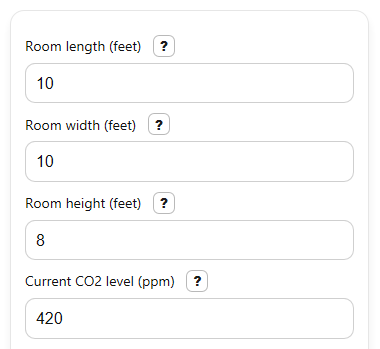
- Enter your room size in Room length (feet), Room width (feet), and Room height (feet).
- Type your starting level in Current CO2 level (ppm), your goal in Target CO2 level (ppm), and how fast you want the dose delivered in Dose time (minutes).
- If your fan stays on while dosing, open Advanced options and enter Exhaust airflow during dosing (CFM). Add CO2 tank size (lb) if you want refill planning.
- Click Calculate, then read CO2 needed for one dose first and Practical CO2 supply rate with exhaust if ventilation is running.
- Sanity-check the result: if Target CO2 level (ppm) is at or below Current CO2 level (ppm), the needed dose should be 0, and if your exhaust is high, the practical rate should be much higher than the sealed-room rate.
Definitions
ppm: Parts per million. Here it means how many parts of the room air are CO2.
Current CO2 level (ppm): The CO2 concentration in the room before dosing starts.
Target CO2 level (ppm): The concentration you want to reach after adding CO2.
CO2 needed for one dose: The amount of pure CO2 gas needed for one raise from the current ppm to the target ppm in a well-mixed room.
Average CO2 supply rate: The average gas delivery speed needed to add that one dose over your chosen Dose time (minutes).
Exhaust airflow during dosing (CFM): Fan airflow in cubic feet per minute that leaves the room while you are dosing.
Extra CO2 lost to exhaust: Estimated extra CO2 needed each hour to replace enriched air that gets exhausted.
Practical CO2 supply rate with exhaust: The sealed-room dose rate plus the estimated replacement rate for exhaust loss.
CO2 tank size (lb): Tank capacity in pounds of CO2, used for rough refill planning.
Common mistakes and quick fixes
Mistake: Entering outside room measurements instead of inside air space for Room length (feet) , Room width (feet) , or Room height (feet) .
Fix: Use the inside dimensions of the actual air volume you are enriching.
Mistake: Mixing up the starting and goal values in Current CO2 level (ppm) and Target CO2 level (ppm) .
Fix: Put the lower present reading in Current and the higher goal in Target.
Mistake: Leaving Dose time (minutes) at 0 or using an unrealistically tiny time.
Fix: Enter a value greater than 0. Shorter times increase Average CO2 supply rate a lot.
Mistake: Leaving the fan on but keeping Exhaust airflow during dosing (CFM) at 0.
Fix: If exhaust runs during dosing, enter its airflow so Extra CO2 lost to exhaust and Practical CO2 supply rate with exhaust are more realistic.
Mistake: Expecting Approximate one-dose raises per tank to match real life exactly.
Fix: Treat it as a planning estimate. Real tanks lose some usable gas to regulator settings, line loss, temperature, and leftover pressure.
Mistake: Entering a tank value in CO2 tank size (lb) and assuming it changes the dose math.
Fix: Tank size does not change CO2 needed for one dose . It only helps estimate tank-based planning outputs.
Limitations & Key Assumptions / Boundary Conditions
- The core dose math assumes the room air is well mixed. Dead spots, poor circulation, or sensor placement can make the real ppm different.
- CO2 needed for one dose is an ideal sealed-room estimate. It does not include leaks, door openings, plant uptake, or regulator waste.
- Extra CO2 lost to exhaust assumes constant exhaust airflow and a steady target concentration during dosing. Real fan cycling can change actual use.
- The tank calculations use an approximate CO2 gas density at near standard conditions, so CO2 needed for one dose in pounds and tank outputs are rough planning numbers.
- If Target CO2 level (ppm) is less than or equal to Current CO2 level (ppm), the calculator correctly returns zero added CO2 because no raise is needed.
- Very high target ppm values will still calculate, but the result may be unsafe for occupied spaces and may not match best practice for your setup.
- This tool does not model controller behavior, pulsed injection, burner output, humidity effects, or changing room pressure over time.
Methodology
Core math
The calculator first finds room air volume, then uses the ppm increase as a simple fraction of that air volume. This gives the pure CO2 gas volume needed for one raise to target.
V_room_ft3 = length x width x height
dppm = target_ppm - ambient_ppm
V_co2_ft3 = V_room_ft3 x max(dppm, 0) / 1,000,000
If dppm is 0 or negative, the calculator returns 0 for added CO2 and flow outputs because you are already at or above the target.
Flow rate
To show how fast the system must deliver gas, the one-dose volume is divided by the dosing time.
flow_cfh = V_co2_ft3 / (dose_minutes / 60)
flow_lpm = flow_cfh x 28.316846592 / 60
This gives the same average delivery rate in both cubic feet per hour and liters per minute.
Exhaust loss estimate
If exhaust runs during dosing, enriched air leaves the room and has to be replaced. The calculator estimates that added demand from exhaust airflow and the same ppm increase fraction.
loss_cfh = exhaust_cfm x max(dppm, 0) / 1,000,000 x 60
practical_cfh = flow_cfh + loss_cfh
Practical CO2 supply rate with exhaust is usually the most useful real-world number when ventilation stays on.
Tank planning
The one-dose gas volume is converted to pounds using an approximate CO2 density of 0.1235 lb/ft3. Tank outputs are then estimated from that mass or the tank's equivalent gas volume.
co2_lb = V_co2_ft3 x 0.1235
tank_doses = tank_size_lb / co2_lb
tank_hours = (tank_size_lb / 0.1235) / practical_cfh
If the tank field is blank, tank outputs should stay hidden. If the practical rate is 0, tank run time is not shown because there is no ongoing draw to divide by.
Worked example
Suppose your room is 10 ft x 10 ft x 8 ft, your Current CO2 level (ppm) is 420, your Target CO2 level (ppm) is 1200, and your Dose time (minutes) is 15.
V_room_ft3 = 10 x 10 x 8 = 800 ft3
dppm = 1200 - 420 = 780
V_co2_ft3 = 800 x 780 / 1,000,000 = 0.624 ft3
flow_cfh = 0.624 / 0.25 = 2.496 ft3/hour
flow_lpm = 2.496 x 28.316846592 / 60 = about 1.178 L/min
co2_lb = 0.624 x 0.1235 = about 0.0771 lb
That means one raise to target needs about 0.624 ft3 of pure CO2, or about 0.077 lb, before extra loss from exhaust is added.
Safety note logic
The safety message is based on the entered target level. A target above 5,000 ppm should trigger a stronger caution because 5,000 ppm is a common 8-hour occupational exposure reference. Very high values, especially near 40,000 ppm, need urgent caution because they can be dangerous in occupied spaces.
Assumptions used
This method assumes a well-mixed room, no unusual pressure effects, and constant conditions during the short dosing window. Real rooms can differ because of leaks, cycling fans, imperfect mixing, controller timing, regulator losses, and changing temperature.