
Measure your dog and get a crate size for home use or air travel, plus a simple shopping match for common crate lengths.
Advanced options
How to use our Dog Crate Size Calculator
- Choose What are you sizing for? Pick Home crate for everyday indoor use or Air-travel crate if you need travel sizing.
- Enter Dog length, nose to tail base (inches) and Dog height, floor to top of head or ears (inches). In "Air-travel crate" mode, also enter "Dog width at widest point (inches)", "Elbow height, floor to elbow (inches)" and "Bedding thickness (inches)", then answer "Is your dog snub-nosed?".
- If your dog is still growing, set Is your dog still growing? to Yes. In Advanced options, you can change Extra room to add for home crate (inches) or choose Common crate size series.
- Click Calculate. Then compare Recommended crate length, Recommended crate height, and if shown Recommended crate width with the crate's inside dimensions, not just the box label.
- Sanity-check the result: your dog should be able to stand naturally and turn around for home use, and if Closest common crate size is between sizes, choose the larger one and confirm the actual inside measurements.
Definitions
Dog length, nose to tail base (inches): The distance from the tip of the nose to where the tail starts. Do not include the tail itself.
Dog height, floor to top of head or ears (inches): The dog's full standing height to the highest natural point.
Dog width at widest point (inches): The distance across the shoulders or widest part of the body. This matters for air-travel sizing.
Extra room to add for home crate (inches): A small allowance added to body measurements for everyday home comfort, commonly 2 to 4 inches.
Recommended crate length: The minimum inside crate length to look for based on the entered measurements and selected use.
Recommended crate height: The minimum inside crate height needed for natural standing room.
Recommended crate width: The minimum inside crate width shown for air-travel mode.
Closest common crate size: The next standard shopping size at or above the needed length, such as 30, 36, 42, or 48 inches.
Puppy note: A reminder that many owners buy the adult-size crate and use a divider while the puppy grows [2].
Common mistakes and quick fixes
Mistake: Entering tail tip length in Dog length, nose to tail base (inches) .
Fix: Measure only from the tip of the nose to the base of the tail, then recalculate Recommended crate length .
Mistake: Measuring only to the top of the skull when the ears stand higher for Dog height, floor to top of head or ears (inches) .
Fix: Use the highest natural standing point so Recommended crate height is not too small.
Mistake: Typing 0, a negative number, or leaving a measurement blank.
Fix: Enter a positive number in Dog length, nose to tail base (inches) , Dog height, floor to top of head or ears (inches) , and in air mode Dog width at widest point (inches) .
Mistake: Using Home crate when you really need a flight kennel.
Fix: Change What are you sizing for? to Air-travel crate so the tool also shows Recommended crate width and travel-focused sizing.
Mistake: Treating Closest common crate size as a guarantee that every 36 inch or 42 inch crate fits the same way.
Fix: Use it as a shopping shortcut, then compare the product's actual inside dimensions with Recommended crate length and Recommended crate height .
Mistake: Picking your puppy's current size instead of planning for growth when Is your dog still growing? should be Yes.
Fix: Set Is your dog still growing? to Yes and read the Puppy note for the divider recommendation.
Limitations & Key Assumptions / Boundary Conditions
- This tool is measurement-based. It is more reliable than breed guessing, but body shape, coat, and posture can still change real fit.
- Home crate results use a simple clearance method: body length plus extra room, and body height plus the same extra room.
- "Air-travel crate" uses the standard IATA internal-dimension formulas for dogs that are not snub-nosed. It does not certify airline acceptance. Snub-nosed dogs require larger containers and carrier-specific checks, so that choice shows guidance instead of standard dimensions.
- Closest common crate size is a shopping shortcut. Real products with the same labeled size can have different inside dimensions.
- If your result falls between common sizes, choosing the larger standard size is usually the safer shopping choice [2].
- If the needed length is above 54 inches, standard size mapping may not be enough and you may need an extra-large or specialty crate.
- The home-mode puppy option adds a divider note; it does not predict adult measurements or enlarge the result automatically.
Methodology
How the calculator works
For Home crate, the calculator adds a chosen clearance to the dog's measured length and height. This matches the common measuring rule used in popular dog crate sizing guides.
Recommended crate length = dog length + home clearance
Recommended crate height = dog height + home clearance
For "Air-travel crate", IATA pet-container guidance uses A (nose to tail base), B (floor to elbow), C (widest body point), and D (natural standing head or ear height). Standard internal dimensions are length = A + B/2, width = 2C, and height = D + bedding thickness. Results round upward to the selected precision. For example, A=28, B=12, C=10, D=22 and bedding=2 give 34 x 20 x 24 inches. Confirm your airline's requirements and actual fit.
Recommended crate width = 2 x dog width
When Common crate size series is set to standard sizes, the tool maps the needed length to the next common crate length in this list: 18, 22, 24, 30, 36, 42, 48, 54.
Closest common crate size = smallest standard length greater than or equal to recommended crate length
Mini example
Suppose your dog is 28 inches long and 22 inches tall, and you choose 3 inches for Extra room to add for home crate (inches).
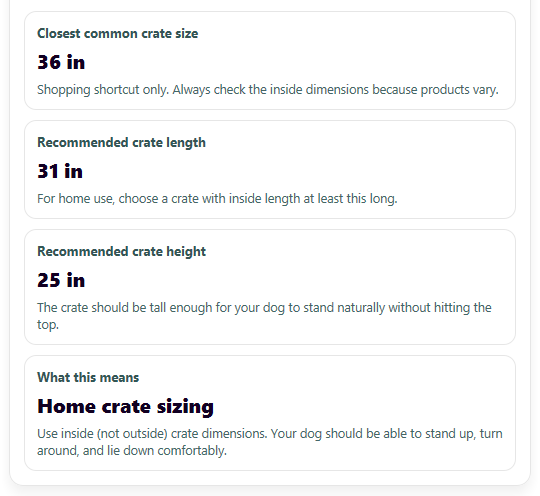
Recommended crate length = 28 + 3 = 31 inches
Recommended crate height = 22 + 3 = 25 inches
The next standard crate length at or above 31 is 36, so Closest common crate size is 36 inches.
How to interpret the result
For home use, focus first on Recommended crate length and Recommended crate height, then confirm the product's real inside dimensions before buying. For air travel, also compare Recommended crate width with the kennel's internal width.
Assumptions used here
This calculator uses a simple home-clearance approach and a fixed standard size list. Air-travel height includes entered bedding thickness. It does not model crate wall thickness or brand-specific interior differences; compare with actual inside dimensions. If your dog is between sizes, the larger standard size is usually the safer choice [1].