
Estimate your dog's first-year, yearly, monthly, and lifetime costs using your own spending choices and an optional emergency cushion target.
Advanced options
How to use our Cost of Owning a Dog Calculator
- Pick Dog stage, then enter Years you expect to own the dog (years) and your core costs: Adoption or purchase cost ($), One-time setup supplies ($), and Routine monthly cost ($).
- Open Advanced options if you want a fuller estimate, then add any yearly costs that apply, such as Routine vet care per year ($), Grooming per year ($), Training per year ($), Pet insurance per year ($), Boarding, daycare, or dog walking per year ($), and Other yearly costs ($).
- If you want a savings target for surprise bills, enter Emergency cushion goal (months of routine costs). This creates a separate cushion number and is not added to ownership cost.
- Click Calculate, then review First-year total cost, Ongoing yearly cost after year 1, Average monthly budget, and Total cost over planned ownership.
- Sanity-check the result by looking at Cost breakdown summary. If one category looks too high or too low for your real plan, adjust that input and recalculate.
Definitions
Dog stage: A simple planning choice for whether you are budgeting for a puppy or first year, or for an adult dog.
Routine monthly cost ($): Regular monthly spending such as food, treats, poop bags, and preventive basics.
Routine vet care per year ($): Planned yearly care, like checkups and vaccines, not major surprise emergencies.
One-time setup supplies ($): Bring-home gear you usually buy once at the start, such as a crate, bed, bowls, leash, and first toys.
First-year total cost: Your one-time costs plus one full year of recurring costs.
Ongoing yearly cost after year 1: Your expected cost for a typical later year after bring-home costs are gone.
Average monthly budget: The first-year total divided by 12, which helps with monthly cash-flow planning.
Suggested emergency cushion: A separate savings target based on a number of months of routine costs, not part of ownership spending.
Common mistakes and quick fixes
Mistake: Leaving Adoption or purchase cost ($) , One-time setup supplies ($) , or Routine monthly cost ($) blank.
Fix: Enter a number for each required money field. Use 0 if that cost does not apply.
Mistake: Entering monthly spending inside a yearly field like Routine vet care per year ($) .
Fix: Put only annual totals in yearly fields. Monthly basics belong in Routine monthly cost ($) .
Mistake: Using less than 1 in Years you expect to own the dog (years) .
Fix: Enter at least 1 year, because the calculator is built for yearly and lifetime planning.
Mistake: Assuming Suggested emergency cushion is part of First-year total cost or Total cost over planned ownership .
Fix: Read it as a separate savings target based on Emergency cushion goal (months of routine costs) , not as added spending.
Mistake: Entering negative numbers to offset costs, such as -100 in Other yearly costs ($) .
Fix: Use 0 or a positive amount. This calculator does not allow negative costs.
Mistake: Reading Average monthly budget as a normal later-year month when you included bring-home costs.
Fix: Remember that this output spreads first-year one-time costs across 12 months, so it is mainly a first-year planning number.
Limitations & Key Assumptions / Boundary Conditions
- The calculator assumes your yearly recurring costs stay the same for every year entered, even though real dog costs can rise or fall over time.
- Total cost over planned ownership is only as accurate as your estimate for Years you expect to own the dog (years).
- The emergency cushion uses only Routine monthly cost ($) times the months you choose. It does not include vet emergencies, insurance deductibles, or large one-time events unless you build those into your own budget.
- If you leave optional yearly fields blank, they are treated as 0 after validation, so your estimate may be low if you forgot a category that applies to you.
- This tool is for budgeting, not price quotes. Actual costs vary by location, dog size, breed, age, health, and the services you use.
- Average monthly budget is a first-year planning view because it spreads one-time bring-home costs across 12 months. Later years may be lower.
Methodology
How the calculator works
The tool adds your recurring dog costs for one year, then combines them with any one-time bring-home costs.
yearly recurring total = Routine monthly cost x 12 + Routine vet care per year + Grooming per year + Training per year + Pet insurance per year + Boarding, daycare, or dog walking per year + Other yearly costs
First-year total cost = Adoption or purchase cost + One-time setup supplies + yearly recurring total
Ongoing yearly cost after year 1 = yearly recurring total
Total cost over planned ownership = Adoption or purchase cost + One-time setup supplies + yearly recurring total x Years you expect to own the dog
Average monthly budget = First-year total cost / 12
Suggested emergency cushion = Routine monthly cost x Emergency cushion goal
Worked mini-example
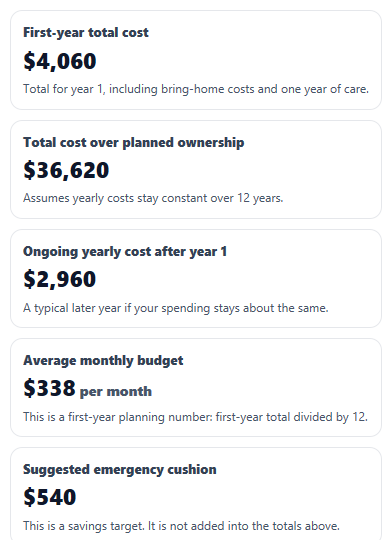
Suppose you enter $500 for Adoption or purchase cost ($), $600 for One-time setup supplies ($), $180 for Routine monthly cost ($), $450 for Routine vet care per year ($), $200 for Training per year ($), and $150 for Other yearly costs ($). Leave the other optional yearly fields at 0, use 12 years owned, and set the emergency cushion to 3 months.
yearly recurring total = 180 x 12 + 450 + 0 + 200 + 0 + 0 + 150 = 2,960
First-year total cost = 500 + 600 + 2,960 = 4,060
Ongoing yearly cost after year 1 = 2,960
Total cost over planned ownership = 500 + 600 + 2,960 x 12 = 36,620
Average monthly budget = 4,060 / 12 = 338.33
Suggested emergency cushion = 180 x 3 = 540
In this example, the first year hits hardest because it includes both bring-home costs and a full year of care. Later years drop to the ongoing yearly total if your recurring costs stay the same.
Assumptions behind the estimate
The calculator uses 12 months per year. It keeps recurring yearly costs constant across all years entered. It also keeps the emergency cushion separate from ownership totals so you can compare spending needs and savings needs more clearly. Common dog budget categories such as food, vet care, grooming, training, boarding, and supplies are consistent with consumer pet-cost guidance [1][3].
When real life can differ
Actual dog costs can change because of inflation, health issues, age-related care, travel needs, breed-specific grooming, or local price differences. If your dog is already owned, entering 0 for bring-home costs can give a more realistic current-budget view.