
Calculate HPLC equilibration time, sequence mobile-phase use, and preparation quantity from your column, method, and injection plan.
Advanced options
Table of contents
How to use our HPLC Column Volume, Equilibration Time and Solvent Use Calculator
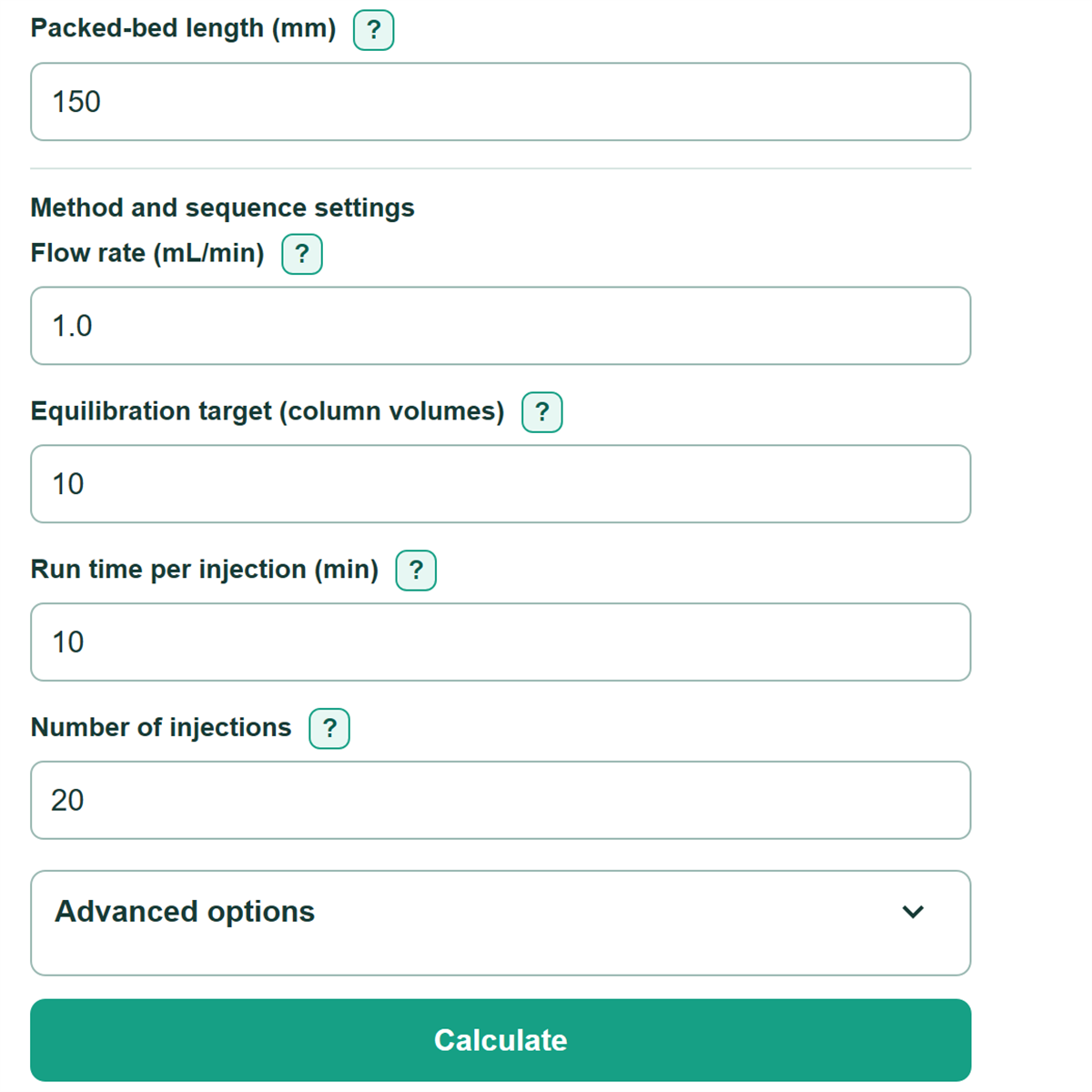
- Choose Column-volume basis. Use the estimate when you have column dimensions, or choose measured when you have a measured void volume.
- For the estimate, enter Column internal diameter and Packed-bed length from the column label. For the measured basis, enter Measured void volume.
- Enter the method settings: Flow rate, Equilibration target, and Run time per injection. Enter Number of injections from the sequence table.
- Click Calculate. Use Total sequence mobile phase for expected instrument consumption and Mobile phase to prepare with overage for your preparation amount.
- Sanity-check the split: Run mobile phase for planned injections should be zero when Number of injections is zero, while equilibration still uses solvent. Confirm the equilibration target with your validated method.
Definitions
Column-volume basis: The volume used as one column volume for the equilibration plan. This calculator uses either a porosity-based estimate or a measured void volume.
Geometric column volume: The cylinder volume calculated from the column internal diameter and packed-bed length before packing porosity is applied.
Packing porosity: The fraction of geometric column volume treated as mobile-phase void volume in the estimate. A fraction of 0.68 means 68%.
Measured void volume: A mobile-phase volume measured for the column, commonly using an unretained-marker experiment. Phase-volume measurements can use different definitions, so keep the method definition consistent. [1]
Equilibration target: The number of selected column volumes planned before the sequence starts.
Preparation overage: Extra mobile phase prepared above calculated instrument consumption for handling and preparation.
Common mistakes and quick fixes
Mistake: Entering the outside diameter instead of Column internal diameter.
Fix: Copy the I.D. in mm from the column label or specification sheet.
Mistake: Using tubing length for Packed-bed length.
Fix: Enter only the packed-bed length printed for the analytical column.
Mistake: Treating an estimated value as a measured Measured void volume.
Fix: Choose the estimate basis unless you have a value from an unretained-marker measurement or method-development record.
Mistake: Setting Flow rate to 0 or using a flow rate from a different method.
Fix: Enter the active method flow in mL/min; it must be greater than 0.
Mistake: Forgetting gradient, wash, or other mobile-phase delivery time in Run time per injection.
Fix: Enter the full mobile-phase delivery time planned for each injection.
Mistake: Reading Mobile phase to prepare with overage as instrument consumption.
Fix: Use Total sequence mobile phase for calculated consumption; the overage is only a preparation allowance.
Limitations & Key Assumptions / Boundary Conditions
- The estimate treats the packed bed as a cylinder and uses the entered packing porosity. Actual column void volume can differ from this estimate.
- The calculator does not add system dwell volume, tubing volume, mixer volume, or autosampler volume.
- Equilibration time assumes constant flow at the entered Flow rate. It does not model pressure limits, flow ramps, pauses, or pump priming.
- Run mobile phase for planned injections assumes every minute in Run time per injection delivers mobile phase at the entered flow rate.
- The equilibration target is a planning input, not proof of adequate equilibration. Confirm adequacy with the validated method and stable repeat retention.
- The calculation includes one equilibration event per planned sequence block. Add separate planning steps if the sequence has additional starts, solvent changes, or re-equilibration events.
Methodology
Calculation method
The calculator first finds a geometric column volume from the packed-bed dimensions. Diameter and length are entered in mm, and 1,000 cubic mm equals 1 mL.
Geometric column volume (mL) = π x [Column internal diameter (mm) / 2]^2 x Packed-bed length (mm) / 1000
With the estimate basis, the geometric volume is multiplied by Packing porosity. With the measured basis, the entered Measured void volume replaces that estimate.
Estimated void volume (mL) = Geometric column volume (mL) x Packing porosity
Chosen column-volume basis (mL) = estimated void volume or Measured void volume
The planned equilibration amount is the chosen basis multiplied by the Equilibration target. Dividing that amount by Flow rate gives the planned equilibration time.
Equilibration mobile phase (mL) = Chosen column-volume basis (mL) x Equilibration target (column volumes)
Equilibration time at entered flow (min) = Equilibration mobile phase (mL) / Flow rate (mL/min)
Run solvent depends on the injection count, while equilibration solvent is charged once for the planned sequence block.
Run mobile phase for planned injections (mL) = Flow rate x Run time per injection x Number of injections
Total sequence mobile phase (mL) = Equilibration mobile phase + Run mobile phase for planned injections
Mobile phase to prepare with overage (mL) = Total sequence mobile phase x (1 + Preparation overage / 100)
Worked example
Using a measured void volume of 1.5 mL, a flow rate of 0.5 mL/min, a target of 20 column volumes, a 12-minute run, and 5 injections: equilibration uses 30 mL and takes 60 minutes. Runs use 30 mL, so total sequence mobile phase is 60 mL. With a 10% preparation overage, prepare 66 mL.