
Enter upstream residual, flow, product details, and price to estimate sodium bisulfite demand, liquid use, peak feed rate, and chemical cost.
Chemical product
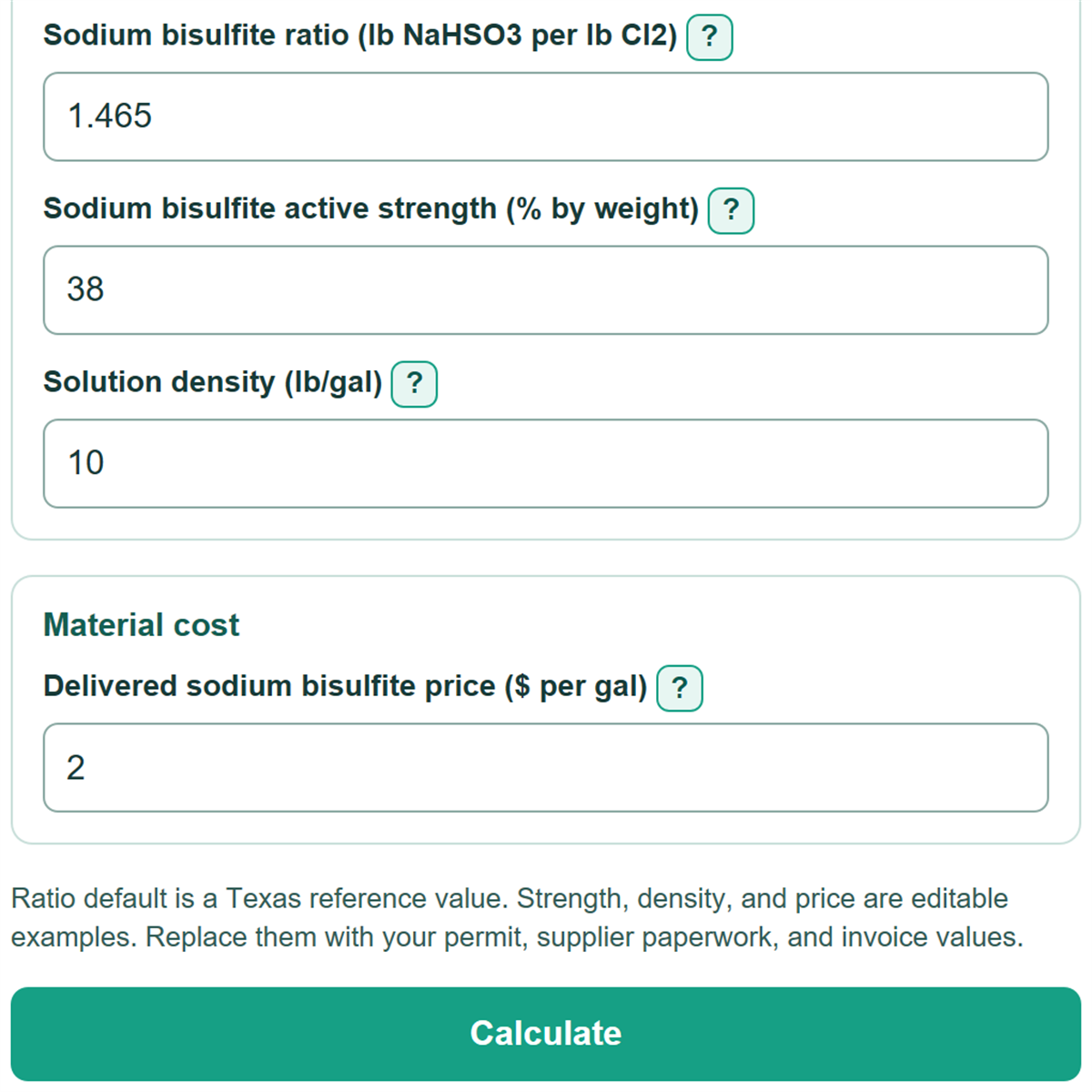
Material cost
Ratio default is a Texas reference value. Strength, density, and price are editable examples. Replace them with your permit, supplier paperwork, and invoice values.
Table of contents
How to use our Sodium Bisulfite Dechlorination Cost Calculator
- Enter the pre-dechlorination measurement in "Upstream chlorine residual to remove (mg/L as Cl2)."
- Enter the operating-period average in "Average effluent flow (MGD)" and the highest planning flow in "Peak effluent flow (MGD)."
- Check "Sodium bisulfite ratio (lb NaHSO3 per lb Cl2)" against your permit or operating procedure.
- Copy active strength, density, and delivered price from current supplier documents, then select Calculate.
- Use "Active sodium bisulfite demand" for daily chemical planning and compare "Peak liquid metering rate" with the usable range of the feed pump.
Definitions
Chlorine residual: Chlorine remaining in water after disinfection. This calculator uses the amount measured before dechlorination as the chemical-demand basis.
Cl2: Chlorine-equivalent notation. A residual reported as mg/L as Cl2 is expressed as an equivalent mass of chlorine.
MGD: Million gallons per day, a common plant-flow unit.
Sodium bisulfite ratio: Pounds of active sodium bisulfite needed per pound of chlorine to remove. The default ratio of 1.465 lb NaHSO3 per lb Cl2 is a Texas design-rule reference; use your facility requirement when it differs. [1]
Active strength: The percentage by weight of sodium bisulfite in the delivered liquid product.
Solution density: The weight of one gallon of delivered liquid, in lb/gal.
gph: Gallons per hour. The peak liquid metering rate is a planning feed rate at the entered peak flow.
Common mistakes and quick fixes
Mistake: Entering a final downstream compliance residual in "Upstream chlorine residual to remove (mg/L as Cl2)."
Fix: Use the residual measured after disinfection and before sodium bisulfite is added.
Mistake: Entering chlorine dose instead of the measured residual in "Upstream chlorine residual to remove (mg/L as Cl2)."
Fix: Enter the chlorine amount still present and needing removal, in mg/L as Cl2.
Mistake: Setting "Peak effluent flow (MGD)" lower than "Average effluent flow (MGD)."
Fix: Enter a peak flow equal to or greater than the average flow.
Mistake: Treating "Sodium bisulfite active strength (% by weight)" as solution density.
Fix: Use the active percentage from product paperwork and enter density separately in "Solution density (lb/gal)."
Mistake: Entering a price per pound in "Delivered sodium bisulfite price ($ per gal)."
Fix: Use the delivered liquid price per gallon so "Daily chemical cost" is calculated correctly.
Mistake: Choosing a pump from "Liquid product use" alone.
Fix: Check "Peak liquid metering rate" because it uses peak flow and is the pump-rate planning value.
Limitations & Key Assumptions / Boundary Conditions
- This is a simplified planning calculation, not a permit-compliance determination or a final downstream residual prediction.
- Use a chlorine residual measured upstream of dechlorination. A sample from another location can give the wrong dose basis.
- The entered sodium bisulfite ratio must match the facility permit, engineering basis, or operating procedure. The default is not a universal requirement.
- Daily use and cost use average flow; peak liquid metering rate uses peak flow. The calculation requires peak flow to be at least average flow.
- Product gallons depend on the entered active strength and density. Supplier product documents can differ by product and delivery.
- Costs include liquid chemical material only. Delivery fees, minimum orders, storage, pump capital, maintenance, sampling, calibration, contact time, and compliance costs are excluded.
- A pump also needs suitable turndown, calibration, reliability, and site-specific controls. The gph result alone does not select or approve equipment.
Methodology
Calculation method
The calculator first converts the upstream chlorine residual and average flow into pounds of chlorine per day. It then applies the entered sodium bisulfite ratio. The default ratio of 1.465 lb NaHSO3 per lb Cl2 is a Texas design-rule reference. [1]
Chlorine mass (lb/day) = residual (mg/L as Cl2) x average flow (MGD) x 8.34
Active sodium bisulfite demand (lb/day) = chlorine mass (lb/day) x sodium bisulfite ratio (lb NaHSO3 per lb Cl2)
The 8.34 conversion changes mg/L times MGD into lb/day. To convert active chemical demand into delivered liquid gallons, the calculation finds the pounds of active sodium bisulfite in each gallon of product.
Liquid product use (gal/day) = active demand / ((active strength / 100) x solution density)
Peak feed rate uses peak flow, not average flow, then divides the peak daily-equivalent liquid demand by 24 hours.
Peak liquid metering rate (gph) = (residual x peak flow x 8.34 x ratio) / ((active strength / 100) x density x 24)
Daily chemical cost ($/day) = liquid product use (gal/day) x delivered price ($/gal)
30-day chemical cost ($) = daily chemical cost x 30
Worked example
With 1 mg/L as Cl2 residual, 1 MGD average flow, a 1.465 ratio, 38% active strength, 10 lb/gal density, and $2 per gal price, chlorine mass is 8.34 lb/day. Active sodium bisulfite demand is 12.2181 lb/day, liquid use is about 3.2153 gal/day, and daily chemical cost is about $6.43. At 1.5 MGD peak flow, the estimated peak liquid metering rate is about 0.2010 gph.
Calculation choices
A zero upstream residual produces zero chemical demand, liquid use, feed rate, and material cost. Average flow can be zero, but peak flow must be at least average flow. Strength must be greater than 0% and no more than 100%, while density and ratio must be greater than zero.