
Estimate grow light PPFD at a new height, find a target hanging height, or compare five canopy readings for uneven light.
Advanced options
This is based on the PPFD result and entered light-on hours.
A larger percent means these five readings are less even.
Table of contents
How to use our Grow Light Hanging Height and PPFD Calculator
- Choose your question under "What do you want to find?" Use a fixture chart or a canopy-level meter reading as your starting point.
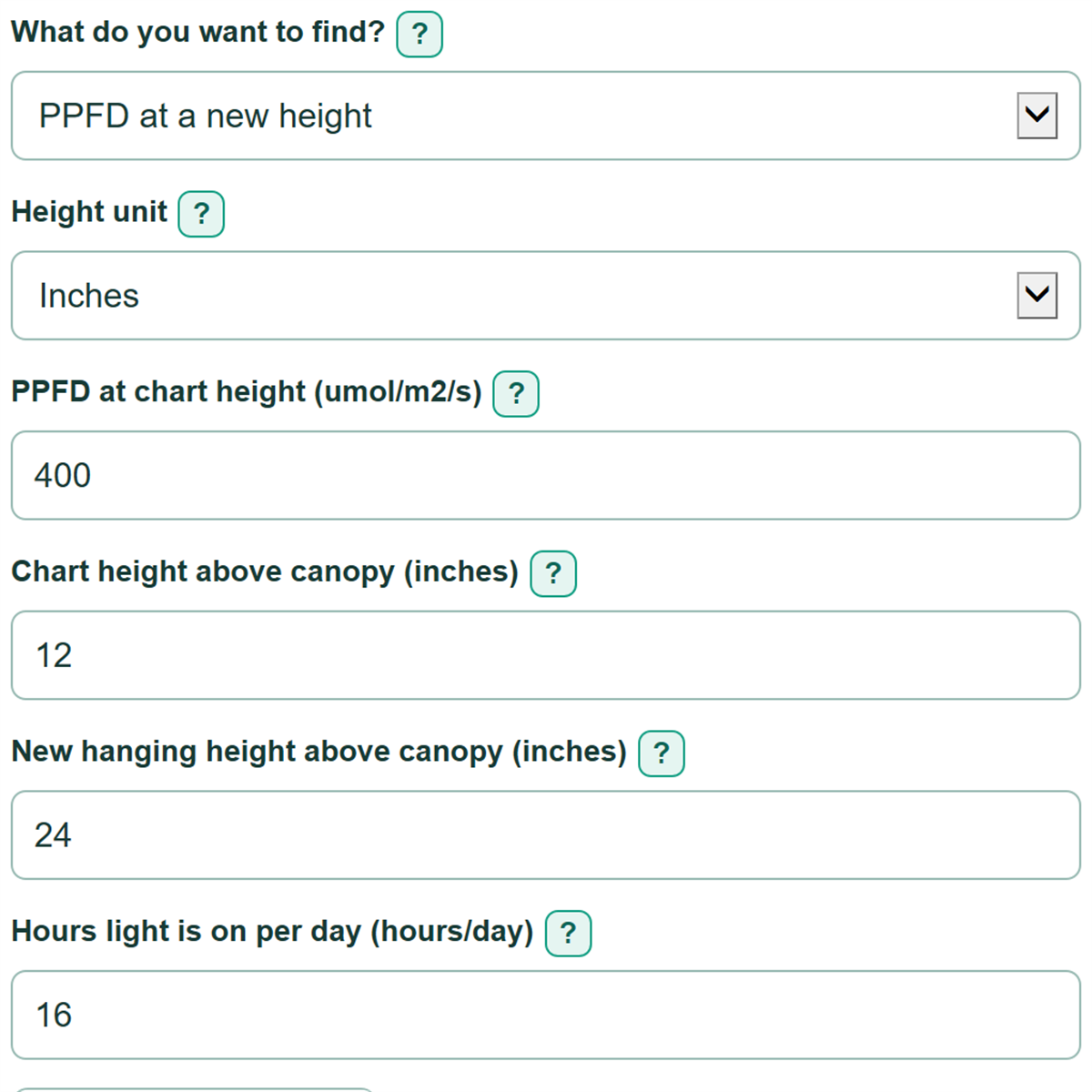
- For a height estimate, select the "Height unit" and enter "PPFD at chart height" with its matching "Chart height above canopy." Measure from the light-emitting plane to the average canopy top.
- Enter either "New hanging height above canopy" or "Target PPFD," depending on the selected question. Enter "Hours light is on per day" to calculate DLI.
- For a real-world check, choose "Check five canopy readings" and enter the center plus all four corner readings taken at canopy height.
- Check that the result makes sense: moving a light from 12 inches to 24 inches should estimate about one-quarter of the PPFD, and changing light-on hours should change DLI without changing PPFD.
Definitions
PPFD: Photosynthetic photon flux density. It measures the light reaching one square meter each second in umol/m2/s.
DLI: Daily light integral. It is the total photosynthetic light delivered over one day, shown in mol/m2/day.
Chart height above canopy: The distance from the light-emitting plane to the average top of the plant canopy that matches the entered PPFD chart value.
Canopy PPFD spread: The highest of five readings minus the lowest, divided by their average, shown as a percent. A larger spread means the sampled light is less even.
Common mistakes and quick fixes
Mistake: Entering watts, lumens, or lux in "PPFD at chart height."
Fix: Enter a PPFD value in umol/m2/s from a fixture PPFD map or a canopy-level quantum meter.
Mistake: Pairing "PPFD at chart height" with a different "Chart height above canopy" than the one shown on the fixture map.
Fix: Copy both values from the same map row and at the same dimmer setting.
Mistake: Measuring "New hanging height above canopy" to the pot rim, floor, or fixture housing.
Fix: Measure from the light-emitting plane to the average height of the plant canopy.
Mistake: Expecting "Hours light is on per day" to change "Estimated PPFD at new height."
Fix: Hours change "Estimated daily light total (DLI)" only; change height, dimming, or fixture output to change PPFD.
Mistake: Treating "Center PPFD reading" as the whole canopy result.
Fix: Enter all four corner values and compare "Average PPFD across five canopy readings" with "Lowest of five canopy readings" and "Canopy PPFD spread."
Limitations & Key Assumptions / Boundary Conditions
- The height results use an inverse-square approximation. Broad LED boards, bar fixtures, lenses, reflectors, and multiple lights do not always follow it closely.
- The entered "PPFD at chart height" must match the fixture's current dimmer setting, mounting setup, and measured or charted height.
- A fixture map center value can be higher than its area average. Use an area-average value for canopy planning when one is available.
- The five-reading check describes only the center and four entered corners. It cannot find dim or bright spots between those locations.
- Plant growth changes the distance to the canopy. Recheck hanging height and PPFD as the canopy rises.
- DLI assumes PPFD stays constant for every light-on hour. Dimming schedules, sunlight, timer errors, and changing canopy position can make real daily light different.
Methodology
Calculation method
The calculator uses the known PPFD and its chart height as a starting point. Both height values use the selected unit, so inches or centimeters give the same ratio when entered consistently.
Estimated PPFD = known PPFD x (chart height / new hanging height)^2
To find a hanging height for a chosen target, it rearranges the same inverse-square approximation.
Estimated hanging height = chart height x sqrt(known PPFD / target PPFD)
For the canopy check, each of the center and four corner readings has equal weight.
Average PPFD = (center + corner 1 + corner 2 + corner 3 + corner 4) / 5
Canopy PPFD spread = (highest reading - lowest reading) / average PPFD x 100
DLI converts the active PPFD result into a daily total using 3,600 seconds per hour and 1,000,000 micromoles per mole.
DLI = active PPFD x hours light is on per day x 3600 / 1000000
Worked example
If a fixture chart shows 400 umol/m2/s at 12 inches and the new height is 24 inches, the estimate is 400 x (12 / 24)^2 = 100 umol/m2/s. With 16 light-on hours, estimated DLI is 100 x 16 x 3600 / 1000000 = 5.76 mol/m2/day.
Calculation conditions
All active PPFD, target PPFD, and height values must be greater than zero. Light-on hours must be greater than zero and no more than 24. The result is a planning estimate because fixture shape, dimming, reflectivity, overlapping lights, and canopy position can change measured PPFD.