
Estimate grow light coverage, fixture count, dimmer level, PPFD, and daily light total from your tent size and light specs.
Advanced options
Table of contents
How to use our Grow Light Coverage Calculator
- Enter Grow space length (feet) and Grow space width (feet) for the lit plant area, not the full room unless the whole room is covered.
- Enter Target PPFD (umol/m2/s), Light time (hours per day), and PPF per light (umol/s) from your plant goal and fixture spec sheet.
- Open Advanced options if you want to change Lights you plan to use (count), Light that reaches the grow area (percent), LED efficiency (umol/J), or Number format.
- Click Calculate, then check Lights needed, Coverage status, and Dimmer setting needed before using the smaller supporting numbers.
- Sanity-check the result: Grow area should match your tent or shelf size, and a very high PPFD shortfall or extra headroom usually means one input was measured or copied wrong.
Definitions
Target PPFD (umol/m2/s): The average plant-useful light you want to land on each square meter every second.
PPF per light (umol/s): The total plant-useful light one fixture produces each second. It is a fixture output rating, not an area reading.
Light that reaches the grow area (percent): The share of fixture light that actually lands inside the plant area after spill and wall losses.
Lights you plan to use (count): The number of matching fixtures used for the coverage check and dimmer estimate.
Daily light total (mol/m2/day): Also called DLI. It is the total plant-useful light received in one day.
Dimmer setting needed: The percent of full output needed from the entered lights to hit the target PPFD, if those lights are strong enough.
PPFD shortfall or extra headroom: Target PPFD minus the full-power average PPFD from your entered lights. Positive is short; negative is extra headroom.
LED efficiency (umol/J): How many micromoles of plant-useful light the fixture makes per joule of electrical energy.
Common mistakes and quick fixes
Mistake: Using the room size for Grow space length (feet) and Grow space width (feet) when only a tent, tray, or shelf is lit.
Fix: Measure the actual plant area at canopy height and enter that lit rectangle.
Mistake: Typing fixture watts or lumens into PPF per light (umol/s).
Fix: Use the manufacturer's PPF rating when available; use LED efficiency (umol/J) only for the watts estimate.
Mistake: Leaving Target PPFD (umol/m2/s) at a number that does not match the plant or growth stage you are planning for.
Fix: Replace the default with the PPFD target you actually want before judging Lights needed.
Mistake: Entering 0, 25, or another non-real schedule in Light time (hours per day).
Fix: Use the planned daily on-time from 1 to 24 hours so Daily light total is meaningful.
Mistake: Setting Lights you plan to use (count) to a fraction or forgetting to update it after changing the layout.
Fix: Enter a whole number of matching lights so Average PPFD from your lights at full power is based on the setup you will use.
Mistake: Setting Light that reaches the grow area (percent) to 100 when much of the light spills outside the plant area.
Fix: Lower the percent for open shelves, small plants under a large fixture, or poor reflector coverage.
Limitations & Key Assumptions / Boundary Conditions
- The result is an area-average estimate. It does not predict center hot spots, weak edges, shadowing from plant leaves, or uneven fixture spread.
- Hanging height, lens shape, wall reflectivity, fixture angle, and plant height can change real PPFD at the canopy.
- Light that reaches the grow area (percent) is an editable planning estimate. A PAR meter or measured PPFD map is better for final setup.
- PPF per light (umol/s) should come from the same fixture model used in the grow space. Mixed fixtures need a combined PPF approach, not one repeated fixture rating.
- Estimated LED watts for target assumes the entered LED efficiency (umol/J). Driver losses, dimming curves, and manufacturer test methods can make actual wall watts different.
- Daily light total uses the target PPFD and Light time (hours per day), not the full-power PPFD from your owned lights.
- The calculator does not choose a safe PPFD for a plant. Use a plant-specific target and adjust if plants show stress.
Methodology
Calculation steps
The calculator uses grow area, target PPFD, fixture PPF, and a capture percent to estimate how much fixture output is needed. Grow area matters because a larger area needs more total light to reach the same target PPFD [1].
area_ft2 = length_ft * width_ft
area_m2 = area_ft2 * 0.09290304
capture_fraction = canopy_capture_percent / 100
fixture_output_needed = target_ppfd * area_m2 / capture_fraction
fixture_count_needed = ceil(fixture_output_needed / ppf_per_fixture)
The owned-light check uses the number of lights you plan to use at full power, then compares that average PPFD with the target.
estimated_average_ppfd = fixtures_owned * ppf_per_fixture * capture_fraction / area_m2
dimmer_needed_percent = target_ppfd / estimated_average_ppfd * 100
coverage_gap_ppfd = target_ppfd - estimated_average_ppfd
Daily light total is calculated from the target PPFD and light time. The factor 0.0036 comes from 3600 seconds per hour divided by 1,000,000 micromoles per mole.
daily_light_total = target_ppfd * light_hours * 0.0036
Estimated LED watts uses photon efficacy. Since one watt is one joule per second, umol/s divided by umol/J gives watts.
target_led_watts = fixture_output_needed / led_efficacy
Worked mini-example
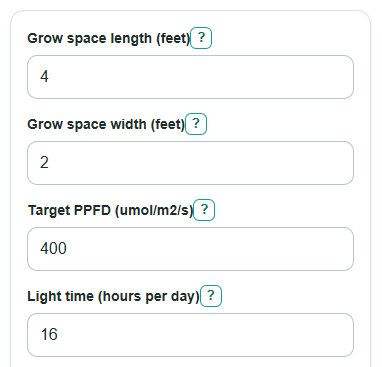
For a 4 ft by 2 ft grow space, area is 8 ft2, or 0.74322432 m2. With a 400 umol/m2/s target and 85 percent capture, total fixture PPF needed is about 349.75 umol/s. One 700 umol/s light is enough by the buying rule, because ceil(349.75 / 700) equals 1.
With one owned 700 umol/s light at full power, estimated average PPFD is about 800.57 umol/m2/s. The dimmer setting needed is about 49.96 percent, and the PPFD shortfall or extra headroom is -400.57 umol/m2/s, which means extra headroom before dimming. At 16 hours per day, daily light total is 23.04 mol/m2/day, and the target LED watts estimate at 2.5 umol/J is about 139.90 W.