
Estimate light towers needed, project diesel cost, and whether renting or buying costs less for your planned job.
Operating schedule
Rental quote
Purchase estimate
Advanced options
Coverage allowance
Extra rental charges
Ongoing ownership costs
Result display
Simplified planning estimate. Confirm placement, glare, shadows, obstructions, and required lighting with a site-specific plan.
Based on the entered fuel-use rate and operating schedule.
Calculation details
Table of contents
How to use our Light Tower Coverage and Cost Calculator
- Enter Area to light from the site plan, then choose the matching Area unit.
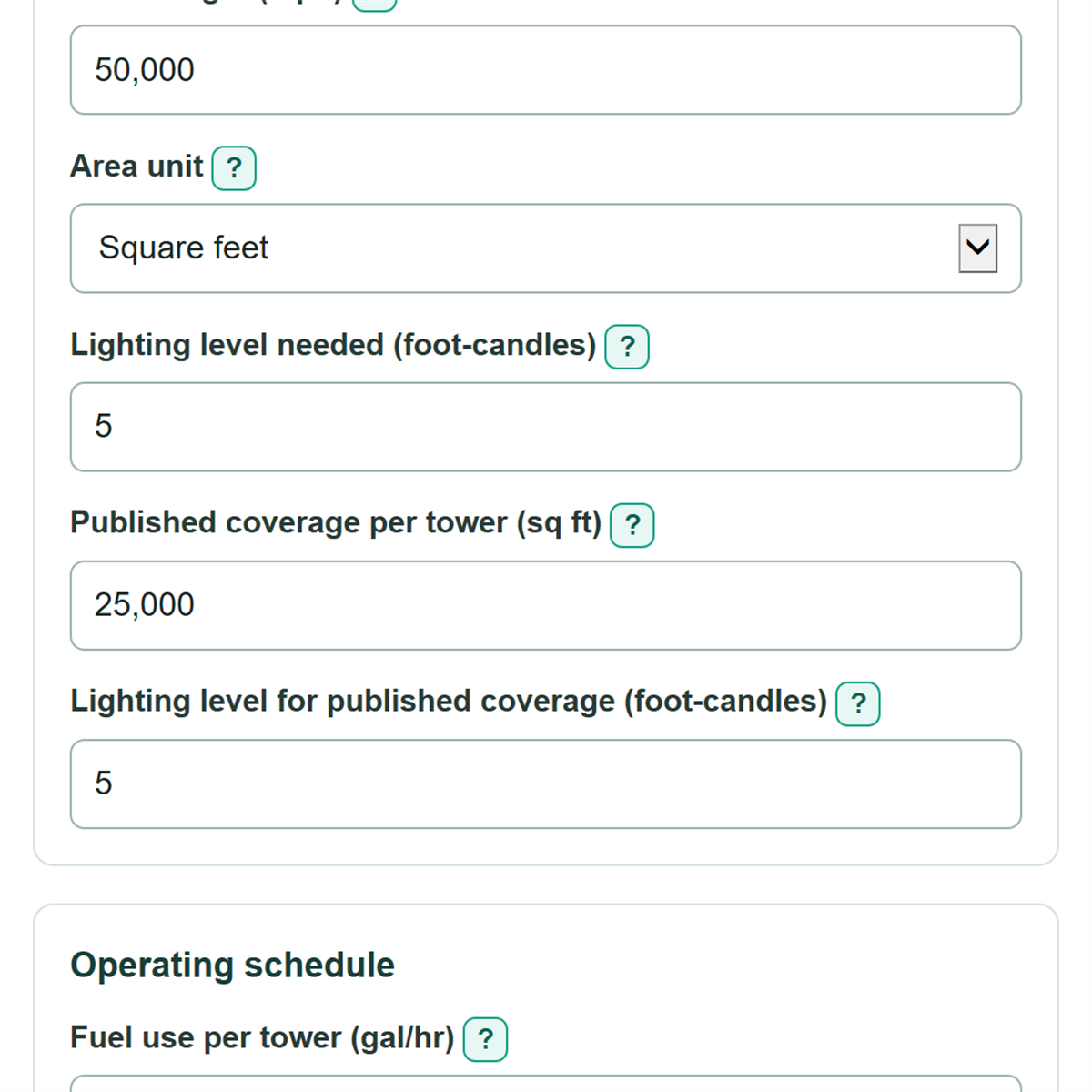
- Enter the required Lighting level needed, plus the selected model's Published coverage per tower and its stated rating level.
- Add the operating schedule, Fuel use per tower, and Diesel price from the schedule, equipment sheet, and fuel quote.
- Copy the vendor's Rental rate per tower and Rental quote period, then enter the purchase and expected resale values.
- Check that the estimated tower count is reasonable for the site layout, then compare the project rental total, ownership total, and signed cost gap before using the estimate in a quote.
Definitions
Foot-candle: A US measure of light reaching a surface. OSHA lists 5 foot-candles for general construction areas in its construction illumination table. [1]
Published coverage per tower: The area a specific tower model is stated to light at a named foot-candle level. It is not a universal coverage area.
Usable coverage after layout allowance: The share of adjusted published coverage used for planning after allowing for overlap, edges, and layout limits.
Tower-hour: One tower operating for one hour. Three towers running for 10 hours equal 30 tower-hours.
Rental billing period: The calendar unit on the quote. This calculator treats a selected rental month as 28 days.
Cost gap: Ownership total minus rental total. A positive gap means ownership costs more; a negative gap means ownership costs less.
Acre: An area equal to 43,560 square feet. [2]
Common mistakes and quick fixes
Mistake: Entering acres while Area unit is set to square feet.
Fix: Choose Acres before entering acreage, or convert the plan area to square feet first.
Mistake: Treating Published coverage per tower as valid at every lighting level.
Fix: Copy the rating's foot-candle value into Lighting level for published coverage and enter the job requirement in Lighting level needed.
Mistake: Using lamp lumens instead of Published coverage per tower.
Fix: Find the coverage area for the exact tower model, mast setup, and stated lighting level on its specification sheet or quote.
Mistake: Entering a weekly price while Rental quote period is set to Per day.
Fix: Select the billing period printed on the quote, then enter that period's rate in Rental rate per tower.
Mistake: Counting delivery and pickup once for each tower when the quote charges once for the fleet.
Fix: Enter each fleet-wide charge once in Rental delivery fee ($ per project) and Rental pickup fee ($ per project).
Mistake: Setting Expected resale value per tower higher than Purchase price per tower.
Fix: Use an expected resale value no greater than the purchase price; this cash-cost model blocks a higher value.
Limitations & Key Assumptions / Boundary Conditions
- Coverage is a simplified planning estimate based on the entered published coverage, lighting levels, and layout allowance. It does not model tower placement, mast height, glare, shadows, terrain, obstructions, or spill light.
- Use a site-specific lighting plan when traffic control, public areas, nearby properties, detailed task lighting, or regulations require it.
- Fuel use follows the entered gal/hr value and operating schedule. Actual use can differ with load, engine condition, temperature, refueling practices, and idle time.
- Rental billing uses calendar time and rounds every partial billing period up. Vendor minimums, taxes, environmental fees, refueling labor, downtime, and other charges are excluded unless entered in supported fields.
- Ownership is a simple cash-cost estimate: purchase less expected resale, prorated annual insurance and storage, usage maintenance, and shared fuel. It excludes financing, taxes, depreciation accounting, downtime, and opportunity cost.
- Break-even assumes future projects have the same fleet size, schedule, rates, resale estimate, and recurring ownership costs. If recurring ownership cost is at least the rental cost avoided, no finite break-even exists.
Methodology
Coverage and fleet size
The calculator converts acres to square feet using 43,560 square feet per acre. [2] It adjusts a tower's published coverage for the job's lighting target and the layout allowance, then rounds up because part of a tower cannot be rented or purchased.
planning coverage = published coverage x published rating level / required lighting level x layout allowance / 100
towers needed = round up(area to light / planning coverage)
For example, 25,000 sq ft of published coverage at 5 foot-candles, a 5 foot-candle job target, and an 80% layout allowance produce 20,000 sq ft of planning coverage per tower. A 50,000 sq ft site therefore needs 3 towers.
Fuel and rental cost
Operating hours are calculated per tower from the shift schedule. Fleet fuel uses all tower-hours, while rental base cost uses calendar billing periods. A partial rental day, week, or selected 28-day rental month is rounded up.
tower-hours = towers needed x hours per shift x shifts per week x project weeks
project diesel cost = tower-hours x fuel use per tower x diesel price
rental total = base rent + damage waiver + delivery + pickup + project diesel cost
Ownership and break-even
Ownership includes the net capital cost, prorated annual insurance and storage, usage maintenance, and the same project diesel cost used for rental. Since fuel is shared by both choices, it is excluded from the repeated-project break-even comparison.
ownership total = towers needed x (purchase price - resale value) + prorated fixed cost + usage maintenance + project diesel cost
cost gap = ownership total - rental total
break-even projects = net ownership capital / (rental cost excluding fuel - recurring ownership cost)
Calculation choices
The 5 foot-candle default is the OSHA table value for general construction areas; replace it when the safety plan or owner specification requires another level. [1] The model requires resale value to be no more than purchase price. If recurring ownership cost is not lower than rental cost excluding fuel, the calculator reports no finite break-even instead of forcing a number.